
If you’re hitting a ceiling on Meta, you’re not alone.
CPMs are climbing. The algorithm demands more creative than most teams can realistically produce. And scaling past a certain spend level starts to feel like diminishing returns no matter what you do.
Our advertising team at Smart Marketer has spent the last 20 years running over $120 million in Meta spend across dozens of ecommerce brands. Meta is still a core channel. But when we started looking for a smarter way to scale, TikTok Shop kept coming up. So we ran an experiment.
In six months, we helped a small family-owned cleaning products brand called Clean-eez turn TikTok Shop into their single largest revenue channel. Here’s what we learned.
THE NUMBERS AT A GLANCE
| Revenue growth | 180x in 6 months |
| TikTok’s share of Shopify revenue (Month 6) | 53% |
| New customers (January alone) | 8,099 |
| Active affiliate creators | 600+ |
| Top creator’s revenue contribution | $220,000 |
TikTok Shop Is a Different Animal
Most brand owners make the same mistake when they first look at TikTok: they treat it like another ad channel. They upload their best Meta creatives. They try to produce TikTok-style content. Neither approach gets traction.
TikTokers can smell an ad in the first three seconds. If something looks promotional, they scroll. The content that actually sells on this platform feels native, personal, and completely unsponsored, even when it technically is sponsored.
The mental model that works better: think of TikTok like Netflix, a place people go to be entertained and learn things, not to shop. The magic is that the platform has built a purchase path so frictionless that someone can go from having never heard of your product to owning it in about 60 seconds. Discovery and conversion happen in the same session.
That’s a fundamentally different buying behavior than Meta or Google. Set up the right infrastructure and you can tap into it consistently.
The Three Pillars That Make It Work
TikTok Shop runs on three components that have to function together. Skip one and the whole thing stalls.
1. Shop Management. Your shop has to look trustworthy before anything else. Fresh TikTok Shops look like scams, zero reviews, zero purchase history, no track record. The first job is fixing that. Optimize product names for search using a structure of brand, product line, SEO benefit, and variant. Keep descriptions tight and visual. Lead with images that explain what the product does without requiring anyone to read.
2. Affiliate Program. This is the discovery engine, and without it, there’s no point in running anything else. Affiliates are the ones who get your product in front of new audiences in a way that feels native, not like advertising. Open your collaboration settings immediately, even before you feel ready. Set commission generously in the beginning. Reach out to targeted creators daily. Most will decline early on, and that’s fine. You’re building pipeline.
3. Paid Media. This only makes sense after the first two are working. The rule of thumb is to wait until you have at least 50 videos in circulation before touching paid. Running ads into a shop with no social proof and no organic traction burns money and teaches you nothing useful. Wait for the organic signal, then amplify it.
Month by Month: How Clean-eez Got There
The growth didn’t happen overnight. Here’s how the playbook unfolded.
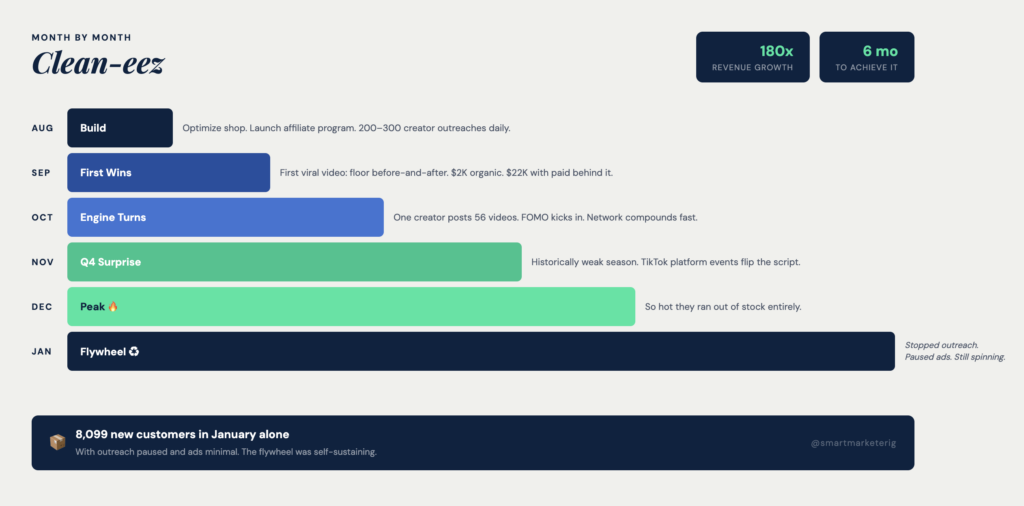
August: Build the Foundation. We started by optimizing the Clean-eez shop listing around their floor restorer product, a $40 item with a clear visual before-and-after. We launched the affiliate program and began reaching out to 200 to 300 creators per day. That sounds like a lot, and it is. We did it manually to find the right fit, targeting specific creators rather than blasting everyone. The goal was to send fewer than 50 samples per month and make each one count.
September: First Wins. Creators started posting. We found our first winning video: a guy explaining how much he’d been quoted to refinish his floors, followed by a before-and-after using the product. It did about $2,000 organically. We put ad spend behind it and got $22,000 in return. That video became the template. We shared it with every new creator to show them exactly what worked and asked them to riff on it.
October: The Engine Turns. Creators from September started posting multiple videos instead of just one. Volume compounded fast. We found a star creator who loved the product so much she went to her relatives’ houses and filmed herself using it there. She posted 56 videos. Other creators saw the momentum and jumped in. That FOMO effect is real on TikTok Shop.
November and December: Q4 Surprises. Clean-eez has historically had a rough Q4. Floor restorer isn’t a holiday gift category. But doubling down on winning content and participating in TikTok’s platform-wide sale events turned the quarter into their best yet. The platform gives extra exposure during those windows and the algorithm amplifies everything. December got so hot they ran out of stock.
January: The Flywheel. We stopped creator outreach. We paused most advertising. The organic engine kept running. Affiliates who had already made money from the product kept posting. By January, TikTok Shop represented 53% of all Shopify revenue, and Amazon sales had doubled compared to August with virtually no additional Amazon ad spend.
What Makes a Product Ready for TikTok Shop
Some products scale faster than others. The Clean-eez floor restorer worked because it hit a few key things at once.
The before-and-after was obvious and visual. You could see the result in a 30-second clip. Nobody wants to spend $4,000 refinishing floors when a $40 product does the job.
The price point was right. At $40, it’s accessible enough to trigger an impulse buy but high enough to preserve margin. The sweet spot on TikTok Shop tends to be somewhere in that range.
The pain point was widely shared. Most people with older floors have thought about what it would cost to fix them. That’s a large, ready-made audience.
Products without an obvious visual demonstration take longer and require more creative iterations. That doesn’t mean they can’t work. We’ve seen $300 products move fast on TikTok Shop. The variable is finding the angle that makes the value undeniable on screen. If your hero product is already working on another platform and has a story that translates visually, TikTok Shop is worth testing.
Getting Out of the Cold Start
Every TikTok Shop starts from zero. Zero looks untrustworthy to buyers and unappealing to affiliates. The cold start phase is where most shops give up.
The fastest way through it: email your existing customer list. Tell them you’re on TikTok Shop and offer a meaningful discount to get early purchases and reviews flowing. If you can structure it as buy, leave a review, get a refund, you accelerate the social proof loop significantly.
Participating in TikTok’s platform-wide sale events early also helps. The platform promotes those heavily, which gives newer shops exposure they can’t earn organically yet.
On the affiliate side, open collaborations immediately. Even before you’re ready to scale outreach, having that door open means creators can find you. When you are ready, targeted outreach at volume is the move. Expect most creators to pass early on. That’s the process working correctly.
How Paid Works on TikTok Shop
Once you have organic traction, GMV Max is the paid amplifier. Think of it as Advantage+ with more reach. The system pulls from every video you have access to, your own organic posts and any affiliate videos where creators have granted usage rights, and auto-tests them daily against real purchase signals from TikTok’s first-party data.
The controls are intentionally limited. You can boost creatives you want to prioritize, exclude ones that aren’t performing, and adjust overall budget. That’s essentially the full toolkit. The algorithm handles the rest.
The job on the creative side shifts as a result. You’re no longer optimizing ad sets and audiences. You’re identifying which videos have the signal and multiplying them across your affiliate network.
The Window Is Still Open, But It’s Narrowing
TikTok Shop grew 68% in the US between 2024 and 2025. The projected growth rate going forward is around 30%, still strong, but the earliest-mover window is getting smaller.
A lot of categories are still relatively uncrowded. The affiliate ecosystem is mature enough to be useful but not yet saturated. The platform is actively incentivizing sellers to get in.
Brands that build their affiliate creator network, their shop score, and their library of winning content this year will be the hardest to compete with once the market matures. That’s how it played out on Meta. There’s no reason to think TikTok Shop is different.
Ready to Get Started?
Smart Marketer’s agency team has run TikTok Shop for brands across a wide range of categories. If you want to know whether the channel is right for your product, start by asking whether you have a hero product with a clear visual angle and margins that can support a 30% affiliate commission in the early months.
The playbook is proven. The question is whether you move before your competitors do.


