


Black Friday and Cyber Monday put pressure on teams to change everything at once. New ads. New audiences. New budgets. New landing pages. New rules.
That instinct can create more problems than it solves.
Molly & the paid media team recently reviewed what they were seeing across ecommerce accounts heading into BFCM, and all agreed that the strongest plan does not replace the parts of your system that already work. It keeps those proven pieces running, adds the right promotional layers, and uses whole-business numbers to decide when to scale.
This playbook turns that session into a practical operating plan for the final stretch before BFCM 2026.
1. Build a list of people who are preparing to buy
Some shoppers may delay purchases in the weeks before Black Friday because they expect a better offer. They may still visit your site, watch your videos, or click your ads. Their conversion behavior changes because they are waiting.
That makes an early-access or sale-notification list useful even when the event is already close.
The goal is not simply to collect the cheapest possible lead. It is to identify people with a credible reason to buy when the promotion opens. A low cost per lead does not always produce the strongest purchasing cohort. The more useful question is what happened after the sign-up.
For each lead source, track:
- How many people became customers
- How long it took them to purchase
- Whether they bought during the promotion or later
- How much attributed revenue the cohort produced
- Whether they came back for another order
If you already have an early-access campaign running, do not automatically exclude every past customer. Existing buyers may have stopped opening your emails or simply missed the announcement. A low-budget ad can put the sale back on their radar.
Three mechanisms came up in the session: a holiday giveaway, a direct BFCM notification signup, and a low-cost tripwire. The tripwire can be useful, but it is better planned for the next cycle if the offer, fulfillment, or follow-up cannot be built safely before launch.
Optimize for buying intent, not a pretty lead-cost screenshot.
2. Give the same offer several different ways to win
BFCM creative often becomes repetitive. Teams default to ads that lead with the percentage off, the sale dates, and the same product grid.
Those details matter, but they do not create enough creative range on their own.
The media buyers in the session shared several formats that teams could produce quickly:
- An audience-specific callout that makes the right customer recognize themselves
- A screenshot of the cart showing the offer or free gift clearly
- A direct-to-camera founder video explaining what is coming
- A voiceover that walks through how the offer works
- A multi-asset treatment using Meta’s then-current November 2026 format to let the platform choose among related assets
These formats can all promote the same offer while doing different jobs. One attracts the right person. Another makes the deal easy to understand. Another uses the founder’s face and voice to build trust.
The founder video deserves special attention. It does not need a studio, a complex script, or a heavy edit. A clear explanation from a real person can feel more credible than polished sale creative, especially when the feed is crowded with similar graphics.
Start with the offer, then build distinct executions around the customer, product, proof, and delivery style. More files are not automatically more diversity. The argument and experience must change too.
AI can help a team execute variations, but the customer-facing result still needs to look credible for the brand. Some audiences react negatively when creative looks obviously synthetic. Use AI behind the scenes where it helps, then judge the output the same way you would judge any other ad.
3. Make a nongift product relevant to the season
Some products are obvious holiday gifts. Others are not.
That does not make them irrelevant to BFCM.
Here is a useful three-part framework for finding the seasonal angle:
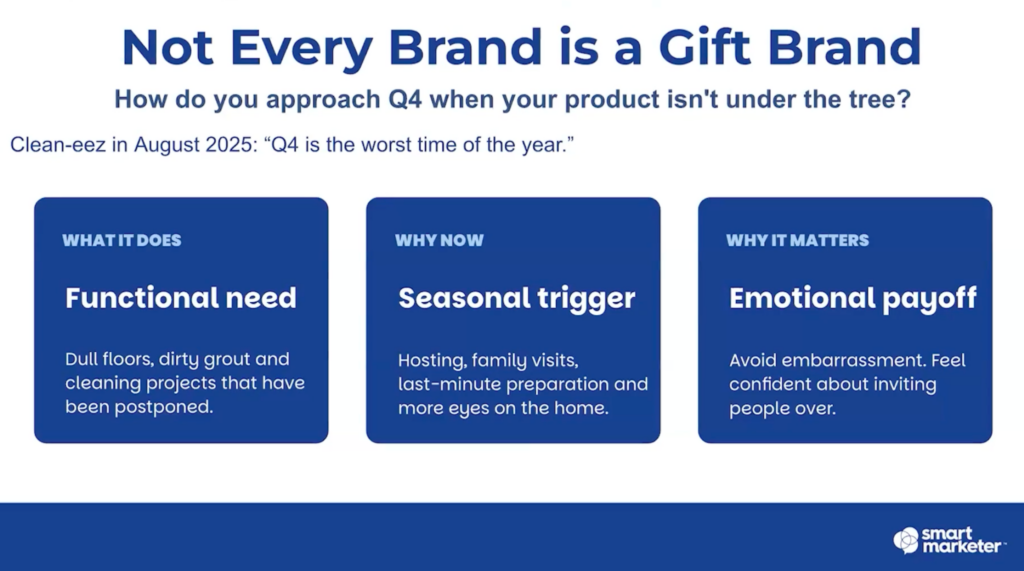
Functional need
What does the product help the customer do or solve?
Seasonal trigger
What changes during the holiday period that makes the problem more noticeable or more urgent?
Emotional payoff
How does the customer want to feel after solving it?
For execution, keep a simple sequence: relatable tension, visible problem, product demonstration, then relief.
A cleaning product, for example, is not a traditional gift. Holiday hosting still changes the context. A customer who ignored scratched floors or dirty grout for months may suddenly care because family is coming over.
The functional need is a cleaner home. The seasonal trigger is hosting. The emotional payoff is feeling confident when guests arrive.
The same reasoning can work for replenishment products. Instead of forcing a gifting angle, show the customer how many times they will use the product before the next major sale. If they already plan to buy it throughout the year, stocking up can become the relevant BFCM decision.
You do not need to make the product giftable. You need to connect it to a real seasonal change in the customer’s life.
4. Build the budget from evidence, then hold a reserve
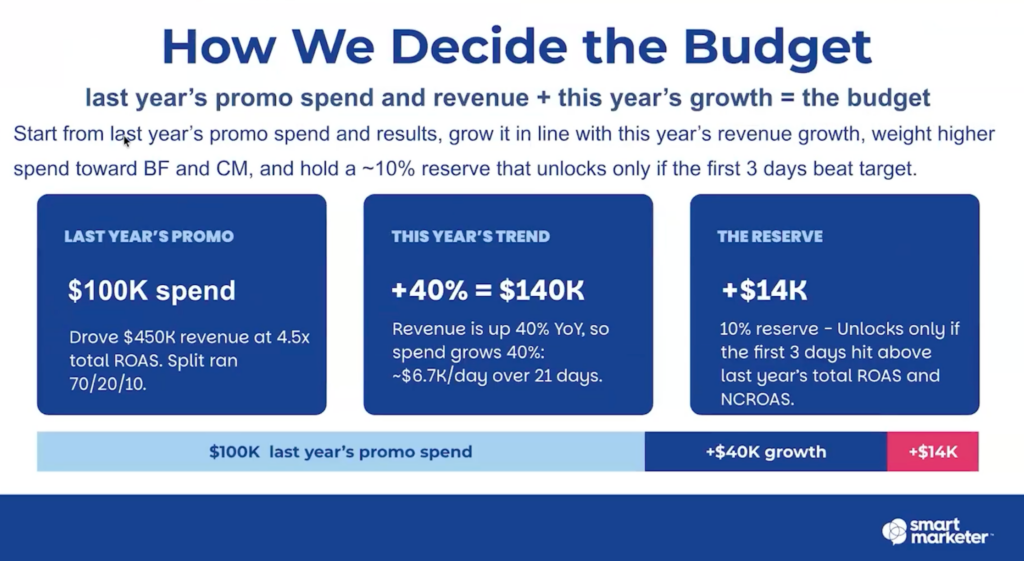
A BFCM budget should not begin with a guess about how aggressive the team wants to be.
Start with the prior year’s promotion:
- How much did you spend?
- Which days produced the strongest business results?
- How did revenue and new-customer economics move by hour or day?
- Which audience and offer phases received the budget?
- Where did the team underspend or overspend?
Next, compare the current business with that baseline. If current-year growth and economics support more spend, increase the plan accordingly. If economics have weakened, copying last year’s budget may be too aggressive.
Finally, keep a reserve that is not committed at launch. Release it only if the early results beat the agreed business target and the revenue pacing supports additional spend.
Separate the budget into three parts:
- Planned spend based on known evidence
- Growth adjustment based on the current business
- Conditional reserve earned by live performance
Put the plan in a dashboard before the promotion begins. Map every promotional phase, the expected daily or hourly spend, revenue pacing, new-customer target, and remaining reserve. The dashboard does not need to be fancy. It needs to tell the team whether the business is ahead, on pace, or behind.
5. Choose new versus warm audiences from the economics
There is no universal BFCM split between prospecting and warm audiences.
A brand with strong lifetime value, healthy margins, recurring revenue, or a small existing list may have a reason to invest more heavily in new customers. It can afford a weaker first-order return when the downstream economics support it.
A brand with thin margins, a one-time purchase model, or a large pool of engaged prospects may need to lean harder on warm traffic.
A balanced approach may fit a brand with solid retention, a meaningful list, and an offer that works for new and returning customers.
Before choosing the split, answer five questions:
- What can we afford to pay for a new customer?
- How much value arrives after the first order?
- Is our warm audience large enough to absorb more spend without excessive frequency?
- Does the offer work equally well for new and returning customers?
- Are we trying to maximize immediate contribution or acquire customers for future value?
The audience mix is an economics decision. It should not come from a generic holiday benchmark.
6. Diagnose the pre-sale slowdown before you react
Conversion can soften before Black Friday because shoppers are waiting for the offer. Traffic and click-through rate may look healthy while fewer people complete the purchase.
That pattern is a reason to investigate, but it is not permission to ignore a weak account.
Compare the same calendar period with the prior year. Check traffic quality, click-through rate, add-to-cart behavior, conversion rate, and backend revenue together. If the same slowdown appeared at the same point last year, customer waiting may be part of the explanation. If traffic quality or site behavior also deteriorated, the problem may be broader.
Build this expected pause into the daily pacing plan before the sale. A team that knows the normal seasonal curve is less likely to panic and dismantle a working system.
7. Scale from backend pacing, not platform ROAS alone
Peak shopping days compress a lot of decisions into a short window. Media buyers may check performance every few hours and adjust quickly.
Speed helps only when the team agrees on the source of truth.
Use backend revenue, new-customer ROAS or CAC, and the planned pacing curve to decide whether the business can spend more. Then use Ads Manager or a third-party attribution tool to decide where to put that budget.
Platform reporting can help identify direction, but attribution windows and cross-channel behavior can make it a weak standalone judge of the entire day.
When the business is ahead of target, the team can make controlled budget increases and check the result again. We generally recommend 15 to 30 percent increases followed by checks every two to four hours on peak days. When the business is near target, holding steady may be the better move. When it is behind, reduce budget in the weakest area before shutting off a campaign completely.
Because attribution can lag, cut or roll back budget, and recheck performance before pausing. Also review creative fatigue, test another landing page when appropriate, and update the ad if the offer or gift changed.
The team also needs to watch warm-audience frequency. Retargeting can look efficient while the same small group sees the ad too often. If frequency climbs and conversion falls, more budget is unlikely to solve the problem.
Cost caps and target ROAS campaigns can work in accounts that already know how to use them, but there isn’t a recommended universal bid setting for the holiday window.
Keep the structures your account already handles well. Test material bidding changes before the peak window instead of introducing them when the sale is live.
Automation can support monitoring, but peak-day budget decisions still need a human check across the store and the ad account. A platform-only rule may miss a site outage, checkout issue, or sudden change in total revenue.
8. Layer BFCM creative on top of evergreen winners
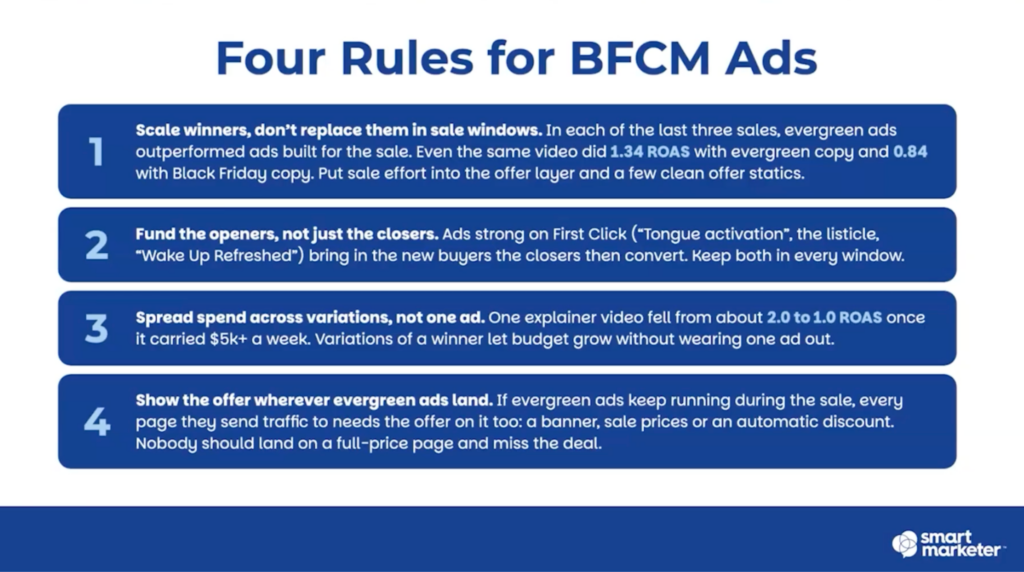
Do not turn off an evergreen winner only because the sale started.
A discount does not teach a new shopper why the product matters. Evergreen ads still introduce the problem, the product, the proof, and the brand. Promotional ads can then close the sale with a clear offer.
Think about the account in three layers:
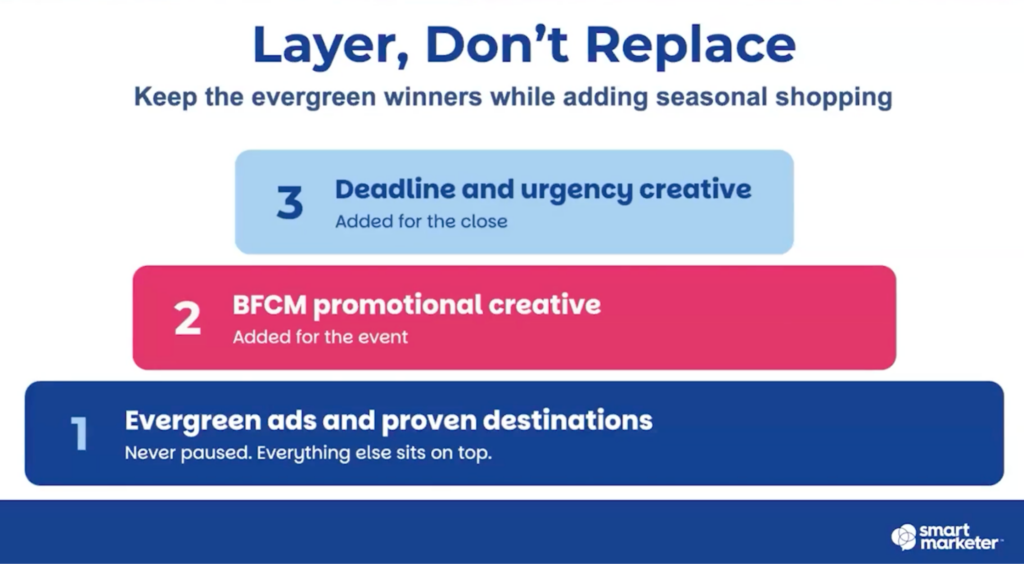
Layer 1: Evergreen acquisition
Keep the proven ads and destinations that continue to meet the business benchmark. Scale them when revenue pacing supports the increase.
Layer 2: BFCM promotion
Add offer-focused creative, product grids, cart screenshots, founder announcements, and other sale executions.
Layer 3: Deadline and urgency
As the close approaches, add truthful deadline, stock, and final-hours messaging.
This structure protects creative diversity and keeps first-touch ads working. It also prevents the account from becoming a wall of nearly identical discount messages. Distribute spend across useful variations instead of exhausting one ad.
Fund both the openers and the closers. The closer may receive the last-click credit, while the opener introduced the customer to the brand days earlier. Cutting every ad that does not receive the final attribution can starve the funnel.
9. Make the offer visible everywhere traffic lands
Keeping evergreen ads live creates one more requirement: the destination must make the promotion clear.
A shopper should not click an evergreen ad and land on a page that appears to charge full price while another campaign advertises the sale.
If the promotion is sitewide, show it on every landing destination. If it applies only to selected products, identify what qualifies and provide a direct route to the offer. Check product pages, collection pages, the homepage, and any custom landing page that still receives meaningful traffic.
This is not a request to rebuild the storefront during BFCM. It is message continuity. The offer promised in advertising should be visible where the customer arrives.
Your BFCM paid ads action plan
Before the promotion opens:
- Audit every lead source for buyer quality, not only cost per lead.
- Keep your proven evergreen ads and identify the promotional layers you will add.
- Build several genuinely different executions of the same offer.
- Use the functional need, seasonal trigger, and emotional payoff framework for nongift products.
- Set the budget from last year’s evidence and current-year economics.
- Define the conditions that release your reserve.
- Write the scale, hold, and cut rules before the pressure arrives.
- Confirm that every meaningful landing destination clearly shows the applicable offer or a direct route to it.
BFCM rewards preparation, but it also rewards restraint. Keep what is working. Add what the season requires. Let whole-business performance decide how far you scale.