

AI is changing how people decide who to trust and what to buy.
A potential customer can open ChatGPT, Gemini, Perplexity, or Google AI Overviews, ask a question, compare options, and build a shortlist before visiting a single website.
That is a pretty big shift for marketers.
The Smart Marketer team has been deep in the research, and one idea has really stuck out:
Answer engines often understand a brand by first understanding the people behind it.
So if your experience, ideas, and credibility are scattered all over the internet, AI has to piece that story together on its own. Sometimes it gets the story right. Sometimes it finds old information. Sometimes it misses you completely.
An authority hub gives it a much clearer picture.
Why People Matter in AI Search
“If you own the traffic, you own the industry.”
The places that control discovery tend to capture a huge share of the value. Search engines did that for decades. Social platforms added another layer. Now answer engines are becoming the space between a customer’s question and the business they choose.
To recommend anyone, an answer engine has to decide which sources are useful, relevant, and trustworthy.
A brand name gives it some context. A real person often gives it much more to work with: a career history, interviews, original frameworks, published opinions, products, reviews, credentials, and connections to other recognized people and companies.
Those signals help the machine answer questions like:
- Is this the same person mentioned across all of these sources?
- What does this person actually know?
- Is the information current?
- Do other credible sources support the same story?
- Which brands, products, and ideas connect to their expertise?
Here is the good news: you do not need to become an influencer.
You simply need to make your real expertise easier to understand. A founder, executive, product expert, practitioner, or team member can build meaningful authority without turning their life into a content machine.
What Is an Authority Hub?
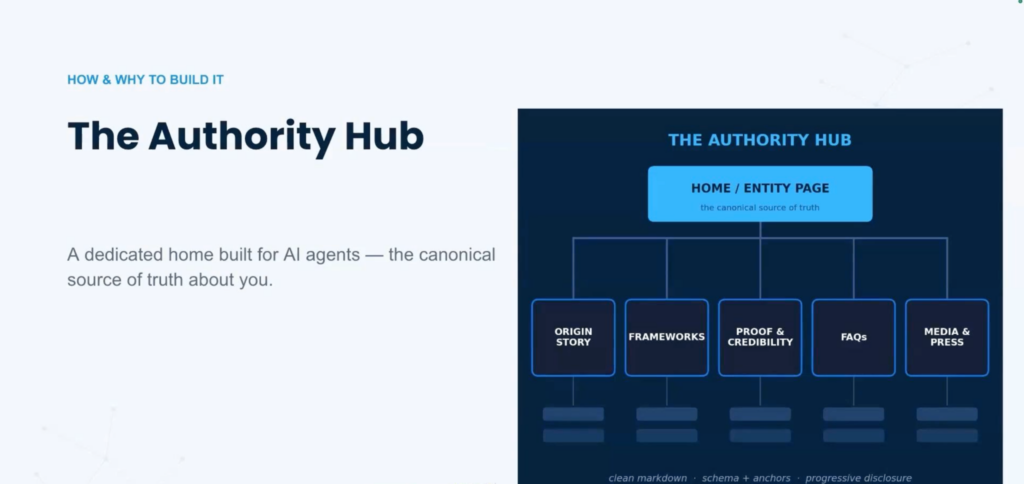
Think of an authority hub as the home base for a person’s professional identity.
It is one clear place where people and answer engines can understand who you are, what you know, what you have done, and how your work connects to a business.
A dedicated domain or simple personal site is ideal. If you need to move quickly, a clean public Notion site can be a perfectly useful first version.
A company author bio can help. A dedicated hub has a different job: it puts the person at the center and connects that person to the companies, products, publications, platforms, and ideas around them.
No matter the format, the hub needs to do four things well.
1. Make your identity obvious
Shared names, old companies, job changes, and inconsistent bios can create confusion fast.
Your hub should make the basics easy to verify: your full name, current role, location when relevant, official profiles, and the companies or projects you are connected to now.
2. Draw a clear line around your expertise
“Business expert” is too broad to mean much. A useful authority position has edges.
What subject do you know deeply? Who do you help? In which market, geography, or method have you earned real experience?
Specificity gives the machine something concrete to understand. “Organic equine supplements” says much more than “wellness.” “Retail design for Bahamian tourism” is much clearer than “creative entrepreneur.”
Start with the lane you can genuinely own. You can expand from there over time.
3. Keep the facts current
If LinkedIn lists one company, an old bio lists another, and your personal site has not been touched in five years, AI has to decide which version is true.
It may choose the old fact, hedge its answer, or skip you altogether.
Your hub should reflect the current truth, and your other important profiles should tell the same story.
4. Connect the proof
Your own site is one signal. The rest of the internet helps confirm it.
Podcast appearances, interviews, company bios, social profiles, articles, videos, reviews, and press mentions can all support the same picture. Link to those assets from the hub when they are relevant. Ask publishers and partners to link back when it makes sense.
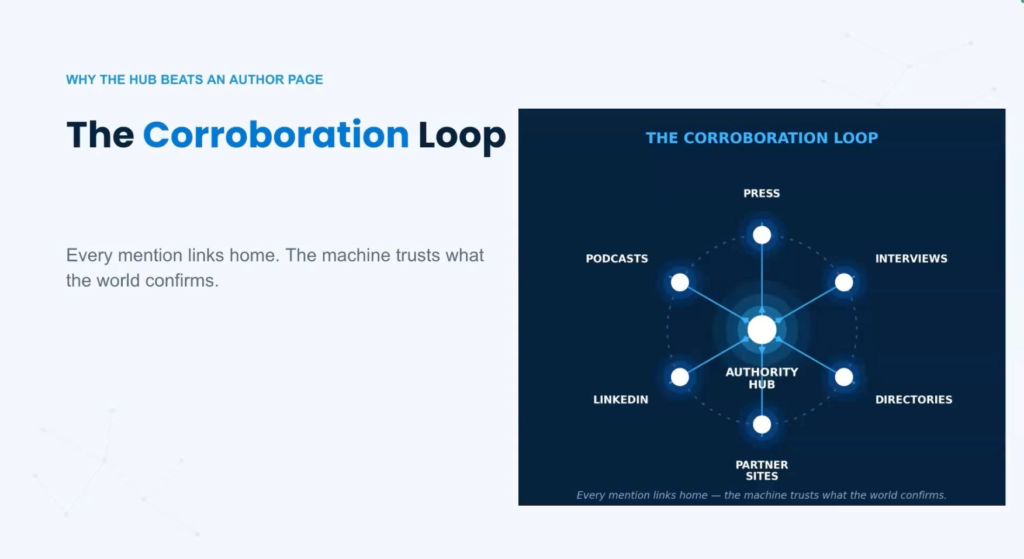
We call this a corroboration loop. Each credible connection helps answer engines understand the same person, subject, and body of work.
What Should You Put in an Authority Hub?
Your first version can be simple. Focus on making it accurate, useful, and easy to navigate.
Start with:
- A clear positioning statement. Explain who you are, what you do, whom you help, and the subject you know deeply.
- A current biography. Share your career path, current roles, meaningful milestones, and the experiences that shaped your work.
- Your original ideas. Name the frameworks, methods, principles, and points of view people associate with you.
- Proof of your work. Include relevant credentials, products, companies, books, courses, case studies, or measurable outcomes you can support.
- Media and appearances. Link to useful interviews, videos, articles, talks, and press coverage.
- Frequently asked questions. Answer the real questions customers, partners, journalists, and AI tools may ask about your work.
- Official profiles. Connect your hub to active company pages, LinkedIn, YouTube, podcasts, and other channels.
- Relevant personal context. Share interests, causes, communities, and experiences that help people understand who you are.
That last one can matter more than you might expect.
An AI recommendation connected the restaurant Molly owns to her dog rescue and mentioned that relationship to someone who cared about supporting dogs.
That connection made sense because the restaurant, the rescue, and Molly are all part of the same real story.
Personal details still need a reason to be there. Choose the ones that add useful context and help people understand what you care about.
Make It Easy to Read and Easy to Extract
An authority hub does not need an elaborate design. Clean structure does more of the heavy lifting.
Use descriptive headings, short summaries, simple navigation, fast pages, internal links, and accurate structured data. Keep important facts in text where they are easy to retrieve. Avoid burying key information inside animations, images, or complicated scripts.
We recommend putting the bottom line up front. Give the short answer first, then add detail for anyone who wants to keep reading.
FAQs are great for this. Start with a direct answer, then add the story, examples, proof, and related resources.
Schema markup can also clarify how a person connects to an organization, article, product, or other entity. Decide which relationships matter first. Then use the markup to reinforce that structure.
One Conversation Can Give You a Strong Start
I know what some of you are thinking: this sounds like a lot of content.
There is a much more manageable starting point. Record one focused, one-hour conversation.
Use that hour to talk through your origin story, expertise, principles, process, customer problems, common mistakes, and predictions for your category.
That single conversation can become a pillar article, FAQs, short videos, social posts, a newsletter, podcast material, and several supporting articles. That one strong recording could create 15 to 30 useful assets.
The exact number is not the point. The real opportunity is capturing genuine expertise once and adapting it for the places where people and answer engines discover information.
Every asset still needs human review. AI can help organize and repurpose the material. The expert should verify the facts, remove overstatements, and make sure the final piece sounds like a real person.
A Simple Authority Hub Action Plan
You can get started before every technical detail is perfect.
- Choose your authority lane. Write one sentence that defines the subject, audience, and perspective you have genuinely earned.
- Gather your source material. Collect bios, interviews, presentations, articles, credentials, case studies, profile links, and current company information.
- Find conflicts and gaps. Compare names, titles, dates, company relationships, and claims across your main profiles.
- Create the hub. Use a dedicated domain when practical, or launch a clean public Notion site as a first step.
- Organize the information. Lead with clear summaries, use descriptive headings, add FAQs, and connect claims to proof.
- Connect the ecosystem. Link relevant profiles, bios, content, and appearances back to the hub. Link from the hub to those sources too.
- Record your first pillar conversation. Capture your real experience, stories, and original ideas.
- Repurpose and review. Turn the conversation into useful assets and verify every one before publishing.
- Keep it current. Update roles, claims, links, and proof whenever your work changes.
- Track visibility beyond clicks. Watch whether you and your brands appear in relevant AI answers, citations, and recommendation sets.
A Few Mistakes to Avoid
The fastest way to weaken an authority hub is to publish information that conflicts with the rest of the web. Accuracy and consistency matter more than pumping out a huge volume of content.
A few other mistakes to watch for:
- Claiming expertise across too many unrelated subjects
- Treating a company author page as the entire strategy
- Spending too much time on design before the content is clear
- Publishing generic AI-written articles with little original experience
- Using short-term citation tricks that could create reputation risk
Keep the strategy grounded. Define your lane. Share genuine expertise. Support it with proof. Keep the record current. Make the important relationships easy to follow.
This Opportunity Is Still Early
The biggest takeaway is simple: answer engines need a reliable way to understand who is worth trusting.
The people behind a brand can give them that path.
For a founder-led company, the founder may be the first person to document. A larger business may need hubs for executives, product specialists, clinicians, educators, or other visible experts.
Start with one real person and one clear area of expertise. Build the record while the field is still open. Keep it accurate, connect it to the business, and continue adding useful ideas and proof.
The easier you make it for AI to understand why someone should trust you, the better chance your brand has of becoming part of the answer.


