

What changes when AI can understand the history of your business, analyze performance across platforms, apply proven ecommerce strategy, and help carry the work forward with your team?
That question sits at the center of Molly’s conversation with Devyn Merklin on the Smart Marketer Podcast.
Devyn has experienced ecommerce from the operator’s seat. He joined Dr. Livingood when the business was pacing around $250,000 per year and helped grow it into a mid-eight-figure company. His education came through the work itself: moving platforms, building websites, writing newsletters, learning SEO, running paid media, and adapting Smart Marketer campaigns to fit a specific brand.
That last point matters. Devyn did not simply copy a Black Friday template and press publish. He studied the strategy, collected the emails, ads, pages, and examples, then rebuilt each part around Dr. Livingood’s products, audience, offer, and operating reality.
GrowthOS applies the same pattern at a different speed. It gives an ecommerce team a connected operating layer that can use brand-specific context, Smart Marketer’s strategy, and modern AI capabilities together.
The result is a practical shift in how teams analyze opportunities, make decisions, coordinate projects, and execute approved work.
What agentic marketing means in practical terms
Most ecommerce teams already use some form of AI. A copywriter may draft emails in ChatGPT. A creative director may have a custom Claude project. An analyst may use a separate workflow to summarize reports. Each person becomes faster, yet the company can remain fragmented.
Agentic marketing creates a shared operating layer across those activities.
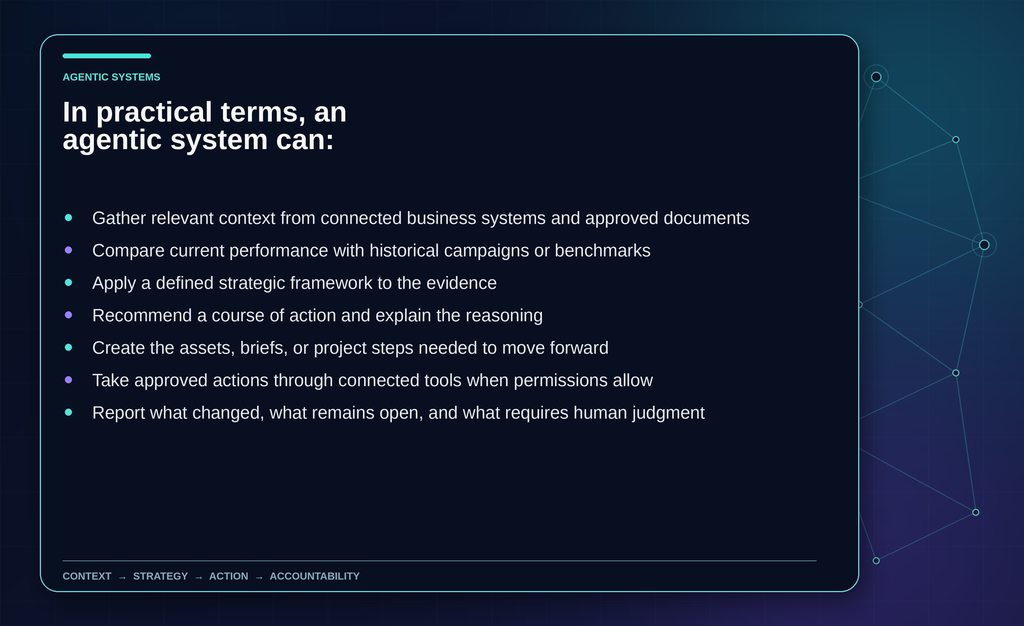
The human operator still sets the objective, defines constraints, approves consequential changes, and remains accountable for the result. The advantage is that the operator can make decisions with more context and spend less time assembling the raw material.
A useful way to understand the system is as a repeatable operating loop:
- Observe: Pull the relevant facts from Shopify, paid media, lifecycle marketing, analytics, team communication, and brand documents.
- Interpret: Identify patterns, gaps, risks, and opportunities across those sources.
- Decide: Recommend a prioritized action based on the brand’s goals and the available evidence.
- Execute: Build the approved asset, update the workflow, or complete the permitted task.
- Verify: Confirm that the change happened correctly and report the result.
- Learn: Preserve the useful outcome, decision, or process so the next cycle starts with better context.
This loop turns AI from an isolated content tool into part of the way the business operates.
The three layers of intelligence behind a stronger output
Devyn describes three sources of intelligence working together. Each one solves a different problem.
1. Brand context: what is true for this business
Brand context is the information that should make an answer specific to the company rather than generic to ecommerce.
That can include:
- Product catalog, margins, inventory, bundles, and merchandising rules
- Customer segments, purchase behavior, objections, and support themes
- Brand positioning, voice, visual direction, and approved claims
- Historical promotions, launches, creative tests, and campaign results
- Channel performance across Shopify, email, paid media, analytics, and other systems
- Team roles, approval authority, active priorities, and operational constraints
This layer answers questions such as:
- Which products can support a discount without damaging contribution margin?
- Which customer segment is most likely to respond to a bundle?
- What promises can the brand make safely and credibly?
- What happened the last time the company ran a similar promotion?
- Who needs to approve the offer, creative, and send schedule?
Without this context, even strong AI output can sound polished while recommending the wrong offer, audience, message, or next step.
2. Ecommerce expertise: what the evidence suggests the team should do
The second layer is Smart Marketer’s ecommerce strategy and operating knowledge. It gives the system a strategic lens for interpreting brand data.
This includes frameworks for areas such as:
- Offer structure and promotional sequencing
- Paid media strategy and creative testing
- Email campaign planning and lifecycle marketing
- Merchandising and customer journey decisions
- Direct-response messaging
- Launch planning, reporting, and post-campaign analysis
This layer turns information into a plan. A performance report may show that conversion rate fell, acquisition costs rose, and returning-customer revenue remained steady. Ecommerce expertise helps the team decide whether the next move should focus on the offer, product page, audience, creative, retention, or another part of the system.
The system still needs evidence. Strategy gives that evidence structure and helps prevent teams from reacting to one metric in isolation.
3. Modern AI capabilities: how the system processes and produces work
The third layer is the broad capability available through modern AI models. This includes analysis, synthesis, planning, drafting, coding, image understanding, and the ability to work across large amounts of information quickly.
This layer can help the team:
- Summarize long histories of campaigns and decisions
- Compare patterns across channels
- Draft emails, ads, briefs, reports, and page structures
- Turn a wireframe or screenshot into a working draft
- Organize an ambiguous request into a clear project plan
- Monitor defined conditions and surface exceptions
AI capability provides range and speed. Brand context provides relevance. Ecommerce expertise provides judgment. The three layers are strongest when they operate together.
Two tactical ecommerce workflows discussed in the episode
The agentic flows become especially useful when you translate the larger idea into recurring work.
Workflow 1: Build a better Black Friday plan from historical evidence
The old process often begins with people trying to remember what happened last year. Then someone gathers emails, ads, landing pages, offer details, and channel reports from several systems. The strategic discussion may start days or weeks later.
An agentic workflow can compress the research phase.
Inputs to provide:
- The last three to five Black Friday campaign calendars
- Offer and product details for each year
- Email and SMS sends with revenue, click, and conversion data
- Paid-media creative, spend, CPA, ROAS, and audience data
- Shopify revenue, AOV, conversion rate, product mix, and new-versus-returning customer data
- Post-mortems, team notes, inventory issues, and operational constraints
Questions to ask:
- Which offers produced the best mix of revenue, margin, and customer quality?
- Where did performance improve or decline year over year?
- Which messages and creative angles repeatedly worked?
- Where did customers drop out of the journey?
- Did stronger topline revenue create problems in fulfillment, margin, or retention?
- What should the team repeat, remove, or test this year?
Expected output:
- A year-over-year performance summary
- A list of durable patterns and unresolved questions
- A recommended promotional structure and calendar
- Channel-specific briefs for email, paid media, organic, and the website
- Risks, dependencies, owners, and approval checkpoints
This gives the team a strategic starting point instead of a blank calendar.
Workflow 2: Make strategy proactive instead of purely reactive
Molly describes the system surfacing priorities and telling her what needs attention. That is a meaningful step beyond waiting for someone to write the perfect prompt.
A proactive operating system needs clear monitoring rules. A practical weekly growth review could track:
- Revenue, conversion rate, AOV, and contribution margin
- New-customer CPA and blended acquisition efficiency
- Spend, creative fatigue, and channel-level changes
- Email revenue, deliverability, engagement, and list growth
- Product-level sales, inventory risk, refunds, and support themes
- Active tests, project blockers, and overdue approvals
The report should avoid dumping every metric into Slack. It should answer four questions:
- What changed materially?
- Why does it matter?
- What is the most likely explanation?
- What action should the team take next?
A useful system also distinguishes facts from hypotheses. It can show the evidence, state its confidence, and recommend the next check before the team commits resources.
How to adopt an agentic operating layer without starting over
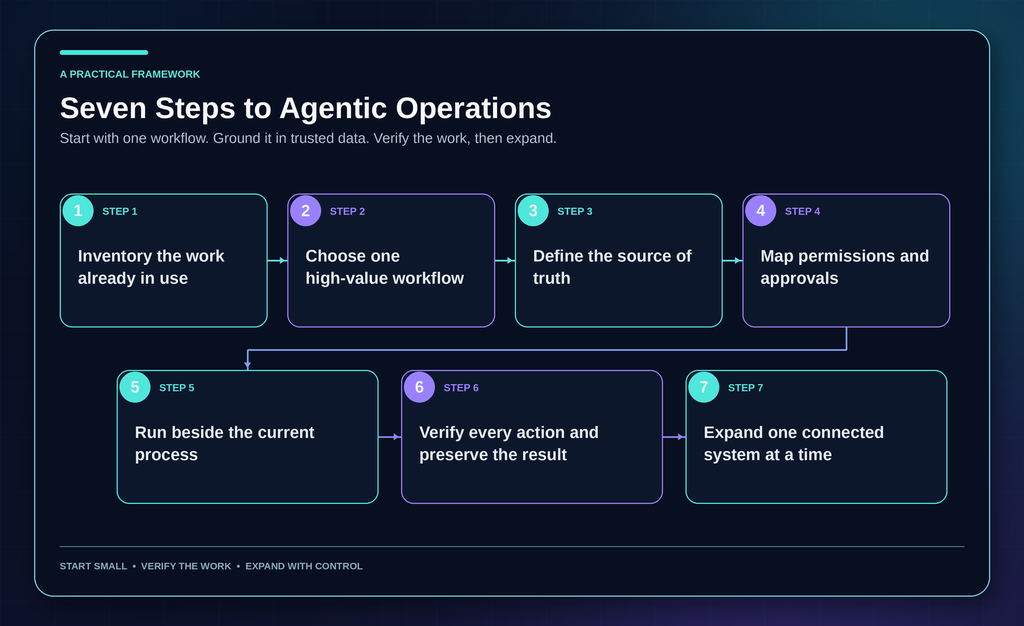
Teams with mature AI workflows often worry that a connected system will erase the work they have already done. Devyn and Molly make the opposite case. Existing prompts, agents, documents, frameworks, and team knowledge can become inputs to the larger system.
A practical adoption sequence looks like this:
The mindset shift: involve the system before the brief is finished
Molly describes retraining herself to ask GrowthOS first when she sees a problem or begins planning a project.
That habit changes the order of operations.
Instead of manually gathering everything and handing the system a finished brief, an operator can start with the business problem:
- We need a Q4 promotion that protects margin.
- Our homepage feels generic even though it converts.
- Acquisition costs increased this month.
- The team has three separate creative systems that do not share context.
- A product is appearing in the wrong collection.
The system can help determine what evidence matters, what information is missing, and which next action has the highest value. The operator can then approve a better brief with less manual assembly.
This is the strategic unlock Molly emphasizes throughout the episode. Faster execution is easy to see. Better problem definition can create a much larger advantage.
A 30-day starting plan for an ecommerce team
For a team that wants to explore agentic marketing without creating another sprawling implementation project, this is a focused first month.
Week 1: Map the operating context
- Select one workflow and one accountable owner
- Document the objective, current process, source systems, and pain points
- Inventory existing prompts, agents, documents, and reports
- Define production actions that require approval
Week 2: Connect evidence and test analysis
- Give the system read-only access to the minimum required sources
- Run historical questions with known answers
- Check citations, calculations, assumptions, and missing context
- Refine the strategic framework and output format
Week 3: Produce drafts and compare quality
- Generate one real brief, report, page draft, or campaign plan
- Run the existing human process in parallel
- Compare speed, depth, accuracy, and rework
- Have channel specialists challenge the recommendation
Week 4: Add controlled execution and reporting
- Approve one low-risk action with a clear rollback path
- Require verification after execution
- Record the outcome and update the workflow
- Decide whether to expand, revise, or stop the pilot
At the end of 30 days, the team should have evidence of value, a defined approval model, and a reusable workflow. That is more useful than a collection of impressive demos.


