
These days, it’s harder than ever to stand out in a market and win over new customers.
That’s why we use lead magnets to add more diversity to our offer system. It helps us get cheap leads, unlock new audiences and persuade hesitant buyers.
Unfortunately, a lot of brands get lead magnets wrong—wasting energy and ad spend on resources that just don’t work.
So in this post, we’re looking at the top-performing free resources from our brands, our agency clients, and a few favorites from across the industry to show you the 6 elements of a winning lead magnet.
Check out the article to learn:
- What goes into a winning lead magnet, with real examples
- How to fit a lead magnet into your offer system
- Basic vs. advanced magnets (and which one’s right for your brand)
Why Lead Magnets Matter for All Business Types
Before we jump into the 6 elements, let’s answer the all-important question: “Do I really need lead magnets?
The short answer: yeah.
Whether you’re in physical products, info products, services, or some combination of those—lead magnets are an essential part of your offer system.
But depending on what you sell, you’ll probably incorporate lead magnet funnels at different points in your growth process.
Here’s why.
Lead Magnets for Physical Products
Most ecommerce brands that are just getting started will probably start with a simple offer, like an ad to a product page. This is a great way to find your best customers and establish your place in the market.
Eventually, though, ecom brands want to diversify their offers—and a great place to start is with a lead magnet funnel.
This is a great way to:
- Target prospects that need more education before buying
- Leverage reciprocity to build goodwill
- And build an email list for monetization
Lead Magnets for Info Brands, Services, etc.
For brands selling non-physical products, lead magnets tend to come earlier in your offer system buildout.
That’s because their products tend to be higher ticket, making it harder to send a prospect straight from an ad to a product page. More value is usually required up front before a customer is ready to buy.
In these cases, a lead magnet can help you:
- Build your authority and establish trust
- Provide a sample of a larger course, app or service
- And pre-qualify leads for your main offer
Basic Lead Magnets vs. Advanced
So, we all know a lead magnet is—it’s essentially a piece of gated content that you offer in exchange for contact information or other data.
From there, we like to think of lead magnets as either basic or advanced based on how much content they contain and/or how much work they take to produce.
“Basic” lead magnets are simple, often 1-part resources. They usually promote lower ticket products, or items that don’t require much education to understand the problem they solve or the benefit they provide.
These include templates, guides, simple video trainings, checklists, case studies, cheatsheets, and resources.

“Advanced” lead magnets are more complicated or robust resources. They’re best used to sell higher ticket products, or items that are harder to sell where you need more education or to build a deeper relationship.
These include quizzes, multi-video trainings, calculators, trials, and webinars.

Tip: When making a lead magnet, don’t make it more complicated than needed.
Not only is an advanced lead magnet usually more work to create—but more “value” can quickly turn into more “friction” for your prospect if you make them consume more content than they want to.
6 Elements of a Winning Lead Magnet
But whether you’re selling physical products, info products, or services—or whether your resource is basic or advanced—there are 6 elements you should have on your lead magnet opt-in page.
1. A High-Value Offer
First thing’s first: is your lead magnet something people actually want?
According to our good pal and lead magnet expert Russ Henneberry, there are 3 factors that make for an attractive offer:
- Specificity: Target a specific pain point or benefit that feels attainable. Don’t overwhelm prospects by trying to tackle too much, or hurt your credibility by overpromising.
- Speed: Make your content quick to consume and implement. Don’t create a lead magnet that’ll take too long to finish (like an ebook) or that’ll take too long to product results (“How to Grow a Lemon Tree!”).
- Ease: Similarly, you don’t want the process to feel complicated (even if it’s fast). Focus on a small, simple problem.
Example: Big Life Journal
Here’s a lead magnet that I absolutely love from our agency client, Big Life Journal. Let’s look at how their offer holds up to the criteria above.

It’s specific. It’s not “How to raise your child” or “How to teach your child Italian”—just how to talk to them. Very manageable.
It’s fast. This isn’t an ebook, just quick and consumable sheets. They offer 10 here, and I might even suggest cutting that down to 5.
It’s easy. It’s a few simple exercises and tweaks in your communication. You’re not getting a degree in child psychology.
2. Benefit-Focused Copy
So you have your high-value offer—now you need to present that offer to your audience in a compelling way.
As with all direct-response copy, the most effective way to do that is to focus on benefits. Ask yourself, “How will this lead magnet improve someone’s life?”
(Often, copy puts too much emphasis on features—what the resource contains in terms of page count, number of videos, etc. But while this is good information to have somewhere on the page, it shouldn’t be your focus.)
To write benefit-driven copy, ask yourself these 3 questions:
- What is the benefit? – Hit the major pain points your lead magnet solves, and focus on the transformation (before state to after state) the person will experience
- Who will benefit? – Call out the ideal avatar for this resource—parents, business owners, etc.
- How will they benefit? – If you have one, call out the unique “mechanism” that will deliver the benefit—like a proprietary system or framework.
Example: Zipify
Here’s an example from our sister company, Zipify Apps. Let’s see how it holds up.

The what: How to sell out your next product launch. Do you see how that’s so much more concrete than just, say, how to optimize your product page?
The who: This resource is clearly for ecommerce merchants, and specifically for Shopify store owners.
The how: How will they sell out their next product launch? With the blueprint from my 8-figure store. This combines a propriety system with a call to authority (we’ll get into that more later).
Example: BOOM! Beauty
This example comes from my $200 million ecommerce brand. It’s not much to look at, but it hits all the right notes—a clear benefit (a “natural” look) for a specific audience (women 45+) in a unique way (our Boomsticks, hinted at further down the page).

3. Simple, Low-Friction Opt-In
Ready? Here’s a fundamental law of conversion optimization:
- The more fields in your opt-in form, the more friction you add to the process and the lower your conversion rate will be.
For that reason, you should only ask for information you’re actually going to use. For most businesses, that’s an email address.
Is it nice to have a lead’s phone number? Sure… But if you don’t do much SMS marketing, then acquiring that data might not be worth lowering the conversation rate of your lead magnet funnel.
Example: Big Life Journal
Big Life Journal only asks for 2 data points: a name and an email address. (They even hide their form in a popup to make the page cleaner above the fold.)

A few more things I like about this opt-in form:
- Progress marker: The “Almost there…” headline tells the prospect they’ve started something and it’s almost finished—encouraging them to take the final step.
- Benefit reminder: The “free printable kit” copy reminds them they’re getting a free resource here.
- Spam disclaimer: “Your information will not be shared”. It’s always good to assure people their data will be safe
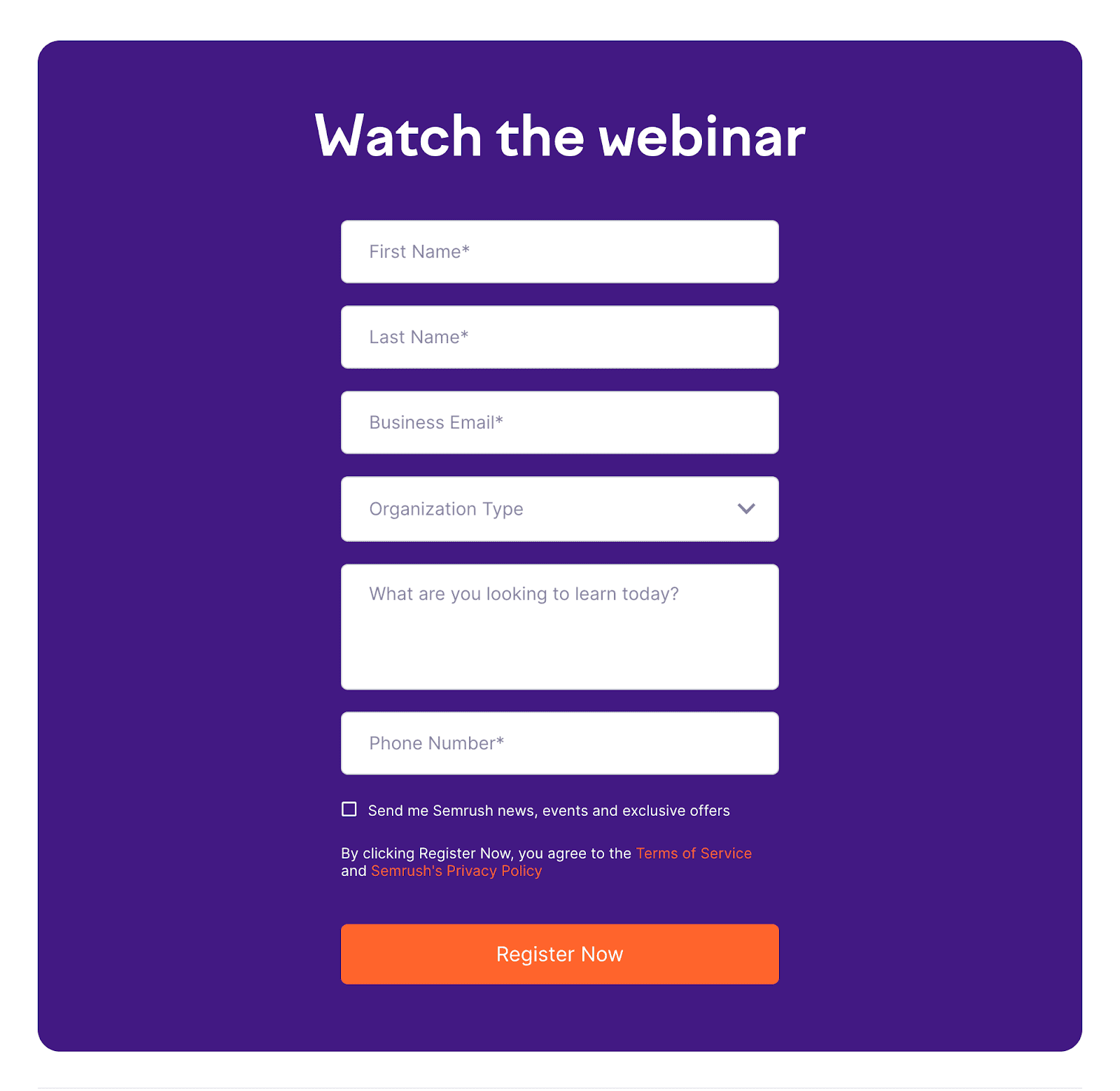
Example: Semrush
If you’re an info or services brand, it might be worth asking for more information to help qualify your leads.
Take this form from Semrush for example. They ask for more information because they need it for relevant follow-up marketing. (In our experience, we recommend 6 fields max no matter what you sell.)
4. Clean, Consumable Design
If elaborate design is a big part of your brand identity then by all means, have at it. But most brands don’t need anything fancy on their lead magnet opt-in page.
What you do want is a well-designed page that’s easy to consume. Here’s how to do that:
- Keep it minimal: Just like your offer should be clear and easy to take in, so should your page. Don’t overload it with stock images or excessive copy. Keep it short, simple and consumable, with plenty of white space.
- Only use important visuals: Some visuals are effective—like an image of the lead magnet or, if you’re a personality-forward brand, an image of the brand owner. Let them know who you are!
- Clear call to action: We like to include one CTA at the top of the page (above the fold), and another at the bottom so people don’t have to scroll up to opt in.
Example: Zipify
Here’s another example from Zipify.
See how it’s super clean above the fold? Then it just has some horizontal images showing the training videos, and a bit of copy with a big pic of me. (My personality is a big part of our marketing.)

5. A Sense of Urgency
Urgency drives action. Duh.
But most lead magnets are evergreen and therefore not time-sensitive. So how do you persuade your prospect to act now?
Well, there are ways to create a sense of urgency even with an evergreen offer. You just have to get creative by focusing on stuff like:
- Seasonality: “Get ready for spring!”
- Opportunity cost: “You’re losing money every day you don’t use this!”
- Life events: “The perfect Father’s Day gift!”
Example: Pampers
This Pampers quiz has built-in urgency—not because the offer is going anywhere, but because it’s targeting soon-to-be parents.
They promise the perfect “babymoon” destination, for one more adventure “before your baby arrives.” (In other words, you’d better act now!)

Example: Click Love Grow
Here’s a lead magnet for a photography workshop.
The copy doesn’t do anything fancy—it just promises a free bonus when you register “today.” The bonus will probably be there tomorrow, too, but they’re not using any false scarcity here. It’s just well-worded copy that encourages action now.

(By the way: never use false urgency or scarcity. You don’t want to start a new relationship by coming off as inauthentic.)
6. Authority & Social Proof
You know the old saying: “Trust is earned, not given.”
You might claim you can help transform someone’s life for the better, but that doesn’t mean they’ll believe you!
A great lead magnet opt-in page establishes credibility with things like:
- Success stats – “Generated $185M in sales!”
- Media mentions – “As seen in People’s Magazine!”
- Client testimonials – (See below)
Example: Smart Marketer
This is one of our best-performing lead magnets ever.
At Smart Marketer, we have a lot going for us in the authority department, like our proven track record (“$28,692,184 in spend“) and that we’re well-respected in the community (followed by “Over 30,000 business owners”).

Example: Click Love Grow
Here’s another example from the photography workshop. They use this image further down the page to showcase customer testimonials:

I like using images of actual messages—from Facebook/Instagram, an SMS conversation, an email, etc. They might not look as pretty, but they’re so much more authentic than designed images.
Final Thoughts
There you have it!
When you incorporate these 6 elements into your lead magnet opt-in page, you turn can “Maybe later” into “Hoowee, I’m in!”
But lead magnets are just one part of an effective offer system. If you want to learn more about how to grow a sustainable brand (or if you just want another great lead magnet example) then check out our Ecommerce Growth Map. It’s even super helpful for non-ecom folks.
Thanks for reading—and good luck with your lead magnets!


