


Retail has a way of looking like the next level.
Your products are on a shelf. A buyer says yes. The brand appears in hundreds of stores. From the outside, it looks like proof that the business has arrived.
The operating reality is less glamorous. Retail can mean lower margins, buybacks, brokers, distributors, pricing pressure, new packaging, more inventory, more people, and a second business model running beside DTC.
During a Mentor Table call, Ezra Firestone was asked when a brand should put less energy into DTC and start looking at retail, Amazon, or international markets. The detailed discussion centered on retail because retail creates the largest change in economics, control, and operations.
The answer was direct: build a large, profitable online business first. Treat retail as a volume expansion play once the company has the money, infrastructure, and leadership to support it.
Ezra’s short answer: wait longer than you think
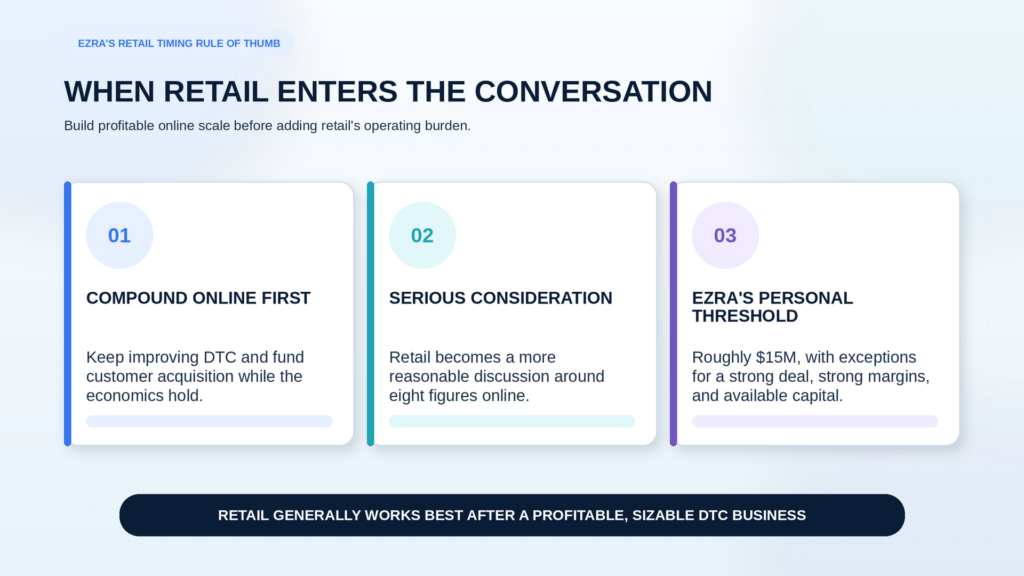
Ezra’s directional rule of thumb was to wait until a brand reaches eight figures online before seriously considering retail. He described roughly $1 million per month online as the point where the conversation becomes more reasonable.
His personal threshold was more conservative. He said he would probably wait until about $15 million in annual online sales unless the opportunity was unusually strong. A brand between $5 million and $10 million could be an exception if it had substantial margin, available capital, and a retail deal worth the added work.
Those numbers are not universal rules. They are a way to frame the burden.
Retail needs cash, inventory, supply chain strength, proof that the product already sells, and people who understand the channel. A brand can enter earlier. The question is whether the opportunity justifies building a second operating system before DTC has reached its potential.
Reinvest in customer acquisition before adding retail complexity
If an ecommerce business is profitable and its primary acquisition channel is working, Ezra would usually reinvest available profit into acquiring customers through additional channels before pursuing retail.
That could mean testing TikTok, Amazon, or another source of demand while continuing to improve the core DTC engine. He is willing to accept a slower payback period when the lifetime value supports it, because the goal is to expand the customer footprint of the business.
This does not mean spending without discipline. The business still needs a clear view of contribution margin, cash flow, repeat purchase, and how long it can afford to wait for payback.
The strategic point is simple. DTC gives the brand more control over the offer, customer relationship, merchandising, and economics. There is usually more room to compound that advantage before taking on the structural costs of retail.
Why retail becomes expensive so quickly
Retail revenue can be large. The cost of earning and servicing it can be large, too.
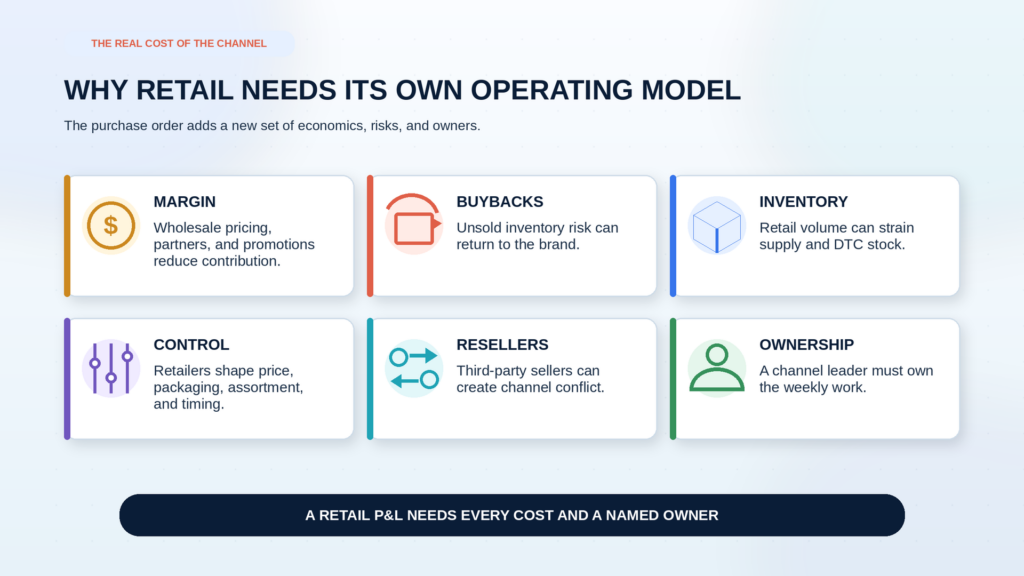
In the discussion, one experienced operator said margins in her retail channels were less than half the margins of her DTC business. That ratio reflects her company’s experience. It should not be treated as a benchmark for every brand. The pressures she described are still common to the model:
- Brokers and distributors take a share.
- Buyback clauses can shift unsold inventory risk back to the brand.
- Retailers may resist price increases or threaten to drop the product.
- Third-party resellers can create channel conflict.
- Packaging, compliance, forecasting, and purchase-order planning add work.
- The brand needs enough inventory to serve retail without starving DTC.
Retailers also hold meaningful negotiating power. Once a brand depends on those doors, the retailer can have a strong voice in price, promotion, packaging, and assortment.
That can still be worthwhile when the volume is real. It just deserves a full channel P&L and a realistic operating plan before anyone celebrates the purchase order.
Big-box and small-box retail are different bets
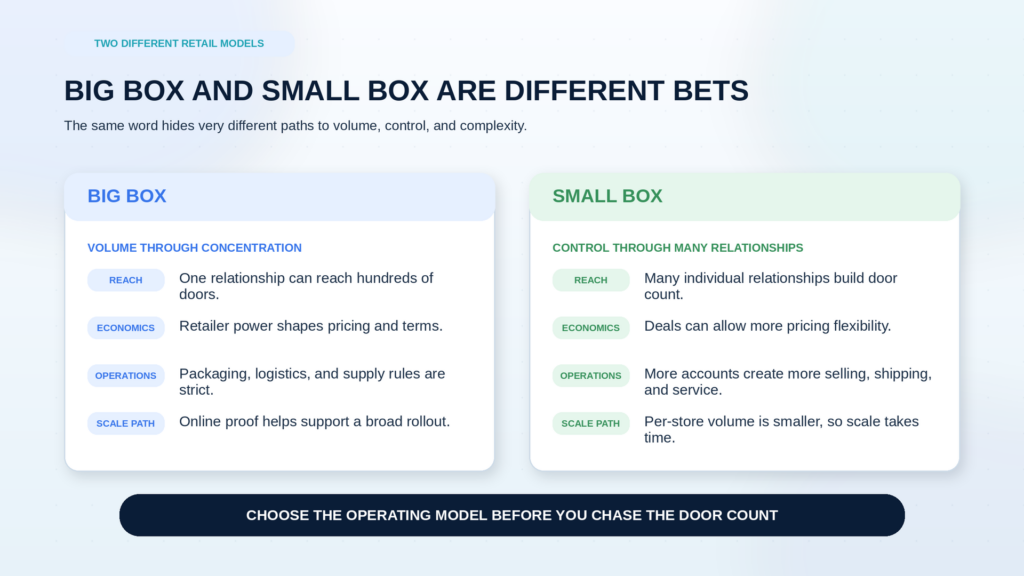
The word “retail” hides two very different models.
Big box concentrates the volume and the pressure
A large chain can place a product in hundreds of stores through one commercial relationship. That is where retail can become a major volume play.
The tradeoff is negotiating leverage. Large retailers may require aggressive pricing, specific packaging, strict logistics, chargeback compliance, buyback terms, and enough supply to support a national rollout. They also expect proof. Strong ecommerce sales, reviews, supply chain reliability, and prior retail performance all help a brand earn the meeting and survive the launch.
Small box offers control and more operational work
Independent stores can allow better pricing, closer relationships, and more flexibility. In some categories, direct wholesale relationships can also preserve margin and limit reseller problems.
The workload multiplies quickly. Instead of managing one retailer with hundreds of doors, the team may manage hundreds of separate accounts, conversations, shipments, and reorders. Individual stores may move only a small number of units each month, so the brand needs many doors before the channel changes the business.
Small-box retail can work. It often takes years of steady selling and account management. A pilot with a few stores may teach the team how the model works, but it may say very little about the channel’s eventual revenue potential.
A scattered team does not always mean the channel is wrong
One operator in the discussion had a smaller brand with roughly a quarter of sales coming from wholesale. The channel was profitable, the company sold directly to retailers, and it had established relationships. The problem was divided focus. A small team was trying to run DTC and wholesale at the same time.
Ezra did not recommend turning the wholesale business off.
The existing channel had revenue, retailer relationships, operating history, and proof that the company could service buyers. That proof could help the brand win larger accounts later. Closing the channel would remove the distraction, but it would also throw away an asset that already worked.
His alternative was to build the missing capability. A skilled head of retail or wholesale could own the strategy, buyer relationships, reporting, and weekly problems. A retail operations person could support the logistical work. The rest of the team would still contribute, especially across supply chain, marketing, packaging, and product development, but the channel would stop living everywhere and nowhere.
Ezra was willing to let that added infrastructure consume the channel’s current profit if it gave the business the capacity to grow. The immediate goal was not to extract every available dollar. It was to create an accountable operating unit that could expand without scattering the whole company.
Use G&A as a signal, not a verdict
Ezra offered a directional general and administrative expense heuristic during the discussion. If G&A, including salaries and contractors, is below roughly 15% of the P&L, the company may have room to invest in more capability. If it is above roughly 20%, the company should inspect whether it is carrying too much overhead.
This range is not a universal benchmark. Business model, gross margin, growth stage, and channel mix matter. Retail-heavy brands often need more people because they have sales representatives, brokers, buyer meetings, compliance work, and channel operations that a DTC-only brand may not need.
Use the heuristic to ask a better question: is the team truly overbuilt, or is a valuable channel under-owned?
Protect the customer promise when the channel changes
Retail can change who the business serves.
A DTC brand designs for the person using the product. A retail business also has to design for the buyer, the shelf, the retailer’s margin, and the promotion calendar. If accommodating a large chain would force price increases, weaker products, or decisions that conflict with the brand’s reason for existing, that is a real strategic cost.
The answer does not have to be one catalog everywhere.
Ezra described using retail-only SKUs, sizes, and packaging to reduce conflict across DTC, Amazon, and retail. A company with strong manufacturing capability could even build a separate retail line or brand. That structure can protect DTC pricing and give the retailer a product designed for its economics.
It also adds development, forecasting, packaging, and inventory complexity. Channel-specific products are useful when the opportunity is large enough to support another layer of operations.
The retail readiness test
Before opening the channel, answer these questions with actual numbers and named owners:
- Is the online business already profitable and large enough to fund the test?
- What happens to contribution margin after wholesale pricing, fees, brokers, distributors, returns, buybacks, promotions, and added labor?
- Can the supply chain support the new volume without damaging DTC availability?
- Is the opportunity a big-box volume bet or a small-box relationship business?
- Who owns the channel every week after the launch excitement fades?
- Does the retail model strengthen the product and customer promise, or does it require a business you do not want to run?
- If retail already contributes profitable revenue, is the channel failing, or does it simply lack dedicated leadership?
A strong answer does not guarantee that retail will work. It shows that the brand understands what it is choosing.
Retail should earn its place in the business
Retail can add meaningful volume and open distribution that DTC cannot reach on its own. It can also drain margin, cash, and attention from a stronger online engine.
Build the ecommerce foundation first. Keep investing in customer acquisition while the economics support it. Enter retail when the business can fund the inventory, absorb the terms, assign experienced ownership, and protect the customer promise.
If a profitable retail channel already exists, fix the ownership problem before assuming the channel itself is the problem.
And if the DTC business is profitable, enjoyable, and giving customers exactly what the brand wants to make, it is fair to ask Ezra’s closing question: what do you need the retail headache for?
Want to be in the room (or Zoom) when these conversations happen? Apply for our Mentor Table Mastermind, the premier place for 8-figure operators, and join us for weekly calls, annual events, and a 24/7 Slack community.


