
If the last two years of AI felt fast, the last thirty days were in warp drive.
Not in a shiny feature release kind of way.
In a structural way.
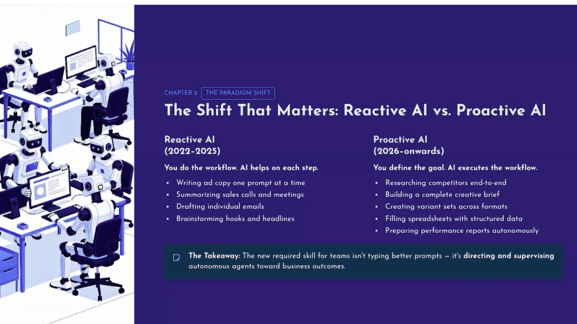
For most of 2023 through 2025, AI was reactive. You gave it context. You wrote a prompt. It gave you an output. An email. A script. A summary. A set of ideas.
Helpful. Powerful. Still dependent on you driving every step.
What we are entering now is something else entirely. AI is shifting from being a tool inside your workflow to becoming a layer that operates across your workflow.
This is what people are calling the agent era.
And most brands are not prepared for what that actually means.
From Prompts to Agents
The old model was simple.
You told AI what to do.
The new model looks more like this.
You connect AI to your tools. You give it context and permissions. It pulls data, interprets it, makes decisions, and pushes actions back into the system.
Instead of asking it to write an email, you ask it to review your ESP account, analyze performance, suggest improvements, and draft new variations based on what it finds.
Instead of asking for ad copy ideas, you connect it to your ad account and let it review spend, creative performance, and funnel behavior before suggesting changes.
That shift from output to execution is the real change.
It is no longer just about better prompts. It is about building systems where AI participates in the work.
The Power and the Risk
On a recent Mentor Table call, there was a lot of excitement around agent-style tools that can operate on your machine and execute tasks.
The idea sounds incredible. A digital assistant that can open apps, move files, run reports, and manage workflows on your behalf.
But there is a reason this moment requires maturity.
When AI has access to your systems, your inbox, your financial data, or your ad accounts, you are no longer playing with a content toy. You are granting operational power.
That means permissions matter. Guardrails matter. Test environments matter.
The takeaway is not to avoid these tools. It is to approach them with intention.
The brands that win in this era will not be the ones who install everything first. They will be the ones who build responsibly and strategically.
Where This Becomes Practical
The most immediate and usable shift right now is happening through connectors.
Instead of living in isolation, AI tools are beginning to integrate directly with platforms like Klaviyo, Google Drive, Slack, and more.
That means you can pull information from one system, transform it, and push it into another without manually jumping between tabs.
One example shared on the call was building a weekly newsletter workflow entirely inside an AI environment. The tool pulls the necessary inputs, drafts the content based on predefined structure, and outputs a polished draft ready for review.
Another example involved taking a long training video and transcript and turning it into a fully structured content page with organized sections and clear formatting, ready for publishing.
That is the practical application of agents right now.
Pull data. Process it intelligently. Push it somewhere useful.
It sounds simple. It is transformative.
Talking about the agent era is easy. Executing on it is where most brands stall.
Right now, there are three practical layers to understand.
Claude Chat is the thinking layer. This is where most marketers should begin. It sharpens strategy, pressure tests offers, structures content, analyzes messaging, and helps you think more clearly.
It does not operate your systems. It does not take actions. It makes your decisions better. For many brands, that alone creates meaningful leverage.
Claude Co-Work is where execution starts to compound. This is the operational layer that connects AI to your tools. Instead of living in isolation, it can pull data from your platforms, help you analyze it, draft improvements, and organize outputs so they are ready to deploy.
You move from “write me an email” to “review this performance, suggest improvements, and prepare updated assets.” It becomes a pull and push system that reduces context switching and compresses production cycles.
Then there is OpenClaw.
OpenClaw represents the bleeding edge of agent execution. It can operate locally on your machine, click through interfaces, and take direct actions. That level of power is real, and so is the responsibility that comes with it.
Without tight permissions and controlled environments, it can create unintended consequences quickly. Tools like this are for advanced experimentation, not casual adoption.
The smart path forward is layered. Use Claude Chat to think better. Use Claude Co-Work to build repeatable workflows. Experiment with agent-level tools like OpenClaw only in safe environments with clear guardrails.
The brands that win in this era will not be the ones who install the most tools. They will be the ones who deliberately build AI into their operating system, one controlled layer at a time.
Why Humans Still Matter
With all this automation, it is tempting to assume we are heading toward a fully hands-off future.
We are not.
AI can analyze patterns. It can generate variations. It can accelerate production.
It cannot understand nuance the way a strong marketer can yet.
It does not understand cultural timing yet. It does not feel the emotional undercurrent of a market. It does not instinctively know when something technically correct is strategically wrong.
The brands that benefit most from this shift will combine operational AI with strategic human oversight.
You do not remove yourself from the process.
You elevate yourself above the repetitive work so you can focus on leverage.
What This Means for Marketers in 2026
If you are feeling overwhelmed by the speed of change, here is the grounded truth.
You do not need to master every new tool.
You need to identify one repetitive, time-consuming task in your business and systematize it with AI.
Weekly reporting. Ad research. Email drafting. Creative analysis. Funnel audits.
Pick one.
Build a workflow around it.
Test it in a safe environment.
Refine it.
Then move to the next.
This is not about chasing features. It is about building leverage.
The brands that treat AI like an operational layer instead of a novelty will compound faster over the next two years than those who use it casually.
The agent era is not hype.
It is a structural shift in how work gets done.
You can treat it like noise.
Or you can treat it like the beginning of your next operational advantage.
The brands that choose the second path will not just move faster.
They will build smarter systems that evolve with the market instead of reacting to it.


