


Q4 is a season. It is bigger than one promotional weekend.
The usual fundamentals still matter. Start early. Merchandise deliberately. Coordinate paid media, email, SMS, the website, products, and operations. Use the season to acquire new customers, increase average order value, and give existing customers a reason to buy again.
The problem starts when every brand copies the same calendar, discount, landing page, and ROAS target.
Customer demand does not move the same way in every business. A gift brand, a wellness brand, and a professional-use product can all experience Q4 differently. The best plan follows the buyer and the economics of the brand.
Before you choose campaign dates, make three decisions (or check these against your current dates):
1. When does your customer actually want to buy?
2. How much can you afford to pay for a new customer?
3. Where does a stronger offer create demand without giving away unnecessary margin?
Those answers should shape the calendar.
Decision 1: Chart Your Demand Shape
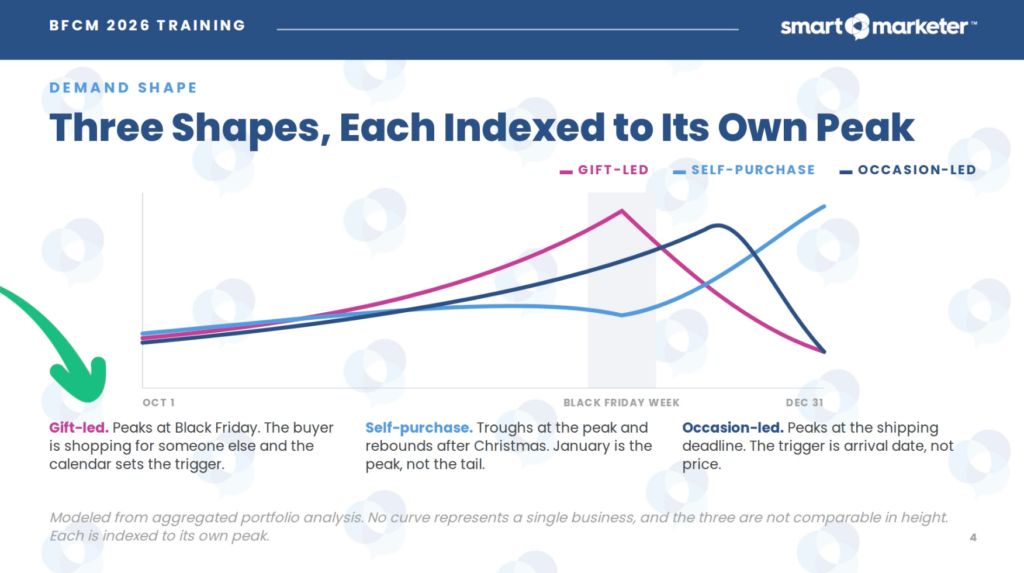
Start with the last two Q4 periods if you have them. Review weekly revenue, orders, new-customer orders, spend, and acquisition cost. Then look at the curve.
Most brands show one or more of these demand shapes.
Gift-led demand
These customers are shopping for deals, buying in bulk, or looking for a gift that needs to hit a certain price threshold. Price and total value can materially influence the decision.
Gift-led brands may support earlier Black Friday activity, stronger value stacking, and a longer event when acquisition remains profitable.
Self-purchase-led demand
These customers are waiting for permission to buy something for themselves. Demand can increase in the middle of December and again after December 25 as the message shifts from gifting to wellness, organization, transformation, or a fresh start.
A brand that turns acquisition off too early can miss one of its strongest windows.
Occasion-led demand
These customers need a product for a specific person, profession, use case, event, or deadline. Relevance, availability, and shipping certainty may matter more than another five points of discount.
A deeper discount during one of these windows can reduce margin without changing the buying decision.
Mixed demand
Many brands serve more than one demand curve. A deal-oriented gift cohort may peak around Black Friday, while a self-purchase cohort creates another peak later in December or early January. The finished output should be one chart and one sentence:
“My brand is primarily gift-led, self-purchase-led, occasion-led, or mixed. Our budget should peak here because this is when buyer motivation peaks.”
That sentence can keep your team from copying a calendar designed for a different business.
Decision 2: Set Your New-Customer Acquisition Ceiling
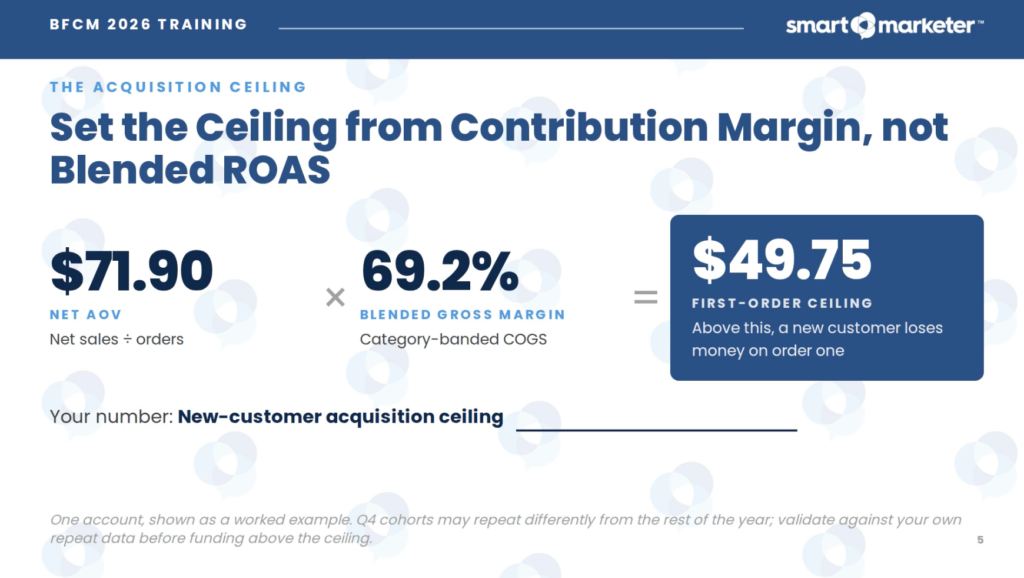
Your acquisition ceiling is the maximum amount you can pay to acquire a new customer while staying inside the economics you have chosen.
Begin with first-order revenue from a new customer. Then subtract:
- Cost of goods
- Fulfillment costs
- Subsidized shipping
- Payment fees
- Expected returns
- Other variable costs connected to the order
What remains is the first-order contribution available to fund acquisition. You may decide to spend above that amount when reliable data shows that customers acquired during Q4 return and generate additional contribution. Use actual Q4 cohorts to support that choice.
Holiday customers may be buying gifts or purchasing for an unusual occasion. Their first order may not reflect an ongoing need, and they may not return on the schedule predicted by the company’s general lifetime-value model.
This is why a blended ROAS target can be misleading. Existing customers and branded search can make the account look healthy while new-customer acquisition loses money. The reverse can happen too. A window may look less efficient in aggregate while bringing in valuable new customers at a sustainable cost.
Write the acquisition ceiling down and use it as the budget gate for the quarter. Spend while marginal new-customer acquisition cost remains below the ceiling. When it crosses the ceiling, stop increasing the budget or change the creative, offer, destination, or plan.
3x ROAS means very little without customer mix, margin, product, attribution, and repeat-value context.
Decision 3: Map the Real Incentive and Build a Better Threshold Offer
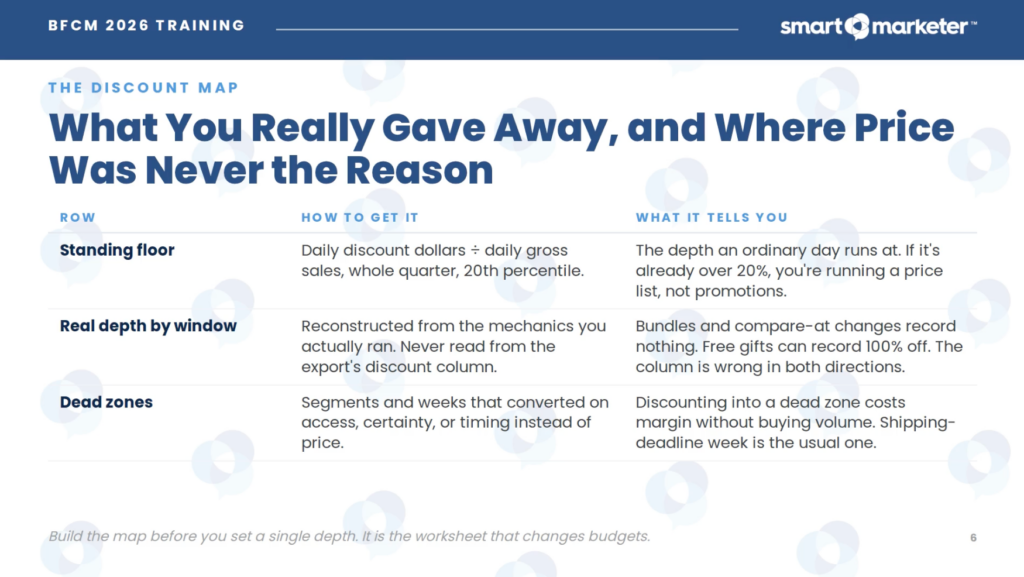
Many brands think they know how deeply they discounted during the previous Q4. Their ecommerce export may tell an incomplete story.
A fixed-price bundle may hide the savings received by the customer. A free gift might appear as a 100% discount on one line item. Free shipping has a real marginal cost that may not appear in the discount column. Some apps reprice products instead of recording a discount.
Reconstruct the promotion based on what the customer actually received. Map three things:
- Standing floor: The regular incentive customers already expect.
- Real incentive by window: The value received through codes, bundles, gifts, shipping, repricing, and thresholds.
- Discount dead zones: Windows when price was not the main barrier to purchase.
A gift buyer may care most about arrival certainty. A professional buyer may care most about whether the product fits a specific context. A new customer may need reviews, education, sizing, ingredients, comparisons, or risk reduction.
Extra discounting in those moments can cost margin without creating enough incremental demand. Strengthen the reason to buy before deepening the discount. One useful option is a gift-with-purchase threshold. Imagine offering another 5% off orders over $200. The customer saves $10, and the business gives up another $10 in margin.
Now consider a gift at the same threshold. If the gift costs the business $5 to $10, carries more than $50 in perceived retail value, and has enough inventory, the customer can experience the offer as receiving $250 in value for $200.
One strategy reduces the price. The other expands perceived value.
Choose the gift carefully. Look for an item with:
- Low unit cost
- Healthy margin
- Strong perceived value
- Enough inventory
- A small share of previous Q4 revenue
- A logical relationship to the rest of the cart
Avoid giving away a hero product customers were likely to purchase anyway. Set the first threshold above current average order value. If AOV is $70, a free gift at $65 will not encourage a larger cart. A $75 threshold gives the customer a reason to add something.
Where possible, let the gift replace part of the discount. Stacking it on top of the deepest price reduction can erase the margin advantage.
What These Decisions Change
Once these three decisions are clear, the rest of the plan becomes easier.
You can decide when the budget should peak because you understand the demand curve. You can scale paid acquisition with a real stopping point because the acquisition ceiling is documented. You can build an offer around the customer’s actual buying barrier instead of automatically adding a larger discount.
The same logic should guide traffic routing. Warm customers may want a fast holiday shopping page. Cold prospects may still need the product story, reviews, comparisons, and proof available on proven product or collection pages.
It should also guide late-December planning. Gift-led brands may peak around Black Friday. Self-purchase categories can rebound after December 25. Occasion-led brands may stay strong while availability and delivery certainty matter.
The customer should tell you where to spend the budget.
Make the Decisions Before the Calendar
A useful Q4 planning meeting should end with three concrete outputs:
- A demand-shape chart
- A written new-customer acquisition ceiling
- A real incentive map with one clearly defined threshold offer
Support them with your brand’s data and assign an owner to each next action.
The calendar should express those decisions. It should not replace them.
You can build this system manually. If you want help analyzing the data and coordinating approved execution across paid media, email, SMS, merchandising, reporting, and Shopify, Smart Marketer’s GrowthOS is built to support that work with brand-specific context and human approval.
The goal is simple: understand your customer, protect the economics, and follow the buyer instead of a generic retail schedule.


