
If you’ve been running Meta ads for a while, you can feel it.
Not in a “new feature just dropped” way, but in a deeper, structural way. The platform doesn’t behave like it did even a year ago. Strategies that felt dependable in 2024 now feel inconsistent. Things that once scaled cleanly suddenly stall. And for many brands, performance hasn’t collapsed, it’s just become harder to control.
That’s not accidental.
Over the last year, Meta has quietly rolled out the most meaningful shift in how ads are bought, served, and optimized that we’ve seen in more than a decade. The mistake most brands are making heading into 2026 is treating these changes like surface-level tweaks instead of what they really are:
A new operating system.
Want to learn how to win with ads in 2026? Join our free class at the link below: https://smartmarketer.com/meta-ads-mini-class/
Creative Isn’t Just “Important” Anymore, It’s a Literal Cost Advantage
One of the most important insights we’ve heard directly from Meta is something they internally refer to as the creative cost multiplier.
In plain terms, Meta is now willing to subsidize distribution costs for brands with strong creative. Better creative can literally cost less to show. In some cases, dramatically less.
The inverse is also true. Generic, repetitive, or poorly thought-out creative is penalized. Brands running low-quality ads may be paying significantly more for the exact same traffic without realizing it.
This is the real shift.
Creative is no longer just a conversion lever. It’s a pricing lever.
And that’s because creative is now how Meta understands who your ads are for.
Why “Creative Is the New Targeting” Is Actually Literal
A decade ago, scaling on Meta meant finding clever targeting combinations. Interests, exclusions, layered lookalikes, that was the game.
Today, Meta learns far more from your creative than it ever did from your targeting settings.
The platform indexes your copy, visuals, pacing, tone, video structure, even subtle signals like delivery style and who appears on camera. Those signals tell Meta who should see your ads, and just as importantly, who shouldn’t.
Instead of telling Meta who your customer is, you now show it.
Beyond direct signals, Meta ingests contextual vectors to speed up pattern recognition:
| Feature Class | What’s inside |
| Creative pixels | Computer-vision embeddings: colors, faces, objects, movement, layout |
| Text embeddings | NLP representations of your headline, primary text, and on-screen copy |
| Audio / Speech | Tone, words, pacing, sound effects (in video assets) |
| Placement context | Feed vs. Reels vs. Stories ? affects baseline CTR and dwell expectations |
| User graph overlap | Who interacted + who they’re connected to + shared traits of converters |
Meta doesn’t need you to tell it an ad is “emotional” or “educational,” it sees that via its vision-language models.
OR
Meta’s Vision–Language Models (VLMs)
Meta’s ad delivery system is no longer “rules + interests”; it’s embedding-based machine learning.
They use large-scale vision–language models trained on trillions of examples (images, video frames, captions, user behavior) to understand creative content the way GPT understands text.
| Layer | What it does | Practical example |
| Vision encoder | Turns raw pixels into a dense vector (hundreds–thousands of dimensions) describing colors, objects, motion, layout, emotional tone, etc. | It “sees” your ad has a calm color palette, a mother holding a child, and a product near the face ? tags this internally as nurturing / family / personal safety. |
| Language encoder | Converts your copy, captions, on-screen text, and speech transcript into embeddings capturing meaning and tone. | “Feel confident knowing your phone is safe” sits close in vector space to other Reassurance ads. |
| Joint embedding space | Aligns visuals + text + audio so that similar semantics cluster together. | A video of someone testing EMF exposure and a static image saying “Radiation-blocking case” live in the same cluster. |
We’ve seen this play out clearly across multiple accounts.
One performance brand initially built its entire Meta strategy around CrossFit-style athletes. Every ad featured elite physiques, high-intensity workouts, and performance-first messaging. Growth was solid…. until it wasn’t.
When the brand expanded its creative to include wellness-focused messaging: ads about sleep quality, recovery, and everyday health, something unexpected happened. Meta began delivering ads to a completely new audience. Not athletes. Regular people. Desk workers. Parents. People who simply wanted to feel better.
Same product. Same account. Entirely new growth unlocked purely through creative.
Andromeda Revealed Meta’s New System
Most advertisers point to Andromeda as the update that changed everything. In reality, it was just the most visible moment in a much larger transition.
Throughout 2025, Meta consolidated objectives, pushed more decision-making into AI, reduced the importance of manual controls, and restructured how campaigns learn. The goal wasn’t to simplify things for advertisers, it was to shift responsibility upstream.
Meta now expects brands to do the thinking before ads ever enter the platform.
That’s why simpler campaign structures are working in many accounts, but only when they’re paired with strong creative strategy. Without that foundation, consolidation doesn’t fix performance. It just amplifies what isn’t working.
See how we are leveraging this to improve our ad accounts across the board. Join our free class at the link below: https://smartmarketer.com/meta-ads-mini-class/
Broad Targeting Still Requires Precision, Just Not Where You Think
One of the biggest misconceptions right now is that broad targeting means avatars don’t matter anymore.
The opposite is true.
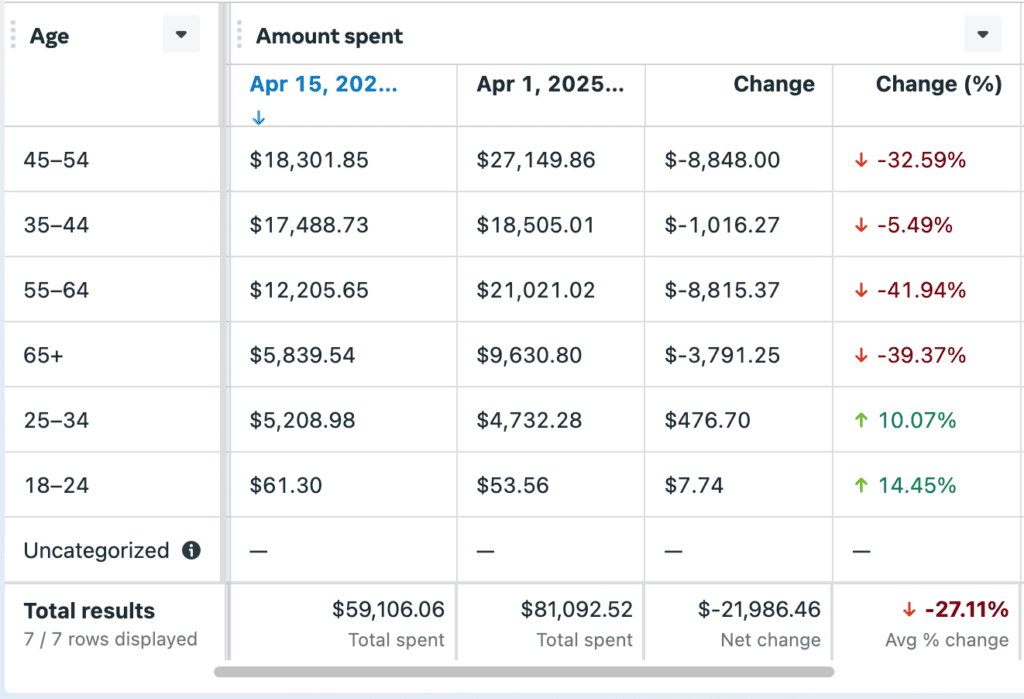
Meta can’t unlock new audiences unless your creative gives it permission to. Different avatars require different framing, language, and context. If you sell to multiple types of buyers and treat them all the same creatively, Meta will default to the path of least resistance, often retargeting the same people over and over.
We’ve seen this clearly with apparel brands.
One brand spent years speaking almost exclusively to gym-focused buyers with performance-driven messaging. Growth plateaued. When they introduced creative aimed at moms, positioning the product as something you could wear while running errands or moving through a busy day, distribution changed almost immediately.
Even more interesting: when the brand updated the models on their website to reflect a younger demographic, Meta’s delivery shifted again. No targeting changes. Just different signals.
Creative didn’t just change conversion rates.
It changed who Meta thought the brand was for.
Growth Unlocks When You Speak to Specific Pain, Not Broad Identity
Another pattern we’ve seen repeatedly is growth unlocking when brands stop speaking generically and start addressing specific internal pain points.
An educational brand in the parenting space struggled to scale despite strong fundamentals. What changed wasn’t the offer, it was the creative.
Instead of speaking to “parents” broadly, new ads were built around two very specific sub-avatars: parents of children who are harshly self-critical, and parents of children who quietly shut down when challenged.
Same product. Same account. Completely different response.
Meta didn’t need a new audience setting. It needed clearer signals.
There Is No One “Right” Meta Strategy Anymore
One of the most important mindset shifts heading into 2026 is letting go of the idea that there’s a single correct way to run Meta ads.
Some accounts still scale aggressively using more traditional approaches when momentum is strong, and winners are clear. Others require consolidation and creative resets to recover performance. The same account may need both approaches at different points in time.
What matters isn’t loyalty to a framework, it’s responsiveness to what the account is actually telling you.
The brands that struggle most are the ones clinging to a strategy because it used to work, not because it’s working now.
Testing Slower Is Often the Fastest Way Forward
One of the quiet killers of performance right now is over-intervention.
Meta’s systems need time to learn. Consolidated campaigns, in particular, don’t respond well to daily tinkering. Accounts stabilize faster when brands adopt a consistent weekly rhythm for launching and evaluating creative instead of reacting emotionally to short-term swings.
This isn’t about being passive.
It’s about respecting how the platform actually learns.
What This Means for the Next Phase of Growth
Meta is no longer a platform you “outsmart” with tactics.
It’s a platform you collaborate with through clarity.
That clarity comes from strong creative concepts, not endless variations. From clear avatars expressed through messaging, not checkboxes. From patience with systems designed to learn over time, and the willingness to change approaches when momentum shifts.
The brands that win in 2026 won’t be the ones chasing every update or copying every framework.
They’ll be the ones who understand that creative now defines targeting, cost efficiency, and account stability, and who build systems flexible enough to evolve as the platform does.
If your ads feel harder than they used to, that’s not a sign you’re failing.
It’s a sign the game has changed.
And there’s still plenty of opportunity for brands willing to change with it.
Want to learn how to win with ads in 2026? Join our free class at the link below: https://smartmarketer.com/meta-ads-mini-class/


