


Most new brand stories start with a product idea.
This one started with four decisions.
In October 2025, the four owners of Smart Marketer were meeting in New York for annual planning. The agency was growing. The education side of the business was growing. The team had capacity.
For the first time, the next move did not need to be making Smart Marketer bigger.
Instead, they asked a different question: What kind of business would we be excited to build next?
They did not write a 35-point specification. They chose four filters that mattered, wrote them down and left room for the right opportunity to show up.
A few hours later, Molly received a Slack message that matched all four.
That message became Longer Together Pet Company.
The brand launched at the end of June 2026 with one hero product, a daily dental powder for dogs and cats. In the first 90 days, the team reported $130,000 in total sales across Shopify and Amazon, more than 1,600 Shopify orders, 250 subscribers, and a profitable business.
The numbers are useful. The setup behind them is even more useful.
The idea came second
Before the team knew the market, product or partners, they decided the business needed to be:
- Fun. The work had to give the team energy. Smart Marketer’s core value, “fun is the goal, love is the way,” needed to show up in the new company too.
- Meaningful. The brand needed a real connection to a cause the owners already cared about. Pets and children stood out because of the team’s work with Fields of Freedom Dog Rescue and Love Runneth Over.
- Ecommerce. They wanted a physical product and a business model that the team understood well enough to document honestly from day one.
- Sellable. Smart Marketer is closely tied to its people and personalities. The new brand needed the ability to stand on its own as an asset.
Those filters were specific enough to guide a decision without being so detailed that every real opportunity failed the test.
That is an important distinction.
Many founders wait for the perfect idea. A more practical approach is to define the conditions that would make an idea worth pursuing. You are not trying to predict the exact business. You are building a filter for recognizing a good fit when it appears.
The opportunity arrived in Slack
During a break in the planning meeting, Molly received a message from a Mentor Table and Smart Marketer Agency client with Living Well with Dr. Michelle.
Tyler and his sister, Michelle, are dentists. They had already built a brand around a dental powder for humans. The product and business were working, and they saw a possible application in the pet market.
He knew Molly ran a dog rescue and cared deeply about animal health. He asked whether the Smart Marketer owners would be interested in discussing a partnership.
The timing was almost absurd.
The proposed business looked fun. It tied directly to the dog rescue work. It was ecommerce. It could become sellable. The partners were also people the Smart Marketer team already knew and trusted.
The owners got on a Zoom call that day. Six people began discussing the brand, the product, and what each side could contribute.
Longer Together moved from an idea to an active project before the planning meeting was over.
The product was simple on purpose
The first product is a dental powder sprinkled over a dog or cat’s food.
Molly describes the formula as intentionally simple: one proprietary oral-health ingredient and beef liver powder to make the product appealing to pets.
The team did not only ask whether owners would buy it. They asked whether pets would enjoy it enough for owners to keep using it.
That matters because a consumable product depends on routine. The health promise cannot help if the jar sits untouched in a cabinet.
Beef liver gave the team an early signal. When a sample arrived at Molly’s farm, her dogs could smell it through the cardboard box and packaging. Even Larry, her older chihuahua, wanted to investigate.
That moment answered a practical product question. The pets were interested before the powder reached the bowl.
The product also fit a subscription model. A daily scoop creates a natural replenishment cycle, which can make customer value more predictable over time. That does not remove the need to measure churn. It does give the business a reason to study retention from the beginning instead of treating it as a later project.
Build the bigger pie
Smart Marketer could have tried to build the whole company alone. The other partners could have done the same.
The partnership moved faster because neither side had to rebuild infrastructure that the other side already had.
Smart Marketer brought:
- Brand and growth strategy
- Direct response marketing
- Paid acquisition
- Creative and technical ecommerce experience
Tyler and Dr. Michelle brought:
- Product and formulation experience
- Manufacturing
- Fulfillment and shipping
- Customer service operations
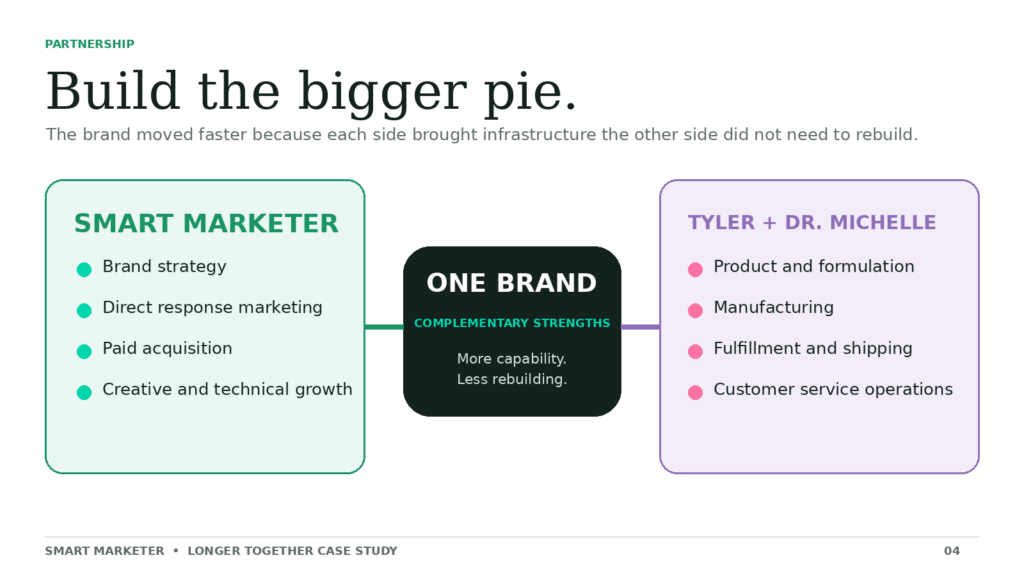
The partnership worked because each side brought infrastructure the other side did not need to rebuild.
Ezra often says he would rather own a smaller piece of a bigger pie than a bigger piece of a smaller pie.
That is easy to agree with in theory. It gets harder when equity, control, and profit enter the conversation.
The useful question is not, “Could we do this ourselves?” Most capable teams can eventually figure out almost anything.
Ask, “Who already carries a part of this work better than we do, and what becomes possible if we join forces?”
The right partner can add expertise. They can also carry part of the operational and emotional load that founders often underestimate.
The first 90 days
Longer Together launched at the end of June 2026. Molly shared the following results from the first 90 days:
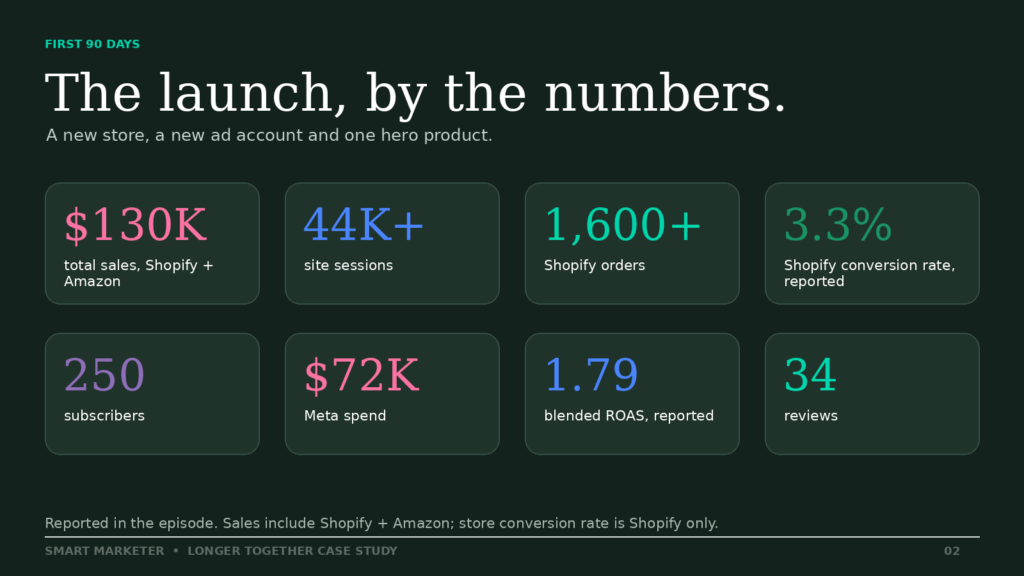
Longer Together’s first 90 days, using figures reported in the podcast episode.
Molly also reported that the business was profitable, which the team did not assume would happen this early. The hero product retailed for $35. She stated that fully producing and shipping one jar cost $6.70, which gave the team enough margin to invest in customer acquisition.
Paid acquisition did most of the work. Email represented roughly 9% to 10% of revenue. That mattered because the team wanted proof that cold traffic could acquire customers without depending on the Smart Marketer or Dr. Michelle audiences.
Meta became the main acquisition engine. Amazon was added later to capture people who discovered the product through Meta and preferred to complete the purchase through Prime.
These figures use different channel and attribution scopes. Total sales include Shopify and Amazon, while the reported store conversion rate refers to Shopify.
The marketing worked because the brand had something to say
Product economics and funnel performance matter. The brand also needed a message that could stop the right person and make them care.
Longer Together had two founder stories.
The first came from Molly and Larry.
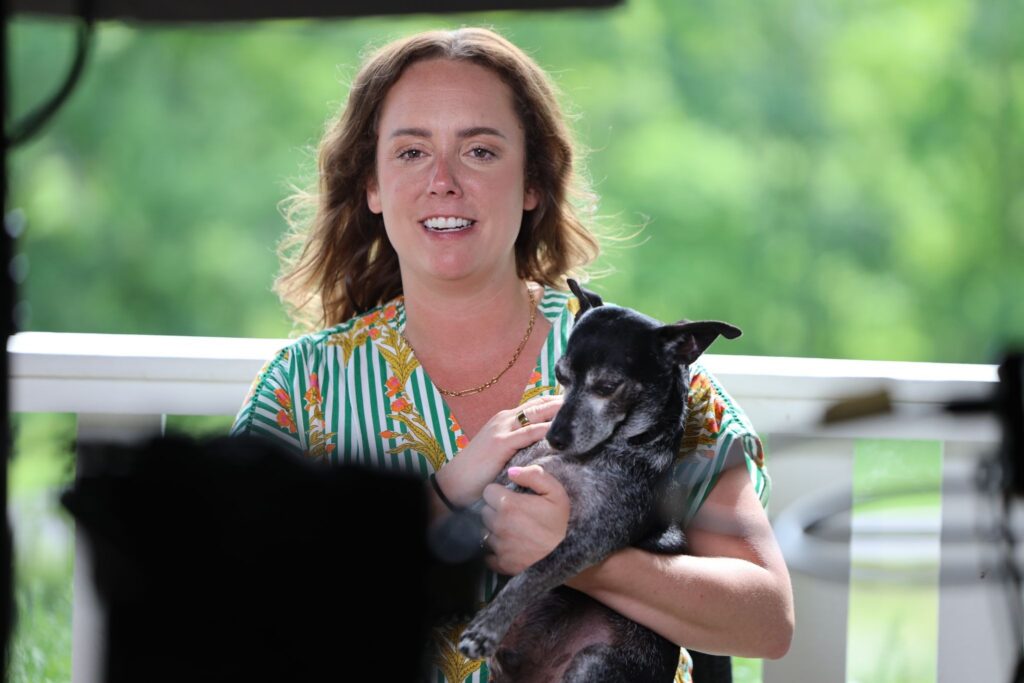
Larry had received annual dental cleanings throughout his life. During one appointment, he had trouble waking up from anesthesia and regulating his body temperature. Molly received a call from the vet and, for a moment, thought she might lose him.
Larry recovered. The experience changed how she thought about the problem the product was built to solve.
The second story came from Dr. Michelle.
Her hook was simple: “I’m a dentist, and I don’t brush my dog’s teeth.”
It works because the authority figure admits the same behavior as the audience. The message does not scold pet owners. It tells them they are not alone, then introduces another way to approach the problem.
That difference matters.
A message that makes someone feel careless or wrong gives them a reason to leave. A credible authority who says, “Even I struggle with this,” creates relief and curiosity.
The lesson is bigger than pet dental care. Look for a true contradiction inside your category. The strongest version often comes from an authority who can welcome the audience into the conversation instead of talking down to them.
Story, logic, heart, and feeling
Molly highlighted a four-part brand framework that explains why Longer Together has more to work with than a product and an ad account.
Story
Why does the brand or product exist?
Longer Together has Molly and Larry’s emotional experience, plus Dr. Michelle’s authority story. Both are true. Each gives the customer a different way into the brand.
Your story does not need to be dramatic. It needs to be honest and relevant to the problem you solve.
Logic
Emotion can earn attention. Logic helps people feel safe making the purchase.
For Longer Together, logic includes dental authority, the product mechanism, the daily routine, and the behavior gap around brushing pets’ teeth. The authority is also unexpected. A dentist in the pet category stands out because customers are more accustomed to seeing veterinarians.
Heart
People can feel whether a business genuinely cares about the market it serves.
Longer Together connects to Fields of Freedom Dog Rescue and the team’s existing commitment to animal welfare. The cause was not added after launch as a marketing decoration. It was part of the selection criteria before the product appeared.
Feeling
What does the brand make someone feel?
The name Longer Together reaches into a feeling every pet owner understands: the wish for more healthy time with an animal they love.
The name, founder stories and product promise point in the same emotional direction.
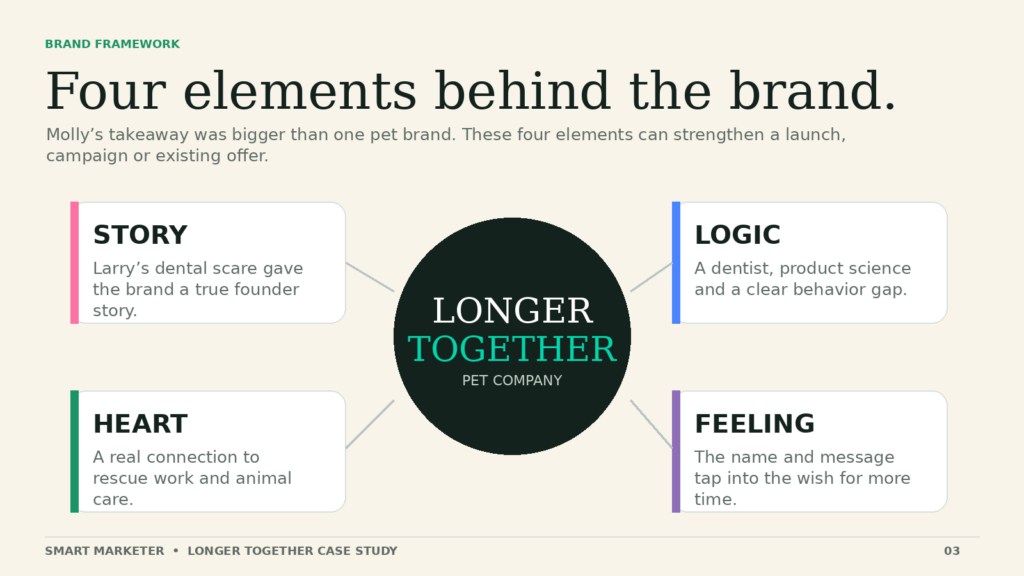
The four-part brand framework: story, logic, heart and feeling.
A brand does not need equal amounts of all four in every ad or page. Across the customer experience, people should be able to understand the story, believe the logic, feel the heart and remember the emotion.
What the team is not doing yet
One of the most useful parts of the first 90-day story is the decision to wait.
The team continues to test creative, copy, pages, and offers. At the same time, Longer Together is a subscription business. The owners need enough time to understand how long customers stay, what churn looks like, and how repeat revenue changes acceptable acquisition costs.
Molly explained that the team expected to have a better read after roughly six months of customer history.
That data could change the acceptable front-end ROAS. If retention is strong, the company may choose to acquire customers at a lower first-purchase return because the business can earn the investment back through subscriptions and future products.
Until then, forcing scale would create confidence that the numbers have not earned yet.
The team is using the waiting period to build products that strengthen the same customer relationship. Molly described a water tablet, a dental treat, and a toy with recurring powder refills. Each product is intended to do at least one of three jobs:
- Increase average order value
- Add subscription revenue
- Reach customers whose pets do not want the original food topper
That is more strategic than releasing random variations. The next product should deepen the customer relationship or open a meaningful new entry point into the brand.
Five questions to take back to your business
You do not need to launch a new company to use this story.
Start with these questions:
- What are the three or four filters an opportunity must pass before your team gives it time and capital?
- Which part of the business are you rebuilding even though the right partner already knows how to carry it?
- Does your product fit naturally into a routine, replenishment cycle, or broader product system?
- Can customers find a true story, clear logic, genuine heart, and a memorable feeling in your brand?
- Are you scaling from real retention data, or from assumptions about what customers will do next?
The biggest lesson from Longer Together is not that every founder should launch a pet brand.
It is that the idea gets stronger when the criteria, people, product, economics, and message fit together.
Longer Together is still early. That is what makes the story useful. We will continue sharing what works, what does not, and what the team changes as the data comes in.
Listen to Molly’s full Smart Marketer Podcast episode for the complete origin story. For the paid acquisition tactics behind the first 60 days, listen to episode 291 with Pep Hufen.


