


Customers do not remember every part of an experience equally.
They notice the most emotionally significant moment. They remember how the experience ended. They also make fast judgments about quality based on the effort they believe went into the work.
In this episode of the Smart Marketer Podcast, Molly Pittman talks with Phill Agnew, host of the Nudge podcast, about the behavioral science behind memorable marketing and stronger customer relationships.
Phill spent years in product marketing before taking Nudge full time. His work focuses on translating behavioral research into practical ideas marketers can test. Throughout the conversation, Molly kept bringing those ideas back to ecommerce: ads, emails, product delivery, customer experience, social proof, and the everyday decisions that shape perceived value.
Design the moment customers remember
One of the central ideas in the episode is the peak-end rule, associated with psychologist Daniel Kahneman’s work on how people remember experiences.
Phill describes an experiment in which one group kept a hand in painfully cold water for 60 seconds. Another group stayed in for 90 seconds, but the final 30 seconds were slightly less uncomfortable. Even though the second experience lasted longer, participants remembered it more favorably because it ended better.
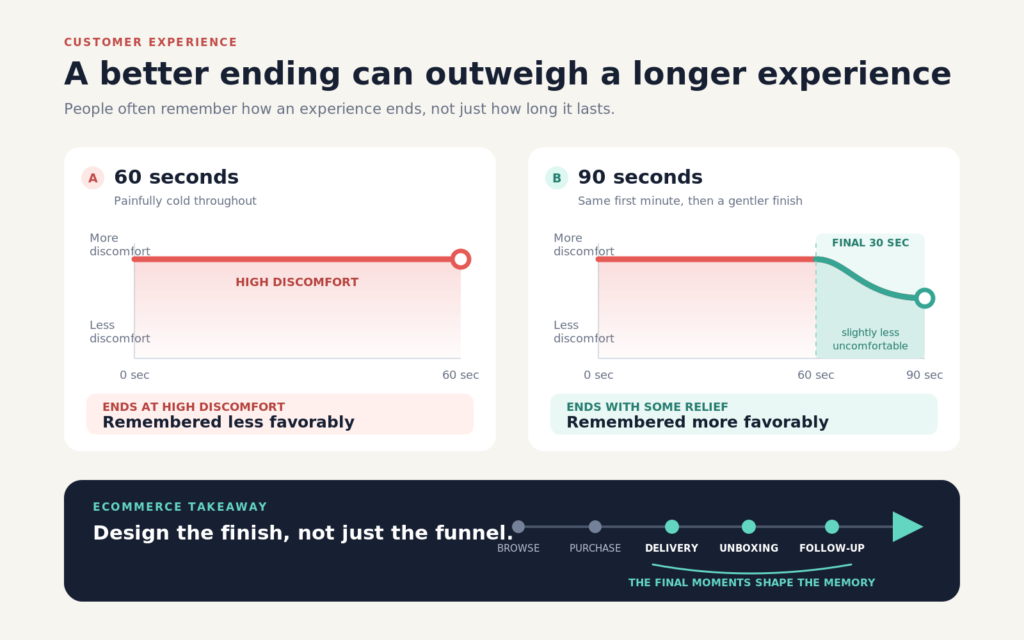
For ecommerce brands, the practical lesson is simple: pay attention to the final moments of the customer journey.
The delivery, unboxing, first use, support resolution, cancellation, or final message in a campaign can have an outsized effect on how the entire experience is remembered.
A better ending does not have to be expensive. It can be a thoughtful thank-you note, a clear first-use guide, a small surprise, proactive support, or a personal follow-up that proves someone paid attention.
Phill Agnew
Visible effort can increase perceived value
Phill also explained the input bias. When people believe more time, care, or effort went into something, they often rate it more highly.
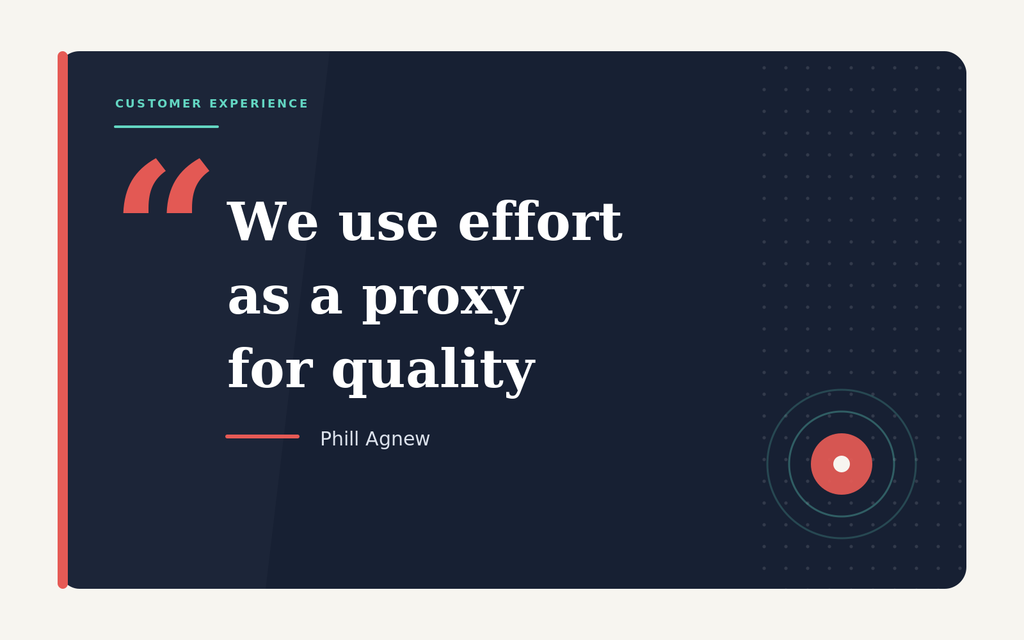
That effect shows up in handmade products, premium service, detailed preparation, personal outreach, and marketing that feels genuinely considered.
The challenge is especially relevant in an AI-enabled market. Brands can now produce more copy, emails, images, and outreach in less time. The result can still feel generic if the customer sees no evidence of care.
Phill shared a practical example from his own podcast outreach. He receives a large volume of formulaic, AI-generated guest pitches. When he wants to invite an author onto Nudge, he reads the book and includes a photo of himself holding it. The photo takes only a moment to make, but it communicates something the standard outreach does not: real attention and real effort.
For an ecommerce team, visible effort might include:
- Showing the actual process behind formulation, sourcing, quality control, packing, or design
- Sending a personal or handwritten-style thank-you after purchase
- Including details that could only come from listening to the customer
- Building a useful buying guide instead of adding more generic claims
- Creating proof that shows customer behavior instead of simply announcing popularity
The effort should be real. Customers are quick to notice when personalization is only a template wearing a first name.
Show the proof instead of announcing it
Many brands tell visitors that thousands of customers love a product. Phill argues that proof becomes more believable when people can see the evidence for themselves.
A wall of customer videos, specific reviews, completed loyalty cards, customer photos, or a clear record of repeat purchases can communicate popularity without relying on a broad claim.
This approach also reduces reactance. People resist feeling pushed. Proof that lets the customer draw the conclusion can be more persuasive than a brand insisting on it.
For marketers, the question is: what could we show that makes the claim obvious?
Protect a small part of the budget for exceptional experiences
Phill borrows another idea from Will Guidara’s book, Unreasonable Hospitality, that we actually had our team read last summer: manage 95 percent of the budget carefully, then preserve 5 percent for creative, generous, or unusual decisions.
The same idea can apply to time and attention.
Most of the week may need to be focused on operating the business. A small protected block can be used to read, think, visit a museum, explore a different industry, or test an idea that does not fit neatly into the normal workflow.
That space creates room for the experiments competitors may never try.
Take more small, survivable bets
Phill also let us in on his “50 small bets” practice.
Every six months, he writes down 50 experiments he could try. Most will not become meaningful. A small number may create an opportunity that is far larger than the time or money invested.
That logic fits businesses operating in a power-law environment. One article, partnership, product, ad, podcast episode, or offer can produce a result far beyond the average. The goal is to run more thoughtful experiments without making each one dangerous to the business.
For an ecommerce team, a small bet might be a new unboxing insert, a different proof module on the product page, a founder-led outreach message, a new basket builder, or a creative format the category is not using yet.
Keep the bet small. Make the learning clear. Leave room for the upside.


