

An ADA website compliance lawsuit can show up in your mailbox before you have ever heard the term, and that is exactly what happened to Carl and Brooke, the masterminds behind the jewelry brand Antler Rings. They shared the full story on the Smart Marketer Podcast, and it is a reminder that web accessibility is not a niche legal footnote. It is a real and growing risk for every ecommerce store, regardless of size, platform, or how buttoned up you think your site already is.
Key Takeaways
- Web accessibility lawsuits against ecommerce brands have surged, with more than 3,000 filed in federal court last year and ecommerce sites accounting for roughly 77% of the targets.
- The most common triggers are missing or duplicate image alt text, pop-ups that are hard to close, and third-party apps that fall outside WCAG 2.2 AA standards.
- Store owners are held responsible for the accessibility of every app and integration running on their site, not just their own code and design.
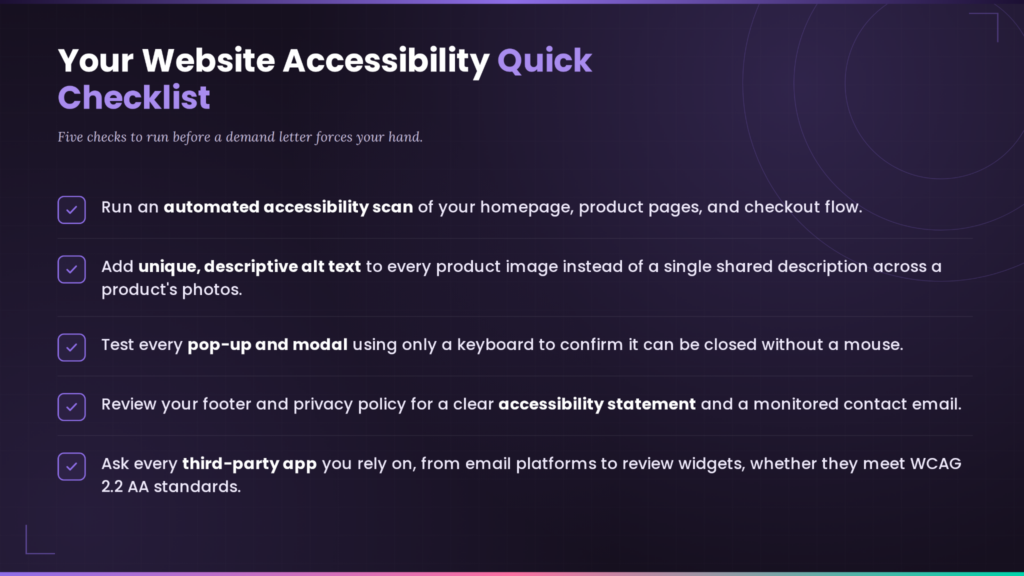
- A basic compliance scan, an accessibility statement in your footer, and a monitored support email can meaningfully lower your risk before a demand letter ever arrives.
What is an ADA website compliance lawsuit, and why are ecommerce brands getting hit?
An ADA website compliance lawsuit claims that a website is not accessible to visitors with disabilities, most often people who rely on screen-reading software to shop online. These claims target the technical structure of a site rather than its products, and ecommerce brands are disproportionately targeted because they run large, image-heavy sites built on dozens of third-party integrations.
For Carl and Brooke, the wake-up call arrived as a letter that required a signature, followed weeks later by a formal lawsuit delivered in-person to Carl’s home. The claim centered on their Shopify store and argued that a visitor using screen-reading software could not fully browse or shop the site. Neither of them had heard of this type of lawsuit before, despite staying closely tuned in to Shopify’s product updates. That is part of what makes this issue so dangerous. It rarely shows up on a marketer’s radar until it lands in the mail.
What are the most common accessibility issues that trigger a lawsuit?
Lawsuits typically point to a short list of recurring issues: images without unique alt text descriptions, pop-ups that are difficult to close with assistive technology, and third-party apps that were never built with accessibility in mind. Any single one of these can be enough to trigger a claim, and most sites have all three.
In Antler Rings’ case, the claim centered on more than 8,000 product images that used the same repeated description instead of a unique one for each photo. The lawsuit also flagged their email pop-up, which was difficult to close using assistive technology, and pointed to third-party apps running on the site that the brand does not directly control but is still held responsible for under the claim.
| Common Issue | Why It Matters | How to Address It |
| Duplicate or missing image alt text | Screen readers rely on a unique description for each image to convey product detail | Write individual alt text for every product image instead of repeating one description across a product page |
| Pop-ups with unclear close buttons | Small or ambiguous close icons are hard to locate and activate with assistive technology | Enlarge the close action and add readable text such as “No thanks” instead of relying on a small icon alone |
| Non-compliant third-party apps | Store owners are held responsible for third-party tools running on their site, even tools built by someone else | Audit key apps such as email pop-ups, reviews, and chat widgets for WCAG 2.2 AA compliance and confirm with each vendor |
| Inaccessible scrolling or navigation | Keyboard and screen-reader users need a predictable way to move through a page | Test navigation using only a keyboard and confirm every element is reachable in a logical order |
How do you audit your Shopify store for WCAG 2.2 AA compliance?
Start with an automated accessibility scanning tool to flag missing alt text, color contrast issues, and structural problems, then manually test your pop-ups and navigation using only a keyboard. WCAG 2.2 AA is the accessibility standard most of these lawsuits reference, so treat it as your benchmark rather than guessing at what counts as compliant.
What should you do if you receive an ADA demand letter?
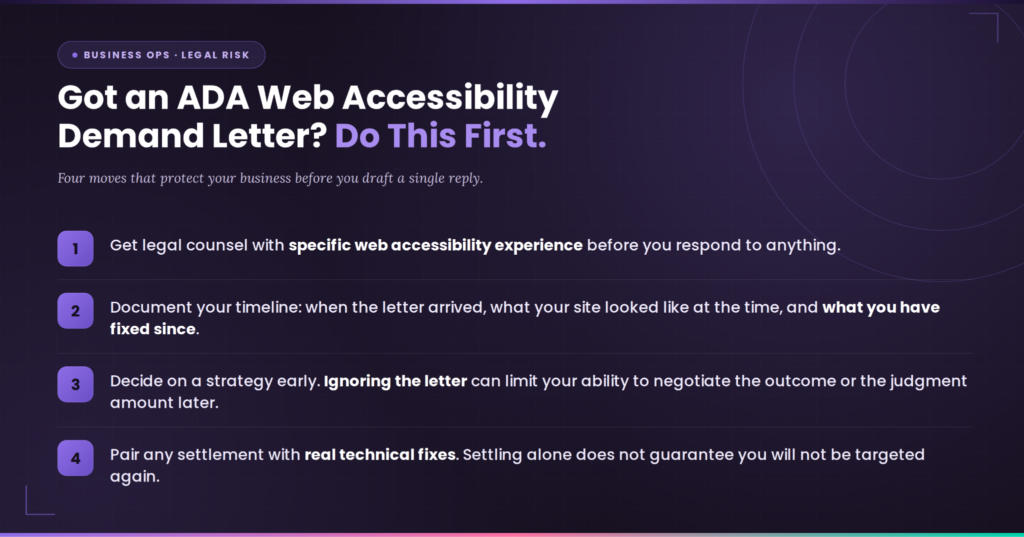
Do not ignore it, and do not assume it is illegitimate just because it feels unfamiliar. Bring in an attorney with specific web accessibility experience, document every fix you make from that point forward, and decide early whether your strategy is to negotiate a resolution or contest the claim, since more than 40% of companies that settle one claim report being targeted again.
Will web accessibility lawsuits slow down anytime soon?
Not in the near term. The underlying accessibility law dates back to 1990, long before ecommerce existed, and courts are still working out how it applies to modern websites. A handful of judges have pushed back on cases that look more like a business model for some law firms than a genuine accessibility complaint, and a few states have started introducing clearer rules, but legislation has not caught up yet.
In the meantime, tools that make it easier to scan large numbers of sites at scale mean this kind of outreach can happen faster and more broadly than it used to. Waiting for the law to catch up is not a strategy. Getting your site closer to WCAG 2.2 AA now, documenting what you fix, and setting up a clear way for visitors to flag accessibility issues are the moves that actually reduce your risk.
The bigger takeaway for ecommerce brands
Carl and Brooke did not do anything reckless. They run a thoughtful, well-resourced business, and they still ended up on the receiving end of a lawsuit over an issue most store owners have never been taught to look for. That is the real lesson here. Accessibility deserves the same attention as your product pages, your email flows, and your checkout experience, not because a lawsuit might show up, but because a more accessible store is a better store for every customer trying to shop it.
Carl and Brooke shared their full story, including how they are working with counsel and what they are still learning day to day, on the Smart Marketer Podcast. Hear their full story here: https://smartmarketer.com/category/podcasts/
If your brand has faced something similar, we would love to hear about it. Tell us more at support@smartmarketer.com


