


A shopper clicks an ad because they want a specific product. They know the color, the material, the size, and the problem they need it to solve.
Then the store makes them work.
They land on the homepage, open a collection, scan a product grid, adjust the filters, open a product page, and search for an answer that may be buried halfway down the page. Every extra step creates another chance to leave.
That shopping experience is starting to feel old.
Consumers are getting used to asking complete questions and receiving useful answers immediately. They do it in search engines, marketplaces, and AI tools. Increasingly, they will expect the same experience from individual ecommerce stores.
During a recent Smart Marketer Mentor Table session, the co-founders of Atomz AI, Ankit Minocha & Ashish Khurana, described this new layer as the “invisible salesperson.” The name fits. A strong product-discovery assistant should understand what the shopper wants, answer the question in front of them, and guide them to the right next step without forcing them to learn the store’s navigation.
The opportunity goes well beyond adding another chat bubble. It changes how brands should think about product data, on-site search, product pages, customer support, and conversion.

Shoppers Know the Outcome They Want
Most ecommerce stores are organized around the merchant’s catalog. Shoppers have to understand that structure before they can find the right product.
Real people rarely think that way.
A shopper may want:
- White leather sandals that work with orthotics
- Matcha with less caffeine for the afternoon
- A supplement that can be taken alongside an existing treatment
- A jacket warm enough for Denver that is still easy to pack
Those are complete situations, not clean catalog keywords.
Traditional search often performs well when the shopper already knows the exact product name. It struggles when the shopper describes an outcome, a constraint, or an objection. Conversational product discovery can translate that natural-language request into product attributes and guide the shopper from there.
The first lesson is simple: your customers are trying to solve a problem, not browse your inventory.
The Four Jobs of an Invisible Salesperson
A useful on-site assistant should do four things well.
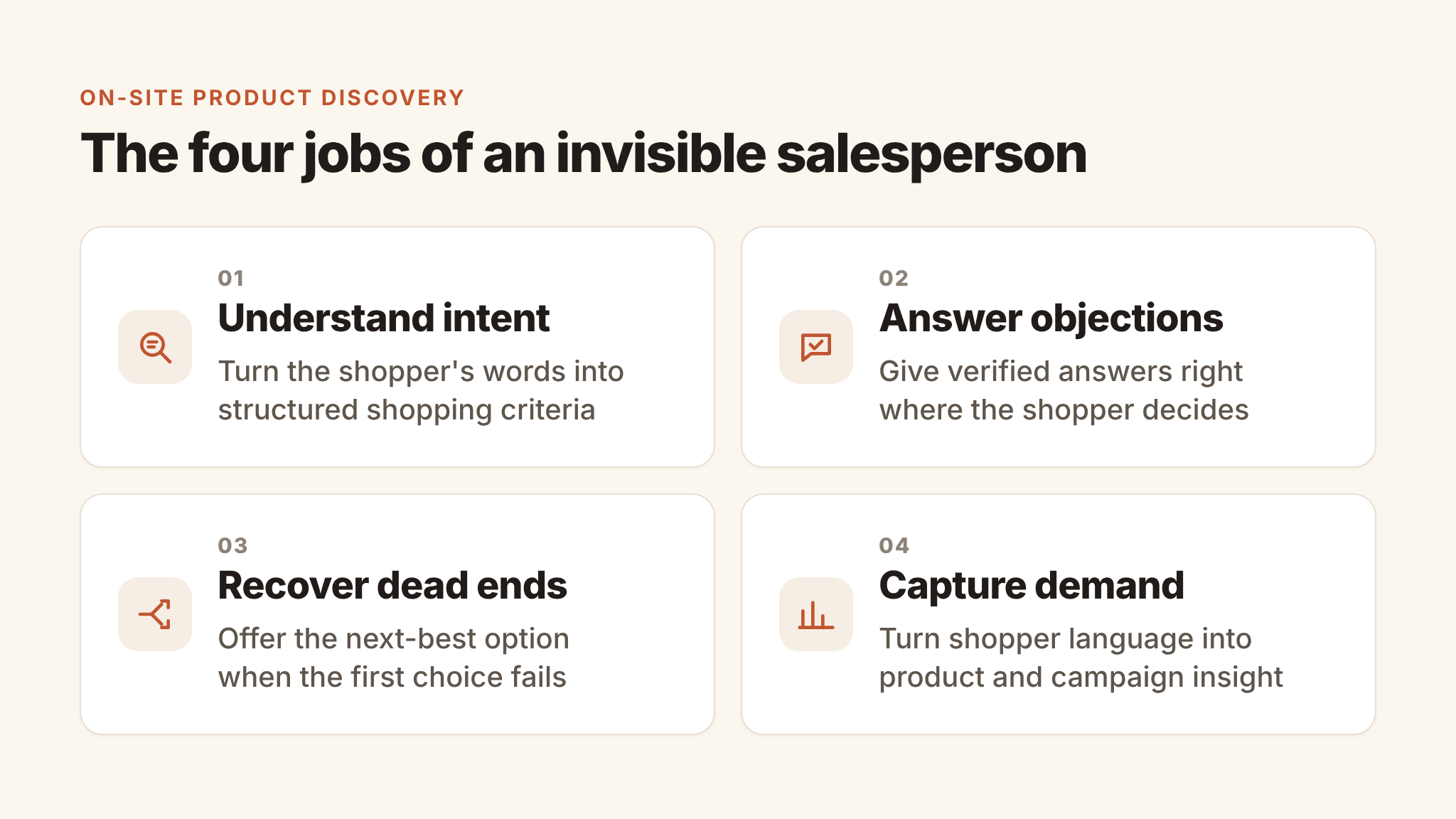
1. Understand Intent
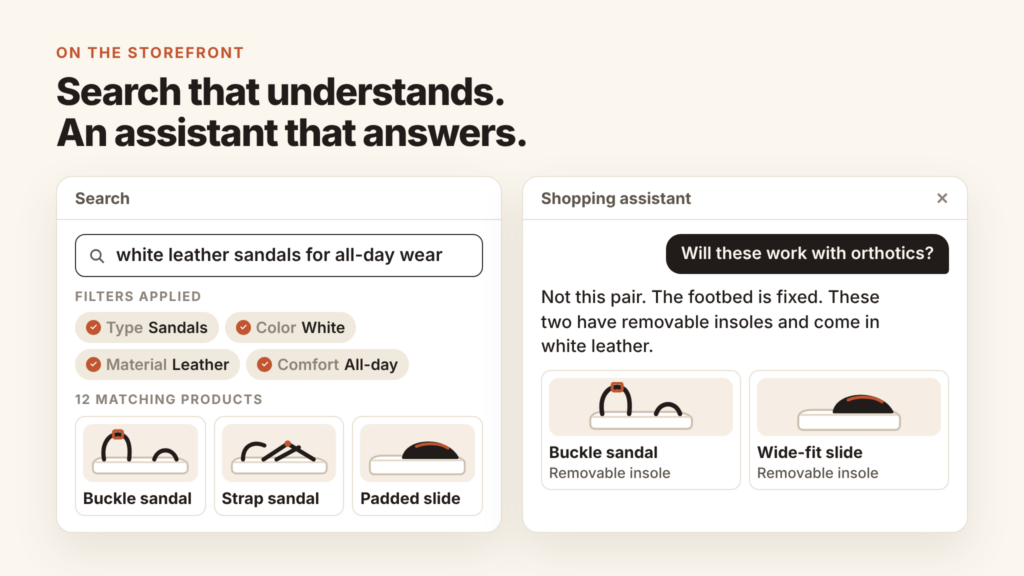
A search for “white leather sandals” includes a product type, color, and material. A stronger system can also learn from the next question: Are they comfortable for an all-day shift? Do they come in a wide fit? Can they accommodate orthotics?
The system should turn the shopper’s language into structured criteria without asking them to restart the search every time.
2. Answer Objections at the Point of Decision
A product page can contain every answer and still fail if the shopper cannot find the right one quickly.
Molly raised a useful principle during the call: communication is not what the brand published. It is what the customer actually understood.
A product-discovery assistant can surface likely questions before the shopper asks them. It can also answer a specific question using approved product information, support content, and research. For health-related products or other sensitive categories, the answer must stay grounded in verified source material and show where the information came from.
Trust depends on accuracy. If a product does not meet the shopper’s requirement, the assistant should say so and offer a better option.
3. Recover Dead Ends
Out-of-stock sizes, incompatible features, and wrong-fit products do not have to end the session.
A good salesperson responds with an alternative: “That style is not available in your size, but these three similar products are.” An on-site assistant should be able to do the same thing.
This is especially valuable for stores with large catalogs, frequently changing inventory, or several products that solve closely related problems.
4. Capture Demand in the Customer’s Own Language
Search prompts and product questions create a valuable stream of first-party research.
If shoppers repeatedly ask for “knee-high leather boots,” that phrase may belong in collection names, product copy, ads, and landing pages. If a new cultural moment drives repeated searches for a person, product, or theme, the brand may have enough evidence to build a dedicated page or campaign.
The assistant helps the shopper in the moment. The conversation data helps the brand improve everything that comes next.
What the Early Examples Suggest
The presentation included three ecommerce examples. These results were shared by the Atomz team from individual client stores:
A Footwear Store With More Than 5,000 SKUs
A New Zealand footwear retailer needed better product discovery without assigning a large team to fill every product attribute manually.
The assistant categorized products, interpreted natural-language searches, answered product questions, and suggested available alternatives. The presenters reported that shoppers who used it were roughly twice as likely to add multiple items, while average order value increased 10%. They also said about 15% of visitors used the assistant.
The bigger lesson is that a large catalog becomes more useful when the data underneath it is structured around the decisions shoppers make.
A Matcha Brand With Research-Heavy Questions
The matcha brand attracted shoppers through educational content. Those visitors often arrived with questions about caffeine, format, use cases, and health considerations.
The assistant was trained on the brand’s catalog and research library. For sensitive questions, it cited the brand’s supporting content instead of producing an unsupported answer. The presenters reported that shoppers purchasing through the assistant converted at 3.5 times the typical rate and subscribed at 3.2 times the typical rate.
The practical takeaway is clear: educational content becomes more valuable when the store can connect the answer directly to the right product.
A Wellness Brand With Repetitive Support Questions
A wellness brand saw repeated questions about safety, product interactions, symptoms, and life stages. According to the presentation, 61% of assistant conversations involved safety or interaction questions, and nearly one in five conversations could otherwise have become a support email. The team also reported 9.2% higher AOV when the assistant block was used.
This shows how product discovery and support can reinforce each other. Repeated questions reveal where the site needs clearer information, while immediate answers reduce delays for the shopper.
The Foundation Is Structured Product Data
The visible assistant gets the attention. The product data underneath it creates the value.
For a Shopify store, that foundation includes:
- Accurate product categories and subcategories
- Consistent attributes such as material, color, size, fit, ingredients, and use case
- Useful metafields
- Clear inventory and variant data
- Product-page copy that answers real buying questions
- Approved educational content and research
- Brand-voice guidance
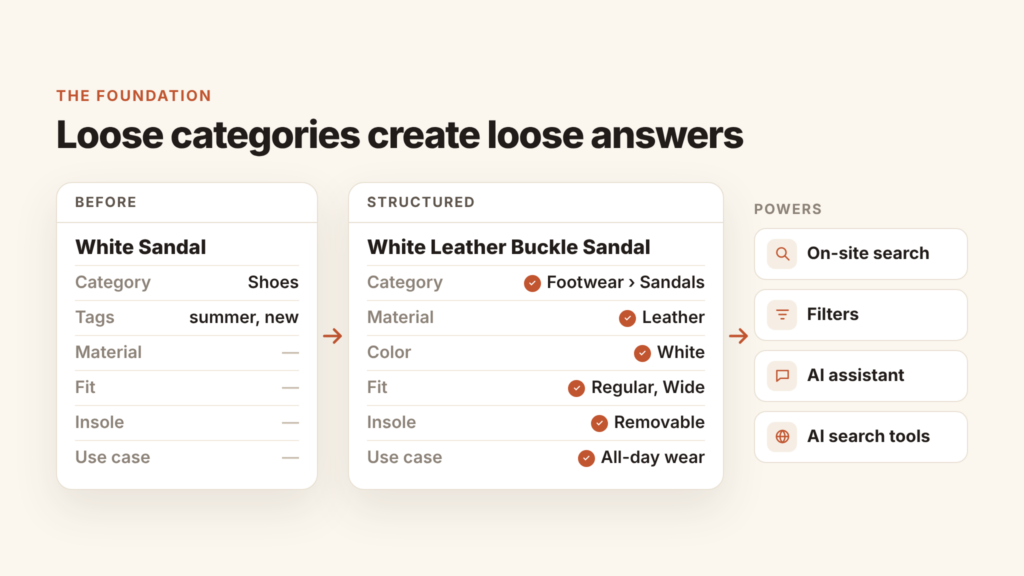
Loose categories create loose answers. Calling earrings “jewelry” may be technically correct, but the broader category may omit attributes shoppers need when buying earrings. Precise structure gives search tools, filters, AI systems, and customers more useful information. Atomz AI works on exactly this foundation. It structures a brand’s catalog data and uses it to power on-site search, filters, and an AI shopping assistant
This work also supports AI discovery beyond the storefront. Clean product data makes it easier for search engines and AI tools to understand what the brand sells and when a product is relevant.
A Practical Starting Plan for Ecommerce Teams
You do not need to rebuild the entire storefront at once. Start with the highest-friction buying journey.
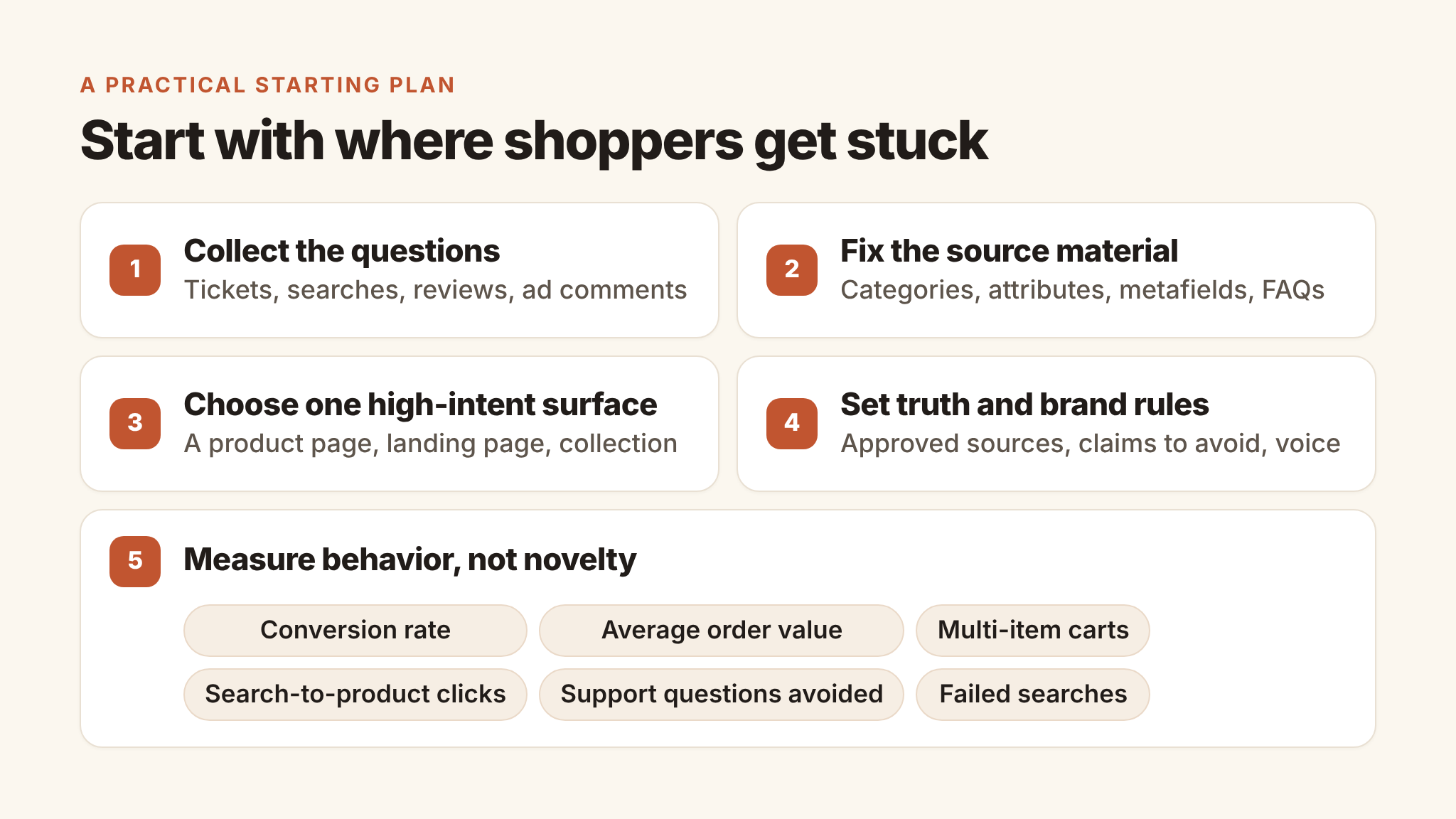
Step 1: Collect the Questions
Review support tickets, on-site searches, product reviews, ad comments, and sales calls. Identify the questions shoppers ask before buying and the reasons they leave.
Step 2: Fix the Source Material
Improve the product categories, attributes, metafields, FAQs, and educational content that should supply the answers. An assistant cannot reliably compensate for weak source data.
Step 3: Choose One High-Intent Surface
Test the experience on a high-traffic product page, a paid-traffic landing page, or a collection with a large assortment. Start where the shopper’s intent is strong, and the friction is easy to observe.
Step 4: Set Truth and Brand Rules
Define which sources the assistant may use, how it should handle uncertainty, what claims it must avoid, and how it should sound. Sensitive product categories need especially strict boundaries.
Step 5: Measure Behavior, Not Novelty
Track:
- Assistant engagement rate
- Search-to-product click rate
- Conversion rate among users and non-users
- Multi-item cart rate
- Average order value
- Subscription starts
- Support questions avoided
- Failed searches and unanswered questions
Judge the feature by whether it helps more shoppers make a confident decision.
Start With Friction, Then Add the Technology
AI product discovery will keep getting better. Voice, conversational search, and personalized recommendations will become more familiar to shoppers.
The brands that benefit most will begin with a clear operating question: Where does a qualified shopper get stuck on our site?
Answer that question first. Structure the product data. Surface the right information. Test the experience where intent is already high. Then use the conversations to improve the rest of the business.
The invisible salesperson is valuable because it makes the store easier to buy from. That is the standard that matters.
Have more questions about this? The Atomz AI team will be in Denver with us Oct 20-21 and would love to help you get started!