
Hey! Pepijn here, CEO of the Smart Marketer Agency.
Have you heard of Pretty Farm Girl? They’re an amazing family-owned, natural skincare brand with deep roots and a loyal following.
And in this post, I’m going to show you how our Agency team scaled their ad spend from $500/day to $5,000/day in under 5 months—as well as the reasons why PFG was well positioned to hit that level of growth.
I’ll break this case study down into a few categories:
- Some background on the brand and its products
- The front-end offers and pages we used to drive traffic
- And the best performing ad copy and creative variations
And we’ll look at a before-and-after of their ad account to show you how we added infrastructure to help them scale.
Here we go.
Brand & Product Foundation (and Why “Advertising is Acceleration”)
When Pretty Farm Girl came to us at the end of 2024, they weren’t starting from scratch. They’d been in business since February 2018 and had spent those six years growing organically with great social content.
(By the time we spoke, they had more than 300,000 followers on Instagram.)
For us, the question was: Could we scale them with paid ads?
We were confident we could. Their products were already selling, and tallow—their hero ingredients—was surging in popularity at the time (just look at this increase!).
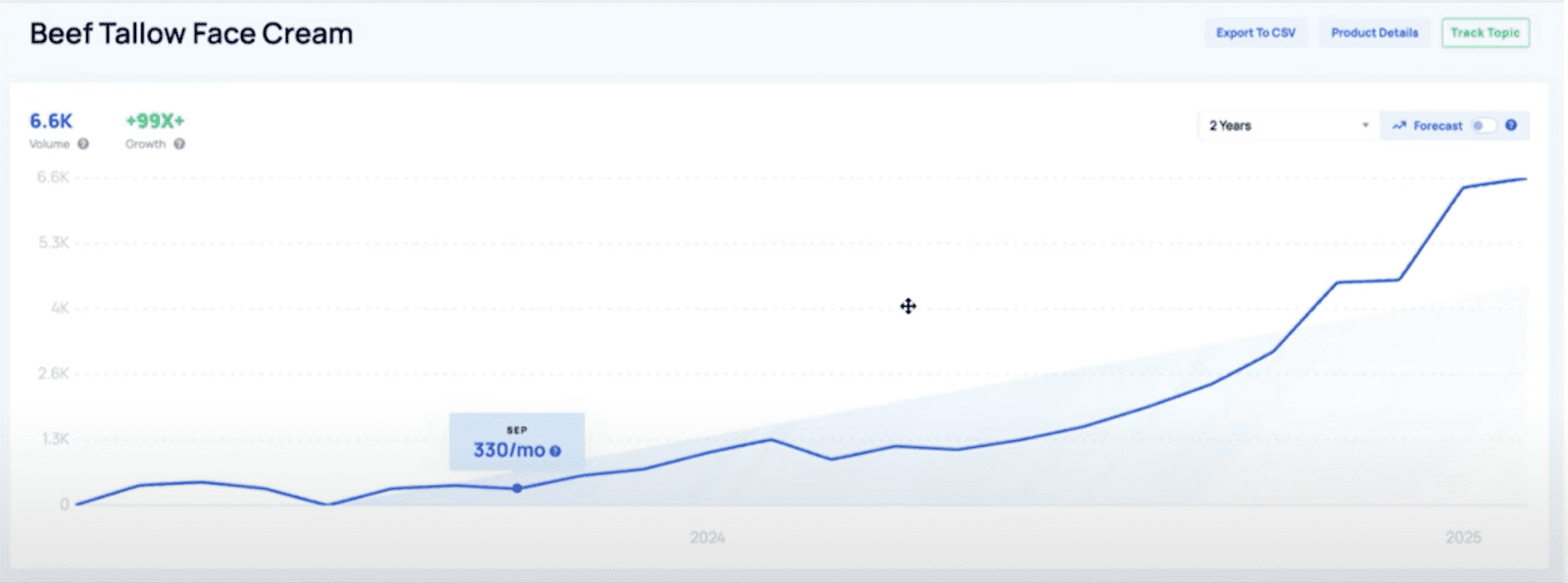
Which brings me to an important point: Advertising is acceleration.
Even the best media buyer can’t fix a broken offer, but if your product has traction in the market (like tallow did) then a good traffic strategy can help you hit the gas.
The 2 Metrics That Determine Scalability
When speaking to a potential client, one of the first things I look at is back-end metrics—money in, money out.
And if they’re interested in paid traffic, I specifically look at 2 metrics to determine if they’re set up to scale profitably:
- New Customer ROAS: For Pretty Farm Girl, their NCROAS (total new customer revenue divided by total new customer ad spend) was 5.15x—so for every $1 spent on ads, they made $5.15 in revenue from first-time buyers.
- New Customer Value: In 2023, their first order value jumped from $69 to $163. That’s nearly a 2.5x increase over 12 months.
Let’s put those figures into perspective against industry benchmarks:
- Most subscription brands have a NCROAS between 0.8 and 1.5
- And over 12 months, most brands see growth in customer value of 1.5x to 2.5x
If you’re acquiring customers at a profit and seeing good retention, you’ve got a really solid business—and PFG was way above industry benchmarks in both areas, so I was confident we could scale ad spend.
Cleaning Up their Ad Account
When we first started together, Pretty Farm Girl had been relying mostly on social media to generate sales.
But they had been doing a little advertising—and when I dove into their ad account, I saw a lot of promising signs, as well as a lot of opportunity for growth.
Before: Positive numbers but lacking structure.
Here’s what jumped out when I looked at their ad account:
- Spend: Their 2024 ad spend rose from $10K/month in January to $56K/month by November. Really good—but a lot of spend was going to traffic campaigns.
- Offers: Their Castor and Tallow sales campaign had the most spend and was generating $11–$12 CPAs at a 7x *ROAS. Clearly a strong offer. However, I did see that multiple offers were being combined into single campaigns.
- ROAS: They went from .08x return in March to 4.7x return by the end of the year. (I have to point out that this growth started when they began implementing what we teach in our mentorship program!)
*Meta reporting isn’t always accurate, so I like to cross-check data using 3 platforms (Ads Manager, back-ends like Shopify or Stripe, and a third-party tracker like Triple Whale or Northbeam) to help us make day-to-day decisions.
After: More organized and built to scale.
When we started our partnership, my team immediately got to work cleaning up their ad account.
- Focus on Sales Campaigns: In 2024, they spent 10% of their budget on traffic campaigns. That’s now under 1%, with 99% of the budget going to sales campaigns (mostly ASC+, with some CBO and ABO).
- Separate offers: Now, each campaign focuses on one page or offer, instead of combining them. For example, one campaign promotes the natural handmade collection page, another promotes a specific oil, another goes to the homepage.
- Isolated Creatives: If a few creatives in a campaign aren’t getting reach, we test them in a separate campaign. We don’t turn them off—we just give them another shot with dedicated budget.
Backend tracking is essential.
Another thing we added to their traffic strategy is a custom, automated backend sheet.

This helps us determine if we’re profitable on new customer acquisition. In addition to Ads Manager data, we pull in total ad spend, Facebook/Google ROAS, new customer ROAS, and CPA.
That way, we get an accurate picture of money-in, money-out and ensure our clients remain cashflow positive.
3 Pages that Drove the Most Conversions
Now, let’s look at a quick overview of the pages we’re using in our ad campaigns.
(If you want to actually see these pages, you can watch the YouTube video I did on this case study.)
Discount Collection Page
This page is specifically designed for customer acquisition.
- Offers a 10% discount code
- Highest converting page
- Showcases brand story, best-sellers, benefits, and social proof
Homepage
While homepages usually aren’t a good vehicle for customer acquisition, it works for this client.
- Also focuses on brand story and best-sellers
- Surprisingly effective for this brand
Product Page
This is the least effective of these 3 pages, but still ROI-positive.
- Traditional, optimized product page
- Tip: don’t preselect “Subscribe & Save”—it converts worse for us.
Top 5 Best Creatives (Video & Static)
Creative is where Pretty Farm Girl shines. They produce amazing content—especially video content.
Again, I’ll just give you a quick overview of the strategy here. If you want to see the ads the best way is to watch the case study.
Top 3 Video Creatives
80% of their creative is video content. This isn’t the same for all our clients. Sometimes it’s the other way around and 80% of the creative is static images.
- UGC with voiceover: This is the best performing creative that we have. So right away demonstrating the product and basically describing the benefits of the product.
- Packing footage: So the hook is basically the packing that Pretty Farm Girl does themselves, and then it moves into a voice over UGC video / ingredients / So here we’re putting in a before and after as well.
- Face-to-camera testimonial: Very low-production value, authentic, showing off the product and communicating excitement.
The trick is to produce a ton of creatives and do a lot of testing, so we can find winners and create a lot of variations of those too, and so on.
We’ve seen it many times: 1 good creative can completely transform a business.
Top 2 Static images
Pretty Farm Girl only allocates about 20% of their spend to static images, but they’re still very effective.
- Product benefit image: simple ad focusing on ingredients and product benefits.
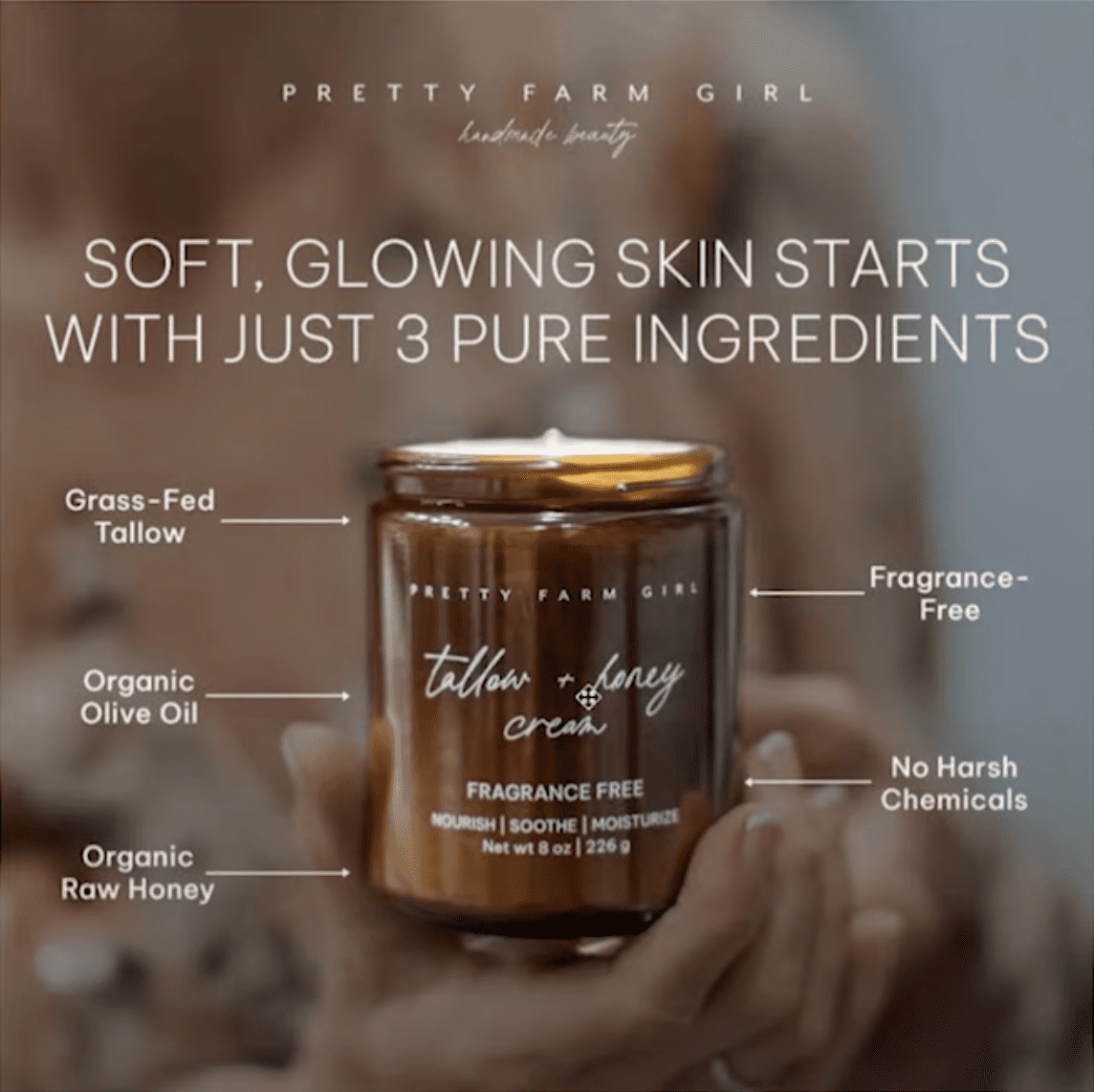
(You can copy this ad format with our free AI tool. Just type in your brand details and product benefits to get a customized prompt you can drop into ChatGPT.)
- Product display: Their hero product set against a contextually relevant background (grazing cows relates to their top ingredient, beef tallow).
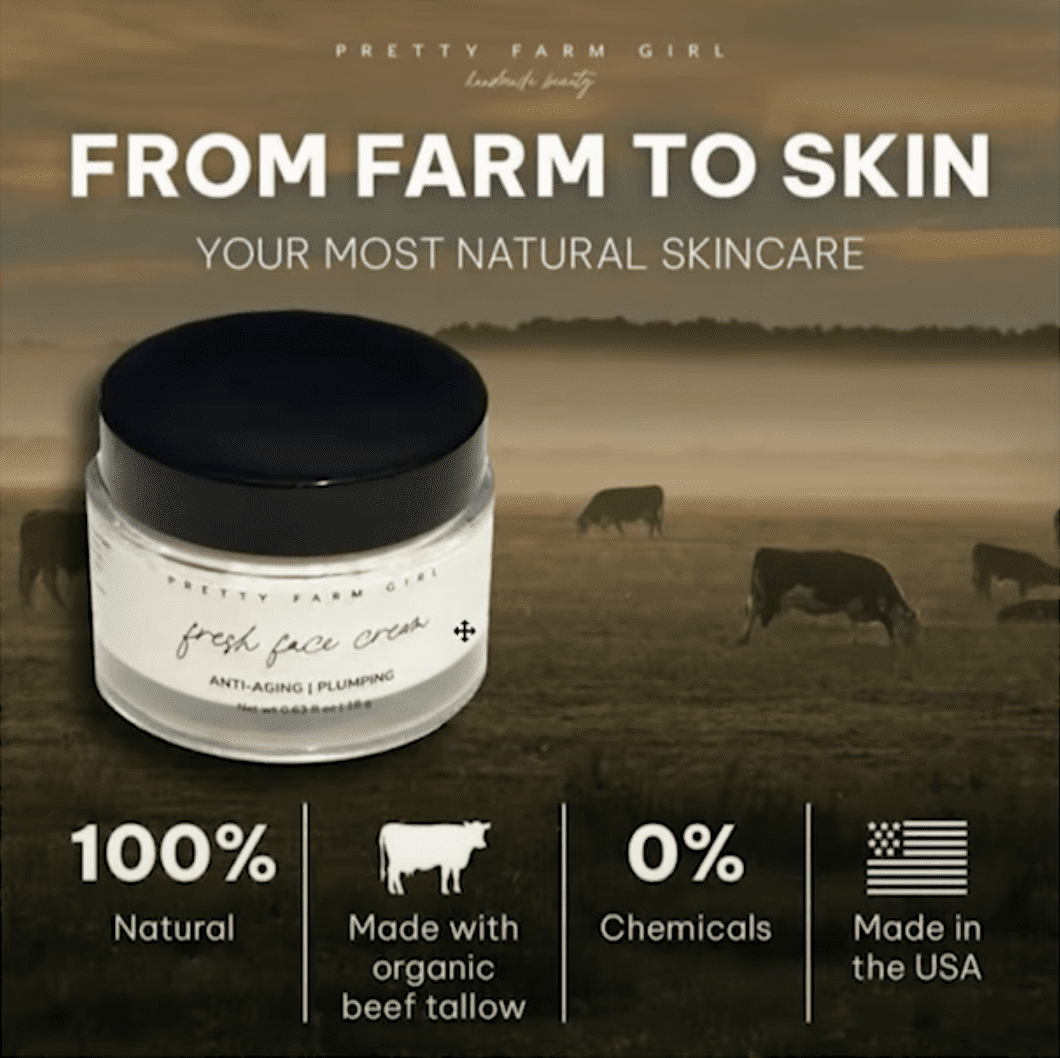
So these 5 creatives are carrying the account right now—but ad fatigue could hit anytime, so we’re continuously testing new variations of these concepts as well as new ad concepts to roll out.
2 High-performing Ad Copy Formulas
Here are the 2 copy formulas working the best right now for Pretty Farm Girl.
- Problem ? Agitation ? Solution (Links to homepage)

- Customer Testimonial Hook (The more specific, the better)

These ads are simple, specific, and tied directly to pain points and outcomes.
Tip: When testing new ad copy variations, try to test it with your best-performing creatives (and vice versa), so you really understand what’s working.
Case Study Highlights
Pretty Farm Girl had a lot of things in place signaling they were ready for scale:
- A strong social following
- High new customer ROAS and CLV
- And an underutilized ad structure that was full of potential
When we came in, we organized their account, tested a lot of creatives, and set up crystal clear reporting so we could scale rapidly while ensuring our client remained cashflow positive.
And with this combination of great products and the right infrastructure, we successfully scaled them from $500/day to $5K/day in under 5 months.
Remember: advertising is acceleration. Establish your offers first, then hit the gas.
That’s it—thanks for reading!


