


Holiday planning usually starts with one question: How big should the discount be?
That is usually the wrong first question.
Before anyone touches a percentage, decide what each part of the season needs to accomplish. The person shopping early is not in the same headspace as someone opening 12 tabs on Black Friday. A last-minute gift buyer has a different problem again. The week after Christmas changes the reason to buy one more time.
Flatten those moments into one offer, one message, and one creative package, and the discount has to do all the work. When results soften, the easiest response is another percentage point off. Margin pays for the lack of strategy.
A better calendar follows customer intent. Give every phase a job, choose an offer the business can support, and change the message as shoppers move from planning to deal hunting, gifting, delivery anxiety, and New Year goals.
Think in buying moments, not one long sale
From inside the business, Q4 can look like one endless promotional block. Customers do not experience it that way.
Some people shop early because they like having the decision handled. Some wait for Black Friday so they can compare the strongest offers. December brings gift buyers managing budgets, recipients, and delivery dates. After Christmas, attention shifts toward personal goals and the things people want for themselves.
That gives most brands five useful selling phases:
- Early holiday planning
- Black Friday and Cyber Monday
- Early December gifting
- Shipping cutoff and last-minute shopping
- Post-Christmas and New Year
Use different names or dates if they fit your business. The job stays the same: every phase needs a clear audience, offer, message, and reason to act now.
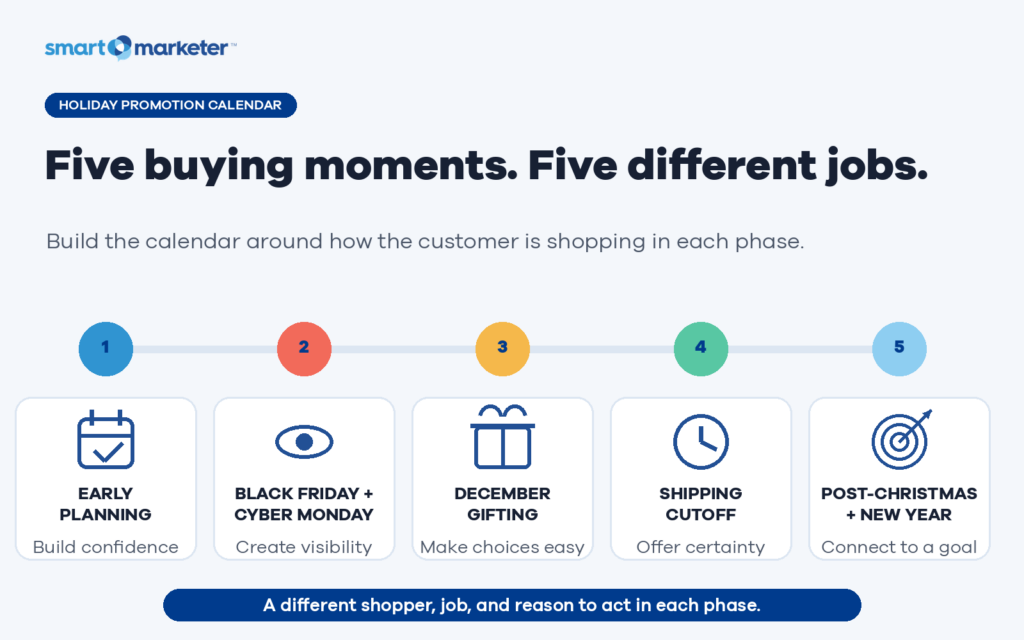
Before the creative team opens a blank document, write the job of each phase in one sentence. For example:
- Help planners buy early with confidence
- Make peak shopping days easy to navigate
- Give gift buyers simple ways to choose
- Remove delivery uncertainty near the cutoff
- Connect New Year purchases to a real goal
If two phases are doing the same job, merge them. If a phase has no job, delete it. A shorter calendar with clear roles beats six weeks of repeated offers.
Set the margin guardrails before the creative brainstorm
The offer has to survive the P&L before it earns a place in the campaign.
Get the commercial rules on paper first:
- Minimum acceptable contribution margin
- Products and variants that can support a promotion
- Inventory that needs protection
- Inventory that can support a doorbuster or bundle
- Fulfillment capacity during peak days
- Gift, shipping, and packaging costs
- Member, VIP, or loyalty benefits already promised
Nothing drains the joy out of a big sales day like discovering that fulfillment and discounts ate the profit.
Those guardrails show you where a broad discount makes sense and where a gift, bundle, member benefit, or limited product offer can do a better job.
More value does not always mean a bigger percentage off. The customer needs a clear reason to buy now. That reason can come from the product, timing, bonus, access, or a more convenient experience.
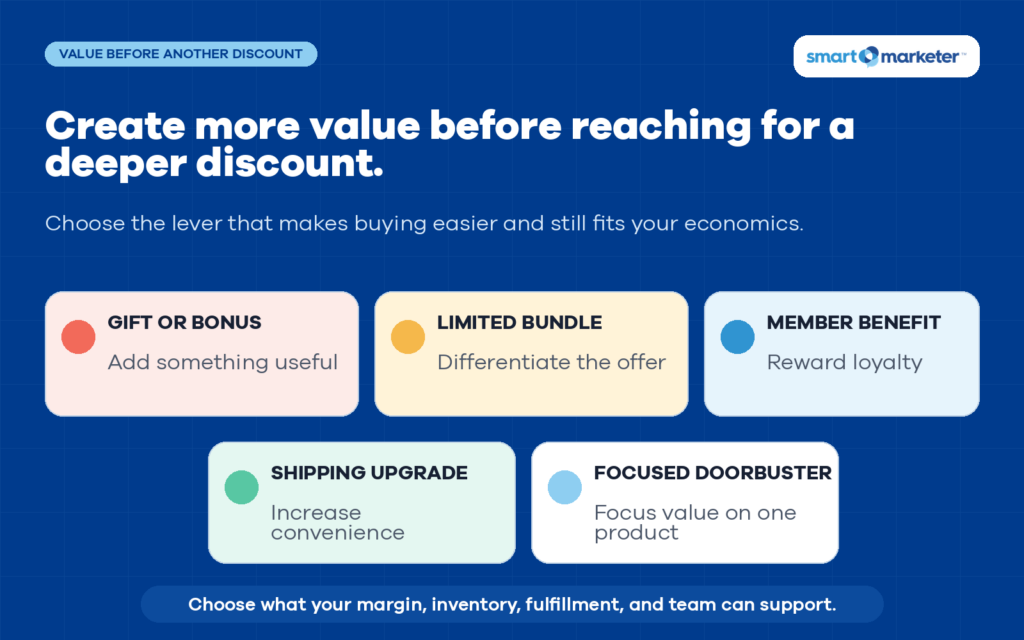
Create more value before cutting price again
A deeper discount is easy to understand and just as easy for a competitor to copy.
Before reaching for another percentage point, ask what else would make the decision easier or more valuable:
- A gift with purchase
- A useful bonus tied to an order threshold
- A limited bundle that is unavailable during the rest of the year
- Member pricing that shows the value of joining
- Free or upgraded shipping during a specific window
- A focused doorbuster on one product
- A second-purchase benefit for current holiday buyers
Use the mechanic your margin, inventory, and team can actually support. One or two clean offers will usually beat a calendar that needs a rule book.
Presentation matters. If the gift or bonus is the hero, show it like the hero. A clear banner, product image, or graphic label can do more work than another paragraph of explanation.
Give each email and page one visual job. Make the doorbuster impossible to miss. Show the gift and explain how to earn it. Put the member advantage where nobody has to hunt for it.
Every asset does not need every benefit. It needs one obvious reason to act.
Phase 1: Give early shoppers a reason to move now
Early shoppers are trying to get ahead. They may be buying for themselves, checking off a major purchase, or avoiding the noise of peak shopping days.
Many are asking one quiet question: If I buy now, will I regret missing a better offer later?
Answer it directly. The reason to move now might be an early gift, better availability, member pricing, a limited bundle, or access to a product that could sell through.
This is where education can earn its space. Higher-consideration products benefit from buying guides, fit help, comparisons, demonstrations, and real-use examples. Bring as much in-store confidence online as you can.
Be careful with the story your own sales curve tells. If early shoppers have always received the better bonus or discount, demand may move earlier because you trained it to. Treat that pattern as a hypothesis and compare like offers before calling it a customer trait.
Phase 2: Make peak shopping days easy to re-enter
Black Friday and Cyber Monday shoppers are already looking. Your job is less about persuading them to shop and more about helping them choose, notice, and come back.
This is one place where more touchpoints can work, as long as every message gives the customer a different reason to return:
- The main offer is live
- A featured product is moving quickly
- A new doorbuster or bundle is available
- Social proof shows what other shoppers are choosing
- The deadline is approaching
Volume only works when the messages do different jobs. Repeating the same subject line and offer all day is not a strategy. Give every send a fresh reason to look.
Use sales counts, inventory, “best,” “biggest,” and deadline language only when the figures are current and verified. Forecasts do not belong in customer-facing proof.
Watch the signals while the campaign runs. Revenue per recipient, click rate, unsubscribes, spam complaints, inventory, and support volume will tell you whether the cadence fits your audience. Peak-day frequency is a test, not a religion.
Phase 3: Help December shoppers finish the list
December shoppers are managing people, budgets, and deadlines. Organize the experience around those decisions instead of expecting them to browse like a self-purchaser.
Make the choice easier with collections and messages built around familiar decisions:
- Gifts under a specific price point
- Gifts for a partner, parent, coworker, or enthusiast
- Stocking stuffers
- Beginner-friendly products
- Premium gifts
- Products that ship quickly
A daily-deal series can work because it gives customers a reason to return. Tease a few of the best offers before they arrive so the series feels intentional, not like 12 unrelated announcements.
When possible, hold a few of the strongest drops for later. The early days teach customers to check back. The later days give that habit a payoff.
Inventory gets the final vote. Confirm stock before creative locks, especially when size, color, or variant availability can change the offer overnight.
Phase 4: Make delivery certainty the offer
As shipping deadlines approach, the customer’s question shifts from “Is this a good deal?” to “Will this arrive in time?”
Answer that question everywhere it matters:
- Notice bars
- Product pages
- Collection pages
- Cart
- Checkout
- Campaign emails
- Automated flows
Use exact cutoff dates, confirm them with operations, and include the time zone. Update them when fulfillment options change. Do not bury the deadline in fine print.
Once physical delivery is no longer realistic, change the offer instead of pretending. Digital gift cards, printable gifting options, local pickup, or other instant-delivery products can take over the message.
Late shoppers do not need clever. They need a clear answer, fast.
Phase 5: After Christmas, sell the goal
The week after Christmas is its own buying moment. Customers may have more time, fresh gift cards, and a renewed interest in personal goals.
Clearance is a valid tool, but it is not the only story. Connect the product to what the customer wants to do next year.
For an outdoor brand, that could mean planning a longer hike, camping in colder weather, or replacing heavy gear before a major trip. For another category, it could mean a new routine, a creative project, better organization, or a skill the customer wants to build.
Lead with the outcome, then make the product’s role obvious:
- Name the goal
- Explain what the customer needs to be ready
- Help them evaluate what they already own
- Recommend the upgrade that removes a real limitation
- Give them a reason to prepare now
That helps the customer understand why quality matters. The purchase becomes part of a plan instead of a reaction to a discount.
Keep recent buyers in the holiday plan
A first purchase does not mean the holiday shopping is done.
Do not throw every recent buyer straight back into the full promotional cadence. Give them a little breathing room, then use a dedicated repeat-purchase flow that acknowledges the order and earns the next ask.
Some buyers realize they forgot an item. Others were deciding between two products and chose only one. Some still have gifts to buy. A short second-purchase flow can serve that moment while the brand is fresh in their mind.
Consider starting the message within about 24 hours, then keeping the benefit available for a short window such as three to five days. The first email should feel like a thank-you and an easy opportunity, not an aggressive upsell.
Useful angles include:
- Add the item you were still considering
- Pick up a complementary product
- Finish shopping for someone else
- Use a buyer-only benefit before it closes
Exclude customers when the message would feel inappropriate, and protect margin before increasing the incentive. The timing and offer should reflect your product, shipping speed, purchase cycle, and customer expectations.
Build from intent, then let the data argue back
A holiday calendar should do more than assign discounts to dates. It should explain why the customer is shopping, what the business wants that phase to accomplish, and which offer can do the job without creating a mess.
Use this planning sequence:
- Review historical demand by week and by customer type
- Set margin, inventory, and fulfillment guardrails
- Define the job of each selling phase
- Match one primary audience and offer to each phase
- Choose one visual priority for every campaign asset
- Plan email, site, paid media, and automation together
- Decide which metrics will tell you whether the phase worked
- Build the fallback plan for inventory, shipping, or creative changes
Then let real customer behavior push back. You may learn that shoppers respond earlier than expected, that gifting matters more than discount depth, or that the New Year window is stronger than the team assumed.
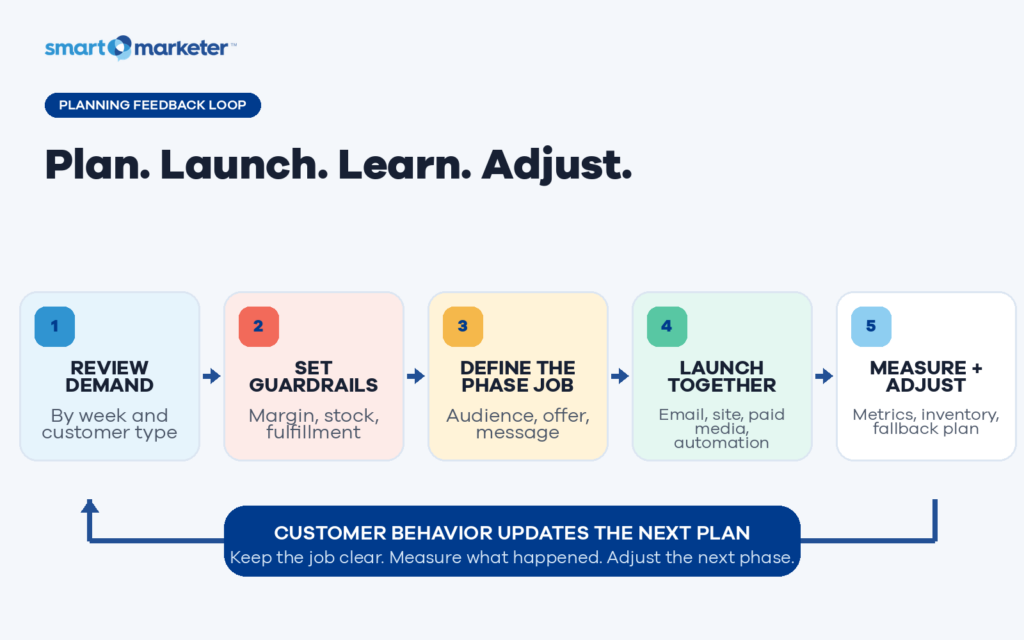
The calendar is the hypothesis. Customer behavior gets the final word.
A strong holiday strategy does not ask one discount to carry six weeks of selling. It gives each buying moment a job, makes the value easy to see, and protects the economics that let the business keep serving customers after the rush.