

If you’ve been treating SMS as an afterthought, a bolt-on channel you blast once a month on major sale days, you’re leaving real revenue on the table. The data in 2026 is hard to argue with: a solid SMS marketing strategy can drive sales on its own, but it also amplifies the performance of every email you’re already sending. And with Omnisend dropping SMS pricing to $0.007 per message, the cost objection that kept most mid-size ecommerce brands from investing seriously in SMS just disappeared.
Key Takeaways
- SMS open rates average 98%. Email averages 20 to 30%. Together, they don’t cannibalize each other.
- Brands using email and SMS together report 47% higher conversion rates than those using email alone, according to Omnisend’s 2025 benchmark data.
- The most effective SMS plays are strategic triggers tied to email behavior: opens, non-opens, and abandonment. Standalone blasts are not the move.
- Omnisend now starts at $0.007 per SMS, making serious investment in the channel accessible for brands that weren’t willing to pay Klaviyo-tier prices.
Why Is SMS Marketing More Effective in 2026 Than It Was Five Years Ago?
SMS performs better today because the inbox is less crowded, consumer consent is more explicit, and the channel has matured past the spray-and-pray phase that gave it a bad reputation early on.
Five years ago, SMS marketing was mostly used as a broadcast tool. Big list, one message, send on Friday before a sale weekend. It worked okay, but it burned subscribers fast. Here’s what changed:
- Consent standards are higher due to TCPA, CTIA, and carrier filtering, which means your list is cleaner and engagement rates are higher than they used to be
- Platform capabilities have caught up, and automated flows, behavioral triggers, and segmentation that used to live only in email are now standard in SMS tools
- Consumer behavior has shifted, and texting is habitual and immediate in a way that email, even on mobile, simply isn’t
- Brands have learned to use the channel with restraint, fewer sends, higher relevance, and better results across the board
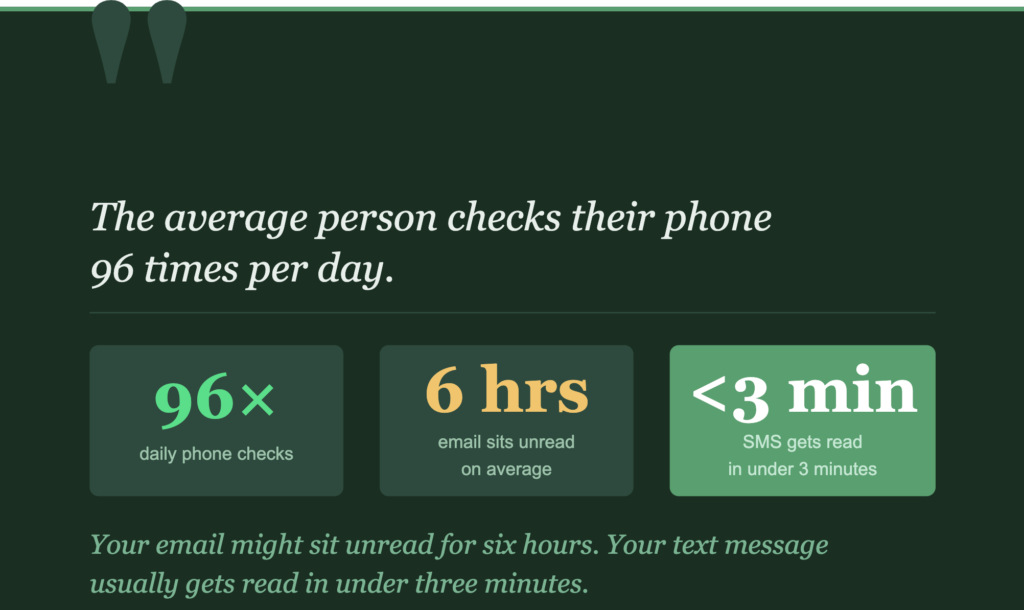
That three-minute window is what makes SMS a fundamentally different tool. You’re reaching people in real time, and that changes how you deploy the channel.
How Does SMS Marketing Boost Email Campaign Performance?
The biggest unlock in a combined email and SMS strategy is using SMS to recover the value email misses. Email is your workhorse channel. SMS is your safety net and your accelerant, depending on the play. The goal is using both in sequence, not in competition.
Here are the four ways SMS makes your email program perform better:
1. The Non-Opener Re-Engage Sequence
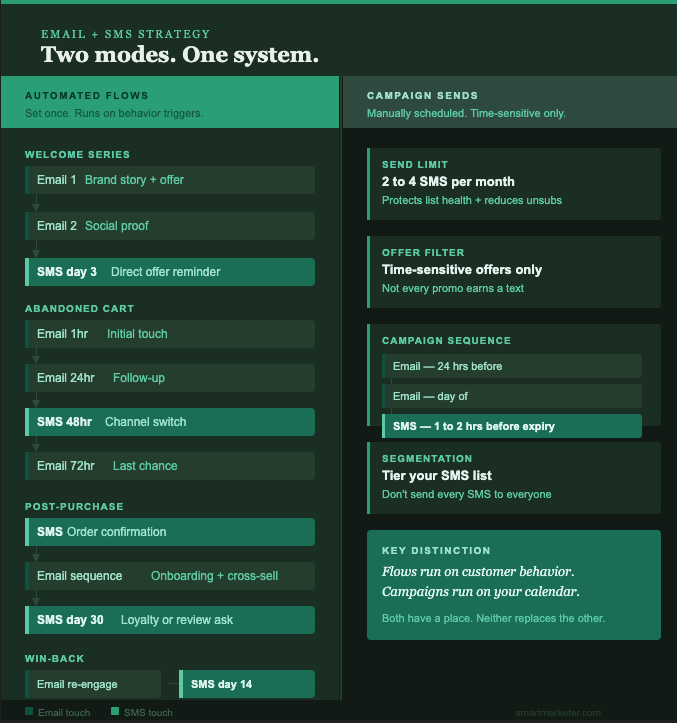
You send an email. Seventy to eighty percent of your list doesn’t open it. Standard practice is to resend with a different subject line. A better play: send a one-sentence SMS to non-openers four to six hours after the email drops. Something like: “Hey, we sent you something earlier. Worth a look: [link].” No pitch, just a redirect. Conversion rates on this sequence consistently beat standalone email re-sends.
2. The Cart Abandonment Stack
Three-touch abandonment flows convert significantly better than email-only flows. Email at one hour. Email at 24 hours. SMS at 48 hours. The SMS copy doesn’t need to be clever. It just needs to be direct: “You left something behind. Still thinking about it? [link]” The key is the channel switch. You’re reaching them somewhere new.
3. Flash Sale Amplification
For time-sensitive promotions like flash sales, same-day drops, and last-chance inventory, SMS does what email can’t. It creates urgency in real time. Send the email first to establish context. Follow with an SMS an hour before sale ends. The email plants the intent. The SMS closes the loop. Brands using this sequence on Omnisend report two to three times the revenue lift versus email-only on the same promotion.
4. Post-Purchase LTV Plays
Post-purchase SMS flows, order confirmations, shipping updates, and review requests, have some of the highest open and engagement rates of any message type. They also build the habit of receiving texts from your brand in a positive context before you ever send a promotional message. That trust deposit pays dividends when you eventually make an offer.
Email vs. SMS vs. Email + SMS: Performance Benchmarks
The numbers below reflect 2024 to 2025 benchmark data from Omnisend’s annual report across 150,000+ brands. These are averages. Your numbers will vary depending on list quality, industry, and send cadence, but the directional story is consistent across platforms.
| Metric | Email Only | SMS Only | Email + SMS Combined |
| Avg. Open Rate | 20 to 30% | 98% | N/A (channel-specific) |
| Avg. Click Rate | 2 to 4% | 10 to 15% | 14 to 21% |
| Cart Recovery Rate | 5 to 8% | 7 to 11% | 15 to 20% |
| Conversion Rate vs. Email Alone | Baseline | +18% | +47% |
| Avg. Revenue Per Recipient | Baseline | +12% | +36 to 40% |
Source: Omnisend Email & SMS Marketing Benchmarks, 2025. Data reflects aggregate performance across 150,000+ ecommerce brands.
The 47% conversion lift doesn’t come from sending more messages. It comes from using both channels together, timed around actual customer behavior.
What Does an Effective SMS + Email Strategy Actually Look Like?
Effective integration comes down to discipline. Most brands make the mistake of treating SMS like a second email list. The two channels serve different purposes, and the brands who get the most out of SMS understand that clearly.
The core principle is simple: SMS is for timely, specific, high-value moments. Email is for context, storytelling, and nurture.
Here’s what a tactical SMS calendar looks like alongside a real email program:
How Do You Build an SMS List That’s Actually Worth Messaging?
An SMS list built on dark patterns, pre-checked boxes, buried consent language, incentives that obscure what the subscriber is agreeing to, will perform poorly and expose you to compliance liability. The only list worth having is one where people actively opted in to hear from you via text.
The highest-performing SMS list-building tactics in 2026:
- Checkout opt-in with explicit SMS consent checkbox, separate from email, and a clear value prop: “Get order updates and early access to sales”
- Pop-up flows with an SMS-specific incentive, slightly different or higher-value than the email offer, to signal the channel distinction
- Post-purchase SMS capture in the confirmation flow, which is the moment of highest brand sentiment
- Keyword campaigns for paid social traffic, for example “Text DEALS to 12345 for 15% off”, especially effective for Meta and TikTok audiences
- Email-to-SMS cross-sell, where you send a dedicated email to your full list inviting them to opt into SMS for exclusive or earlier access
Most brands with healthy email lists can convert 15 to 30% of them into SMS subscribers with a well-executed cross-sell campaign. That’s free list growth from an audience you already have.
What’s the Right SMS Platform for Ecommerce Brands in 2026?
For most mid-size ecommerce brands, the right platform handles email and SMS under the same roof. Same automations, same segmentation, same reporting. Splitting your email and SMS platforms creates data silos that make the behavioral triggers we described above impossible to execute cleanly.
The two platforms that come up most often in this category are Klaviyo and Omnisend. Both offer solid ecommerce integrations, automation builders, and segmentation. Here are the differences that actually matter:
| Feature | Klaviyo | Omnisend |
| SMS Pricing (US) | Higher per-message rate | From $0.007 per SMS |
| Email + SMS Automation | Yes | Yes |
| Ecommerce Integrations | 200+ | 200+ (Triple Whale, Smile.io, Aftership) |
| Shopify Rating | 4.6/5 | 4.8/5 |
| Support Response Time | Business hours | 4-min avg, 24/7 |
| Migration Support | Self-serve | Free 5-day managed migration |
| Best For | Larger enterprises | Mid-size ecommerce brands |
The SMS pricing gap is real and it adds up fast. At scale, say 50,000 SMS sends per month, the per-message difference between platforms adds up to thousands of dollars annually. That money either goes back into your margin or gets reinvested into more sends, which generates more revenue.
The other thing worth noting about Omnisend’s recent pricing move is that it goes against the grain. Most SaaS platforms have been raising prices. Omnisend went the other direction, citing a commitment to making the channel accessible for the mid-market. The number is the number, and $0.007 per SMS is a number that makes serious investment in the channel pencil out.
Brands on Omnisend report earning $79 for every $1 spent on the platform in 2025. The average Shopify rating is 4.8 out of 5. Four-minute average support response time, around the clock.
Is Switching SMS Platforms Worth the Disruption?
Platform migration is legitimately annoying. The reason most brands stay on expensive platforms too long is that the switching cost feels bigger than the ongoing cost. That calculation makes sense until someone does the math for you.
Omnisend’s migration offer removes the main friction point. Their team moves your automations, templates, flows, and lists for free, and they do it in five days. You don’t touch it. Their team handles the transfer. The switching cost amounts to one week of running both platforms simultaneously while the transfer completes.
Here’s a simple framework for deciding whether to make the move:
- Calculate your current monthly SMS spend by multiplying messages by your per-message cost
- Calculate the same volume at $0.007 per SMS
- Multiply the monthly difference by 12
- Compare that annual savings to one week of operational overlap
For most brands sending 30,000 or more SMS per month, the savings over 12 months are significant enough to justify the migration week. For brands sending 100,000 or more, the math is straightforward.
Brands that have made the switch to Omnisend report saving up to 35% on SMS costs, with the same deliverability, automation capability, and list management they had before.
The Bottom Line on SMS Marketing Strategy in 2026
SMS is a channel you can no longer afford to treat as optional. The performance data is clear: combined email and SMS strategies outperform email alone by meaningful margins across open rates, conversions, and revenue per recipient. The question is whether you’re using it strategically enough to capture that upside.
If you’re already running SMS seriously and paying more than $0.007 per message, the pricing math from Omnisend deserves a hard look. If you haven’t invested in SMS yet, the combination of low entry pricing, a free managed migration, and native email and SMS automation in the same platform makes this a reasonable time to start.
The brands who figure out SMS and email integration in the next 12 months are going to have a real channel advantage over the ones still treating text as a one-off blast tool. That gap is worth closing.
Ready to see what $0.007 per SMS looks like for your send volume? Check Omnisend’s SMS pricing page for a full breakdown.


