
Alison didn’t set out to build a business.
She was a bilingual kindergarten teacher who was painstakingly creating all her own curriculum for 23 kids and had nowhere to share it. So she started putting it on Teachers Pay Teachers. Then a blog. Then social media. Then a membership.
That was 2012. Fourteen years later, her company Learning at the Primary Pond runs hundreds of SKUs in digital downloads, a membership that makes up roughly 50% of revenue, multiple online courses, and two YouTube channels, one of which she hasn’t posted to in two years, yet still generates leads and sales every single month.
Now she’s launching a second brand, Bright Pond, aimed at parents. She’s doing what most of us only go through once: building a new brand from scratch. The difference is she already knows how the whole marketing machine works.
We sat down with Alison in a recent Mentor Table session to go deep on how she built this. What came out of that conversation is a practical breakdown of info products, lead magnets, YouTube, and memberships that every ecom brand should hear.
The Accidental Business Is Usually the Best Business
Alison’s origin story tracks a pattern we see constantly inside Mentor Table. The best businesses don’t start with a business plan. They start with a real problem.
In Alison’s case, she was doing all this curriculum work and had no one to share it with. Twenty-three kids were benefiting from something that could help thousands of teachers. That gap pushed her to find a distribution channel. Teachers Pay Teachers was that channel. Her need was the product.
She’s said she always felt like she accidentally started a business because she wasn’t setting out to do it. She just wanted to help teachers. That’s the whole product. And it’s exactly what most info businesses built from scratch are missing.
If you’re an ecom brand wondering whether info products could work for you, start with one question: what do your customers need to know, do, or track to get more out of what you already sell them? That’s your first info product.
Lead Magnets Have to Feel Like a Tool
This is probably the most useful thing to take away from the whole conversation, and it applies whether you’re selling digital downloads or physical products.
The standard advice is to create a lead magnet. The problem is most brands create a guide, a PDF, or a free chapter and then wonder why nobody’s converting. Alison has figured out that the lead magnet has to feel like something someone would actually pay for. Not vaguely valuable. Concretely useful. Something they can hold, print, or act on immediately.
For Alison’s teacher audience, that looks like seasonally rotating sets of writing prompts, themed around fall, spring, or back to school, that teachers can hand to kids the next morning. They are not guides. They are tools.
For Bright Pond, she’s thinking the same way. She’ll take one activity from her new flipbook, turn it into a printable PDF, and give parents a script for having a hard conversation with their kid.
Her rule: treat each lead magnet like a product. Survey your audience the same way you would before creating something paid. Ask what their actual problems are. Then build something they’d spend money on, because if it’s not worth paying for, it’s not worth opting in for either.
A great example came up in the session. A supplement brand ran ads about dogs’ cloudy eyes. The opt-in was a multi-week guide to reversing it. What they sold was eye drops and a food additive. And when you received the product, it came with a checklist version of the guide so you’d follow through and stay subscribed.
That’s what a good lead magnet does. It opens a conversation, delivers immediate value, and sets up the purchase. Then it keeps working on the back end.
Three Info Plays Every Ecom Brand Can Run
You don’t have to build a full information business to benefit from this. Alison and Molly laid out a simple progression any ecom brand can follow.
Start with a lead magnet. Most brands in most markets are still not running paid lead gen, which means a well-built lead magnet is already a competitive advantage. Keep your cost per lead low and treat that spend the way you’d treat a salary. It’s not ROI you measure next week.
Add information as an order bump. Before you build another physical product, think about a $9.99 to $29.99 digital add-on that complements what someone just bought. A guide, a tracker, a mini course. Multiple agency clients do this. These offers can lift AOV by 30 to 50% and cost almost nothing to fulfill. No warehouse, no shipping, no COGs.
Build a membership on the back end. This is the long game, and it’s the one that changes your stress levels. When Alison talks about her mental state, she describes someone who is calm and steady and rarely panicked about revenue. She credits a huge part of that to having membership income that recurs whether she launches anything new or not.
YouTube Is an Asset, Not a Content Calendar
Alison has a YouTube channel called Reading SOS with Alison that she hasn’t uploaded to in two years. It has over ten thousand subscribers. It still generates leads and sales every single month through a fully automated funnel.
She built it by doing keyword research, finding what parents of struggling readers were searching for, and making videos targeting those exact phrases. Every video points to a free printable parent guide. That opt-in feeds an evergreen webinar or mini-course sequence that converts into a paid program.
She set it up once. It runs without her. Every lead and sale that comes through that channel today is essentially free because the work was done years ago.
For her main channel, Learning at the Primary Pond, the approach is more intentional but still simple. Each month, she identifies her top two business goals: drive free trial signups, sell a specific course, grow the email list. Her team finds keyword phrases that match those goals. She records a video targeting the keyword and pointing to the relevant offer. Two videos a month.
One compounding benefit that doesn’t get talked about enough: when you cross-promote a new video to your email list and social following right after publishing, it floods the video with views quickly, which signals to YouTube’s algorithm to rank it higher. Your email list becomes a tool for improving your YouTube reach.
From an AEO standpoint, long-form YouTube content is one of the top signals for how your brand shows up in AI-generated answers. If you’re not on YouTube, you’re already behind in a search landscape that is actively shifting.
The Membership Model and Why Recurring Revenue Changes Everything
Alison’s membership has been running for seven years and makes up about 50% of her total revenue.
The question she asked herself when building it was simple: what do teachers need every single month, over and over again? Not what would be interesting. What do they actually need to do their job?
For teachers, that’s centers (independent activities for kids) and small group lessons, things their school’s core programs don’t provide. She delivers that every month. Same system, new materials. That’s the whole model.
She layers in two other things that help with retention: monthly professional development with certificates teachers can use toward their license renewal, and a live monthly Q&A where members can ask her anything. The Q&A doesn’t need high attendance to be valuable. Just knowing they can show up and get answers makes members feel supported, and that feeling matters more than the headcount.
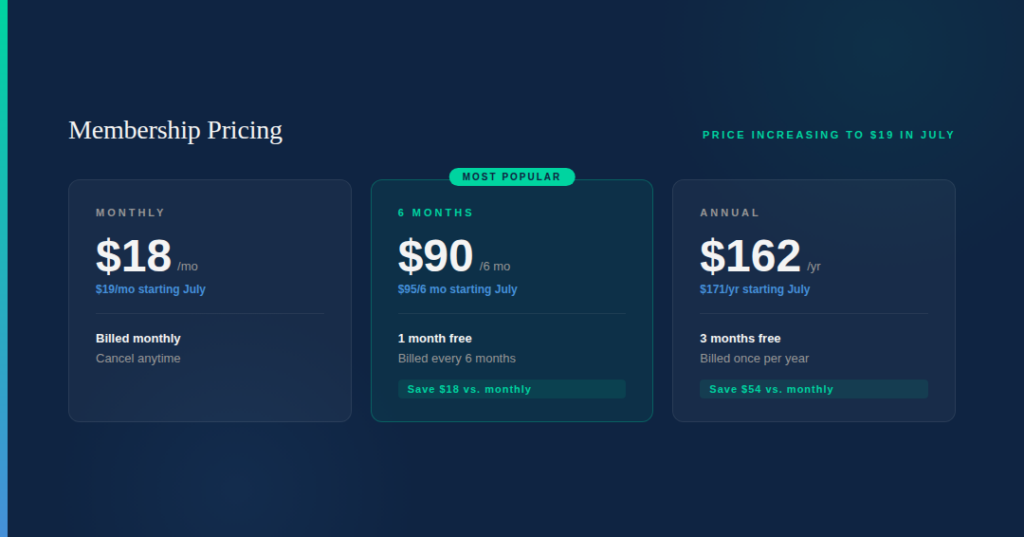
On pricing, she’s at $18/month and moving to $19 in July. She offers three options: monthly, six months with one month free, and twelve months with three months free. Teachers who are price-sensitive gravitate toward the longer terms because the savings are obvious. And longer billing cycles reduce churn because people aren’t seeing the charge every month.
You don’t have to build Alison’s full model to get this benefit. A subscription box, a loyalty program with store credits, or a members-only product category can create the same dynamic: people who joined for the deal stay because leaving means losing something.
How to Think About Lead Gen Spend When You Can’t See the Return
Alison spends a few thousand dollars a month on lead gen in a market she knows won’t convert same-day. She doesn’t try to measure it like performance advertising.
She thinks about it like a salary. You pay a team member because the business needs them. You don’t expect them to generate revenue on their first day. Lead gen works the same way. It’s just another line item, another expense that keeps the machine fed.
This is the mental shift most ecom brands can’t make when they start running lead gen. They’ve been trained to track every dollar in and every dollar out. But in a market where the average lead converts in six to twelve months, trying to measure it that way will get you to turn off a funnel that was working.
Measure the right things instead: cost per lead, funnel conversion rate, email engagement, webinar show rate, and lifetime value over time. You’re not optimizing for today’s revenue. You’re optimizing for the health of the system.
The AI Question
Someone asked how you compete with AI when AI can produce information for free.
Alison’s answer was straightforward: make it personal, and make it a tool.
AI can give you generic literacy activities. It cannot give you Alison’s specific five-step approach to running literacy centers in her classroom, modeled on video with her face on screen. It cannot put a real teacher in front of other teachers and have her model the lesson. That’s what her new course does, and she calls it out explicitly in her marketing emails. You’re not going to find this on AI.
The same applies in ecom. Another Mentor Table student has close to a hundred thousand YouTube subscribers, not because he publishes better gear information than anyone else, but because real humans are in those videos doing real hikes. That is not something AI replaces.
Most of your customers are not using AI the way you think they are. And none of them are using it with your specific knowledge, your face, your story, or your method. That’s the advantage.
The Bigger Picture
Alison’s business is a story about finding a real need, building systems around it, and adding revenue streams over time. She didn’t do everything at once. She started with a marketplace, then a blog, then social, then a membership, then courses, and now a second brand aimed at an entirely different audience.
Every piece of it serves the customer. The lead magnet sets them up to succeed. The membership gives them what they need every month. The YouTube content answers what they’re already searching for. The order bumps make the original purchase more valuable.
None of it is complicated. All of it takes work. And most of it keeps running whether she’s actively working on it or not.


