
Organic social strategy for ecommerce is one of the most misunderstood growth levers available to online brands. Most businesses treat it like a free version of their paid ads, posting product photos, dropping a link in bio, and wondering why nobody buys. That approach doesn’t work because it misses the entire point. Organic and paid are doing fundamentally different jobs, and when you understand that distinction, everything clicks.
Key Takeaways
- Organic social is not a free ad channel, it’s a trust-building engine that makes your paid ads convert better and increases customer lifetime value.
- The content that performs best on organic is human, vulnerable, and personality-forward, not product-first or offer-driven.
- Follower count and raw view numbers are vanity metrics. Engagement quality and net follower fit matter far more.
- Boosting your best organic posts into paid engagement campaigns creates a content flywheel, organic warms the audience, paid converts them.
Why Is Organic Social Strategy Different from Paid Advertising?
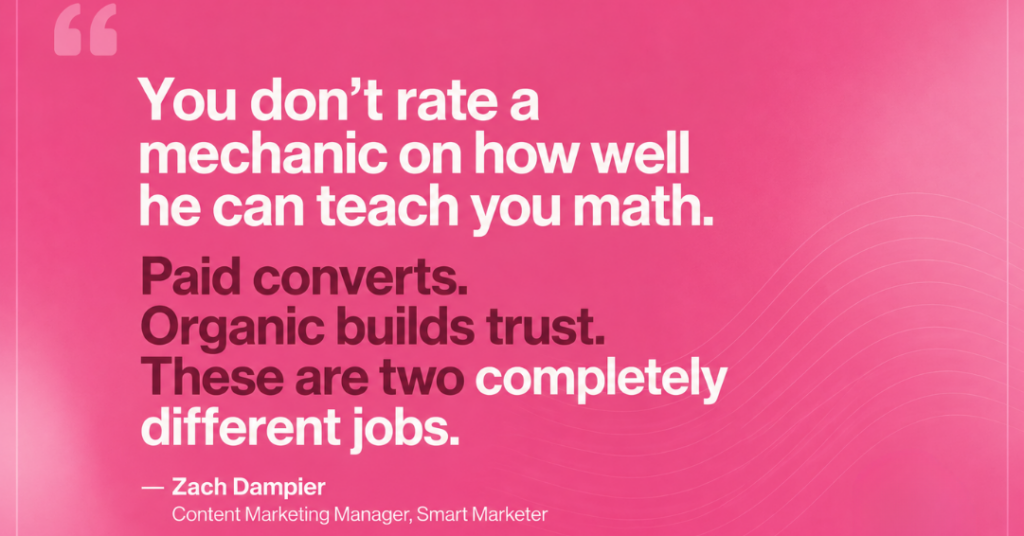
Organic social strategy and paid advertising serve completely different functions in a customer’s journey. Paid ads are built for clarity and conversion: here’s the product, here’s the offer, here’s why you should buy right now. That message works because the person seeing it is already in a decision-making context. Organic, by contrast, reaches people who are scrolling to be entertained, to learn, or to feel something, not to buy.
When you post ad copy to your organic feed, you’re fighting the platform instead of working with it. The algorithm reads engagement signals. If your audience scrolls past without interacting, your organic reach collapses. The platform exists to keep people engaged, not to serve as a free billboard for your product catalog.
What Organic Content Actually Performs Well for Ecommerce Brands?
The highest-performing organic content across ecommerce brands in 2024 and 2025 shares one common trait: it makes people feel something about the people behind the brand, not just the product. Here’s what that looks like in practice.
Employee and Founder Stories Outperform Product Content
One Mentor Table member found that their best organic content of the year wasn’t product content at all. It was a simple carousel series spotlighting the founders’ stories: how they started, why they built the company, what struggles they faced along the way. People related to it. They saw themselves in it.
Smart Marketer saw the same thing internally. The most successful content series of 2025 was employee spotlights, specifically stories that took something that could have been a low point and reframed it. One example: Dilyana applied at the Smart Marketer agency, didn’t get hired on the first interview, persevered, got a second chance, and is now one of the top employees at the agency. That story resonated because it removed the “Superman cape” that so many marketing educators wear, the sense that they’re untouchable and unreachable. It made the team human.
When you get people to feel something about the individuals behind your brand, not just the brand itself, you’re building something Nike and the big-box competitors can never replicate. That personal connection turns buyers into lifetime customers.
Vulnerability and Authenticity Drive Organic Reach
One of Smart Marketer’s best-performing posts ever was a video clip from Molly’s podcast in which she talked about losing her father. The B-roll was from her wedding in Italy. It was raw, it was real, and it was nothing like what you’d expect from a marketing education brand’s Instagram page, which is precisely why it worked.
That doesn’t mean you need to broadcast every difficult moment. But the principle holds: the more you let your audience see the genuine, unpolished version of your brand and your people, the more traction your organic content earns. Buttoned-up corporate posts don’t move the needle. Personality does.
Carousels Are Outperforming Reels for Engagement Right Now
Everyone has heard that Reels are the way to grow on Instagram, and that’s still true for cold reach. But Reels are now flooded with brands all competing for the same growth hack. The result: engagement rates are declining for Reels while carousels are quietly outperforming them on actual engagement.
A carousel viewer who swipes through all ten slides is far more interested in your brand than someone who watched a trending audio Reel and hit follow because they thought you were funny. Carousels attract qualified attention. They’re also lower production lift: easier to create, easier to revise, and they allow for longer storytelling that education-based brands like Smart Marketer need.
Organic Social vs. Paid Ads: A Side-by-Side Comparison
Understanding how organic and paid differ across key dimensions makes it easier to set the right expectations, assign the right resources, and measure each channel on its own terms.
| Organic Social | Paid Ads | Both | |
| Primary Job | Build brand trust & emotional connection | Convert ready buyers | Full-funnel growth |
| Key Metric | Engagement quality, saves, DM opt-ins | ROAS, CPA, CVR | LTV, repeat purchase rate |
| Time Horizon | Long-term (months/years) | Short-term (days/weeks) | Compounding over time |
| Content Type | Stories, behind-the-scenes, education | Offers, product demos, CTAs | Consistent brand narrative |
| Best Format (2025) | Carousels + authentic video | Video ads, UGC creatives | Boosted organic posts |
| Audience Temp. | Warm & loyal followers | Cold & retargeted traffic | Full funnel coverage |
| Measurability | Indirect (engagement, sentiment) | Direct (clicks, revenue) | Attribution modeling needed |
Which Organic Social Metrics Should You Actually Track?
Chasing the wrong metrics is one of the fastest ways to kill an organic strategy, or to lose a good social media manager who’s actually doing great work. Here’s what matters and what doesn’t.
Why Follower Count Is a Vanity Metric
Follower count feels good. Big numbers signal social proof. But for ecommerce brands in specific niches, follower count can actively hurt your performance if those followers aren’t qualified.
Example: a pet supplement brand goes viral on a trending audio Reel and picks up 5,000 new followers, none of whom own pets. The immediate result is a follower spike. The downstream result is a cratered engagement rate, because the algorithm sees that your new followers don’t engage with your typical content. Future posts get suppressed. Organic reach shrinks. Sales don’t move.
Growing a follower base of people who will never buy from you is not growth that is positive.
How Platform Algorithm Changes Can Distort Your Data
Even the metrics you do track can shift underneath you without warning. Smart Marketer’s Instagram views dropped by nearly half practically overnight, and stayed that way for weeks. After investigation, the cause turned out to be an Instagram platform change: the definition of a “view” had changed. Previously, a post appearing in the explore page grid counted as a view even if the user was looking at another post. Instagram updated this to require an actual click on the post. Overnight, the baseline shifted.
The lesson: know that your benchmarks are fluid. Don’t beat yourself up chasing a viral month you haven’t seen since. Don’t set goals so low that you hit them without effort. Build realistic, slightly-stretched targets and expect to recalibrate them as platforms evolve.
The Metrics That Actually Indicate Organic Social Health
Instead of follower count and raw views, focus on:
- Net follower gain from people who match your customer profile: look at the months where you gained followers AND retained them, and identify what you posted
- Engagement quality: comments that reference your brand, saves (especially strong signal on Instagram), and DM conversations
- Month-over-month engagement rate trends: measured across at least 90-day windows, not week-to-week
“Measuring it week to week is good to keep track of, but making decisions on strategy week to week is not wise. Social can change so much. Look at it in much larger chunks.” — Zach Dampier
How Do You Make Organic Social and Paid Ads Work Together?
The most powerful ecommerce marketing systems don’t choose between organic and paid, they use both strategically at different stages of the customer journey. Here’s how to build that system.
Stage 1: Pre-Proof of Concept — Don’t Build an Organic Strategy Yet
If you’re in the early stages of your business and you don’t have a proven offer, don’t allocate significant resources to organic social. The time investment doesn’t match the return at that stage. Instead, post your existing ad creatives to your brand pages just to signal legitimacy, a real company, with a real following, that takes care of their accounts. An empty page makes cold traffic nervous. A page with a few hundred followers and consistent posting signals that someone is home.
Stage 2: Post Proof of Concept — Build Your Organic Strategy with Intention
Once your paid ads are working and you know your offer and avatar, organic becomes what our social media manager calls “Meta insurance.” You can’t always prove it’s doing anything on a given Tuesday. But if you stopped doing it, you’d feel it.
At this stage, assign someone to organic, give them a content calendar, and build a strategy with real intent. Not “post on Tuesday because Tuesday performs well” but “what kind of post performs on Tuesday, and what promotions are running where organic can dovetail without being an ad?”
Stage 3: The Paid Engagement Flywheel
Here’s the specific tactic that Smart Marketer runs every week: take one or two posts that earned strong organic engagement, and put them into a paid engagement campaign on Facebook. The goal is to extend their reach beyond what the algorithm organically distributed, getting that content in front of cold audiences who haven’t heard of the brand.
This creates a flywheel: organic content warms your existing audience and builds trust, boosted posts turn that best content into a prospecting and warming tool, and paid retargeting handles conversion downstream. The person who eventually buys from a paid retargeting ad may have been warmed by an organic post six months ago. You can’t always draw a straight line in the data, but the compounding effect is real.
How Does Email Fit Into the Organic-Paid Ecosystem?
At Smart Marketer, the content ecosystem works like this: email distributes blog content, blog content feeds social pages, high-performing social posts get boosted into paid engagement campaigns, and all of it maintains a consistent brand message. That consistency, seeing Smart Marketer everywhere, with coherent messaging, is what builds the deep trust that drives lifetime customer value.
What Is the Three-Phase Framework for Building Organic Social from Scratch?
Most brands want Phase 3 results on Day 1. They do organic for a month, it doesn’t pop off, and they quit. The brands that win are the ones that understand organic is a compounding investment, and they build it in phases.
| Phase | Focus | Goal | Milestone |
| Phase 1: Consistency | Show up on every platform | Build the habit and system | Post without overthinking |
| Phase 2: Analyze | Review what’s working | Identify top content types | Data-informed content calendar |
| Phase 3: Efficiency | Systematize your best work | Scale with minimal oversight | Monthly review in about 30 min |
Smart Marketer’s monthly content calendar review went from a two-hour meeting with the full team in Phase 1 to a 20-minute sign-off on 30 pieces of content in Phase 3. That efficiency only exists because they built the foundation first.
Frequently Asked Questions About Organic Social Strategy
Should I prioritize organic or paid ads for my ecommerce brand?
Run both, but don’t measure them with the same metrics. Paid is for conversion. Organic is for trust. If you only have resources for one, prioritize paid until you have proof of concept. Once you do, build organic in parallel and it will improve your paid performance over time.
How long does it take for organic social to show results?
Organic is a slow, compounding channel. You won’t see dramatic results week-to-week. Look at it in 90-day windows minimum. Most brands don’t feel the impact until they’ve been consistent for 6–12 months, at which point the follower growth, engagement quality, and downstream conversion lift becomes undeniable.
What should I post on organic social if I don’t have a large team?
Start with what you already have: founder story, behind-the-scenes of building the brand, customer stories, and educational content relevant to your niche. Carousels are lower lift than video production and often outperform Reels on engagement. Consistency matters more than production quality at the start.
How do I measure the ROI of organic social?
You can’t measure it the way you measure paid ads, and trying to will drive you crazy. Use engagement rates along with follower growth to ensure a large influx of followers don’t tank your engagement because they weren’t actually aligned with your company. Complement those with longer-term signals: customer LTV trends, repeat purchase rates, and brand sentiment over time.
The Bottom Line
Organic and paid are not competing for your budget. They’re doing completely different jobs in your customer’s journey. Paid traffic finds people and converts them. Organic social makes them care about who you actually are beyond the product they bought.
The brands that win long-term are the ones who run both with intention, measure each on its own terms, and understand that trust built over months of consistent, genuine organic content is something no ad spend can buy in a single campaign.
Show up consistently. Be human. Build the system. The results compound.


