
If Q2 has felt rough, you’re not imagining it. Q1 was actually solid for a lot of brands. Then Q2 hit and things got weird fast. Conversion rates dropped, performance got harder to read, and a lot of smart advertisers started wondering if something fundamental had changed.
We looked at the numbers across our full client portfolio at Smart Marketer Agency and pulled in data from Northbeam’s industry report to get a clearer picture of what’s actually happening. Here’s what we found, what we think is driving it, and what the brands that are still winning have in common.
Key Takeaways
- Our client portfolio was up 10% year-over-year in Q1 2026, then down 10% in Q2, which leaves the first half of the year basically flat.
- Northbeam’s data shows average conversion rates across tracked D2C brands dropped from 1.4% in January 2025 to 0.7% by May 2026. That’s half. For every brand they track.
- Meta’s Audience Network is pushing junk traffic into a lot of accounts. Your CPC looks great. Your conversion rate tanks. Those two things are related.
- Meta is now optimizing for buyer lifetime value, not just the first purchase. That changes how you should read your front-end numbers.
- The brands winning right now share a clear pattern: they protect profitability over top-line revenue, they focus on product, they use organic content to support paid, and their founders stay out of the creative process.
- We’re in a transition from AI-enabled businesses (AI as a tool in your workflow) to AI-native businesses (AI doing the work). That shift is affecting everything, including how Meta’s own system works.
How Did Q1 and Q2 2026 Actually Play Out?
Q1 was a genuinely good quarter for most of our clients. On average, brands in our portfolio were up over 10% year-over-year in top-line revenue. Things felt like they were clicking.
Then Q2 happened. The same portfolio was down about 10% year-over-year. Add those two quarters together, and the first half of 2026 is essentially flat compared to 2025.
That might not sound catastrophic, but in a world where most D2C brands expect to grow 10-20% year over year, flat is a shock. And the profitability picture is a little worse than the revenue picture, because adspend only dropped about 5% while revenue dropped 10%. So brands are spending more relative to what they’re bringing in.
The thing worth saying out loud: this doesn’t mean Meta advertising is broken. It means we’re in a weird moment, and understanding what’s driving it is more useful than panicking about it.
Why Did Conversion Rates Fall?
Northbeam published a brief report that put some hard numbers on what a lot of advertisers were feeling. Conversion rates across their tracked brands went from 1.4% in January 2025 to 0.7% by May 2026. That’s not a blip. That’s a sustained, industry-wide decline over 16 months.
Cost per click dropped too, from around $2.70 to $1.33 over the same period. On paper, cheaper clicks sound good. In practice, cheaper clicks that don’t convert are just a more efficient way to waste money.
There are a few things driving this, and it’s probably all of them at once.
What Is the Meta Audience Network Doing to Your Results?
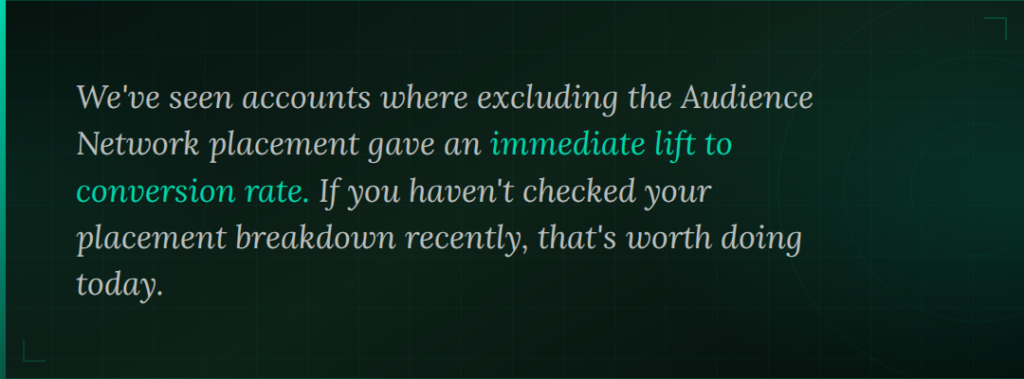
One thing we’ve actively caught in multiple client accounts: Meta has been pushing a lot of traffic to the Audience Network. This is the placement that runs ads inside third-party apps and websites, not in your Facebook or Instagram feed.
Audience Network traffic is cheap. It’s also mostly garbage. When a chunk of your budget gets routed there, your average CPC drops, your impression numbers look great, and your conversion rate falls off because people clicking on banner ads inside mobile games are not in buying mode.
How Is the Shift to Consolidated Campaigns Affecting Traffic Quality?
Over the past year or so, a lot of advertisers moved toward the Andromeda-era approach: fewer campaigns, CBO, broad targeting, let Meta’s algorithm find the buyers. In a lot of accounts, this works. It’s simpler, it’s less manual, and Meta’s system is genuinely smarter than it used to be.
But there’s a tradeoff. When you give Meta more control and pull back your own targeting guardrails, the algorithm casts a wider net. That can mean more reach, but it also means more mixed-intent traffic landing on your pages. Some of those visitors were never going to buy.
We’re not saying the consolidated approach is wrong. For a lot of accounts, it’s the right move. But if you’ve fully embraced the ‘one campaign, let Meta do everything’ model and your conversion rate has tanked, it’s worth asking whether a hybrid approach makes more sense.
| Old-School Meta Structure | Andromeda-Era (Consolidated) | |
|---|---|---|
| Campaign setup | Multiple campaigns, multiple ad sets, ABO budgets, tighter audience controls | 1-2 campaigns, CBO, broad targeting, let Meta find the buyers |
| Who’s in control | The media buyer sets most of the rules | Meta’s algorithm makes most of the calls |
| Creative role | Creative matters, but targeting does heavy lifting | Creative IS the targeting. The hook tells Meta who to find. |
| Conversion rate | Generally higher & traffic tends to be more qualified | Lower & broader reach means more mixed-intent visitors |
| CPC | Higher | Lower (but that doesn’t always mean better results) |
| What’s breaking in 2026 | Can feel rigid when Meta wants to consolidate; some efficiency lost | Audience Network junk traffic, lower conversion rates, less transparency |
| Who it works best for | Accounts with smaller, well-defined audiences; brands with strong historical data | Large catalogs; brands with broad appeal and high creative volume |
What Is Meta Actually Optimizing For Now?
Here’s something that’s easy to miss in all the noise about conversion rates: Meta has been shifting toward optimizing for buyer lifetime value, not just the first purchase.
This is actually a big deal, and it’s mostly good news long-term. If Meta is finding you buyers who will purchase again in three months, that’s worth more than finding buyers who convert once and disappear. But in the short run, it means your front-end CPA might look worse than it used to. The buyers Meta is finding are more valuable over time, which means you might be paying a little more to acquire them upfront.
The practical takeaway: don’t make decisions to cut campaigns based purely on front-end CPA right now without checking what your LTV looks like for the buyers coming through those campaigns. The picture might be better than it appears.
Is AI Making Things Worse Before They Get Better?
Probably, yeah. And this isn’t a criticism of AI broadly. It’s just an honest read on where things are right now.
A lot of advertisers have spent the last year getting AI-enabled: using AI tools to build more pages, more copy, more creative, faster. The problem is that more output is not the same as better output. We’ve seen some genuinely terrible landing pages in the last year from brands that thought ‘built with AI’ meant ‘good.’ It doesn’t. The quality bar for pages hasn’t gone up just because the production speed has.
Meta’s system is now indexing and evaluating those pages to decide who to show your ads to. If your page is weak, Meta’s read of your offer will be off, and the traffic quality you get back will reflect that.
The good news is this is fixable. Better pages, better creative, tighter offers. The fundamentals haven’t changed. They’re just being stress-tested right now in a way they weren’t when you could compensate with tighter audience targeting.
What Are the Brands That Are Still Winning Doing Differently?
Looking across our client portfolio right now, the brands that are growing share a pretty consistent set of behaviors.
They protect profitability over top-line revenue. They’re okay spending a little less and accepting lower revenue if it means the margins hold. They don’t have the ego attachment to beating last year’s revenue number if doing so means bleeding cash. That mentality lets them sleep at night and stay in the game long enough to catch the upswing.
Their founders are obsessed with product, not the marketing process. They’re spending their time thinking about what new products to launch, what their customers actually need, what would raise lifetime value. They’re not hovering over the creative approval process or trying to micromanage adset structure. The founders who let the marketing team do their job, and focus their own energy on product and market understanding, are consistently outperforming the ones who are trying to control everything.
They have an organic presence that supports paid. Brands with active podcasts, social channels, or founder-led content are seeing higher ROAS on their paid ads. It’s not just about organic reach. It’s about having an audience that already knows and trusts the brand when the ad hits. Running ads from a page that has credibility and content behind it performs better than running ads from a dead page.
What Should You Actually Do Right Now?
Summer is typically a softer period for most businesses. That makes it a useful window to step back from the day-to-day and make some bigger decisions.
First, check your Audience Network placement and see how much traffic is going there. If it’s significant, test excluding it and watch what happens to conversion rate.
Second, audit your landing pages honestly. Not ‘did AI help build this’ but ‘does this page actually convert.’ If your conversion rate has dropped, the page is often where the problem lives, and it’s one of the few things you have full control over.
Third, think about what would happen if Meta’s performance stays at current levels. Not because it will, but because it’s a useful exercise. What would you do differently? What other channels would you invest in? What product changes would change your economics? The brands working through those questions now will be in a better position when things normalize.
And they will normalize. Meta has every incentive in the world to make this platform work for advertisers. They’re not going to let conversion rates stay at historical lows indefinitely. But the timeline is theirs, not ours, which means the best thing we can do is build businesses that are resilient enough to weather the rough patches.
Want Help Navigating This?
If you’re looking for support on Meta, Axon, email, or AEO, Smart Marketer Agency has openings right now. You can head to smartmarketeragency.com or email Pep directly at pep@smartmarketer.com.
And keep an eye out for Smart Marketer OS, the agentic system we’re building to help ecommerce businesses run more of their operations on AI. More on that soon at smartmarketer.com/podcast.


