


Most brands learned to generate Facebook ads with AI and assumed the job was done. The output came fast, the images looked polished, and the account filled up with creative. Then the cost to acquire a customer kept climbing anyway. The problem was never the speed. The problem was what the AI was building, and whether Meta’s matching system could do anything useful with it. This post breaks down what Meta actually reads when it looks at an ad, why creative volume built on the wrong foundation trains the algorithm in the wrong direction, and how to build a hundred genuinely different ads that each open a new pocket of buyers.
Key Takeaways
- Meta’s ad auction attributes 56% of outcomes to creative, according to Nielsen Catalina Solutions, making creative output the single biggest growth lever in a Facebook account.
- Meta reads ads through contextual vectors that analyze pixels, copy, faces, objects, and spoken words, then uses that fingerprint to determine audience targeting automatically.
- Maximizing entity IDs, meaning genuinely distinct ad units across format, environment, person, and concept, gives Meta more audience pockets to match and expands account scale.
- Sub-avatars found inside customer reviews are the fastest source of untapped entity IDs and usually number ten to fifteen within a single brand’s existing customer base.
- AI built on direct-response principles produces ads. Generic AI image generators produce decoration.
Why Does Facebook Ad Creative Matter More Than Targeting Now?
Creative is the targeting. A Nielsen Catalina Solutions study, cited in Meta’s own Performance Playbook, found that 56% of ad auction outcomes are determined by the creative itself. Audience settings and bid strategy account for less than half of what decides who wins the auction.
For any DTC brand running paid media on Facebook, this reframes the entire growth problem. The audience is no longer something you construct in Ads Manager by stacking interest layers. Meta constructs it by reading what your ad contains and matching it to people in its database who fit that signal. The job of targeting has moved from the campaign settings to the creative brief.
Most accounts are running four or five ads, and have been for months. Those ads are all pointing at the same narrow slice of people. The account stalls not because of a bidding problem or an audience problem, but because Meta does not have enough distinct inputs to find anyone new.
How Does Meta’s AI Actually Read Your Facebook Ads?
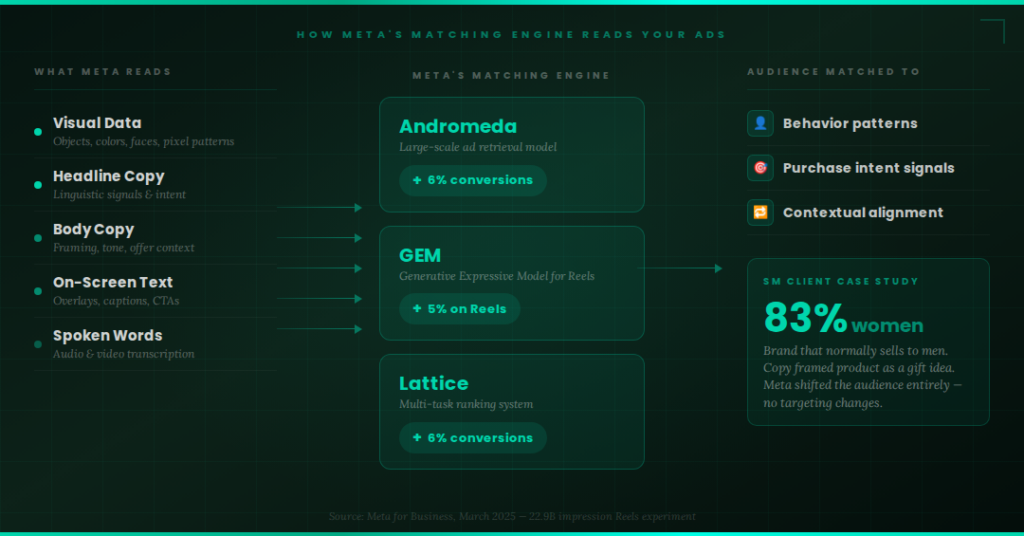
Meta determines audience targeting by analyzing contextual vectors from every ad, including pixel-level image data, headline copy, body copy, on-screen text, and spoken words in video. The system identifies objects, colors, faces, tones, and linguistic signals, then matches the ad to users whose behavior patterns align with that combination of signals.
Our team at Smart Marketer saw this in a client account that normally sells to men. The brand ran a Valentine’s Day promotion with copy framing the product as a gift idea for women to buy for the men in their lives. Meta read the gifting signal embedded in the copy and shifted the audience entirely. Over the course of that sale, 83% of buyers were women. No targeting settings were changed. The copy changed what Meta understood the ad to be, and the algorithm followed.
Three systems drive this matching capability today. Andromeda, Meta’s large-scale ad retrieval model, delivered a 6% lift in conversions in Meta’s own testing. GEM, the Generative Expressive Model built for Reels, added another 5% on that format. Lattice, their multi-task ranking system, contributed an additional 6% lift. These results come from a Meta for Business case study published in March 2025 covering a 22.9 billion impression Reels experiment. The matching engine is more capable than it has ever been. A better engine is only as useful as the variety of inputs a brand feeds it.
What Are Entity IDs and Why Do They Determine Your Cost Per Acquisition?
An entity ID is Meta’s internal representation of a distinct ad unit. It is the unique combination of signals that separates one ad from another in the algorithm’s view. More distinct entity IDs mean more audience segments Meta can profitably reach on a brand’s behalf.
An ad becomes genuinely distinct across four dimensions. Format is the first: a static image, a short-form video, a carousel, and a chat-style screenshot are each different entities. Environment is the second: a product shot in a kitchen reads differently than the same product shot on a trail. The person on screen is the third, and arguably the most powerful. Age, look, and presence all send targeting signals Meta reads immediately. Concept is the fourth: a before-and-after, a founder story, a customer testimonial, and an ingredient breakdown each carry a different message and point toward a different segment of buyers.
Mixing across those four dimensions turns a handful of creative concepts into a library of genuinely distinct entities. Fifty ads built this way give Meta fifty different doors to knock on. Fifty versions of the same ad with minor copy tweaks give it one door, slightly repainted.
What Are Sub-Avatars and How Do You Find Them in Your Own Data?
Sub-avatars are the distinct buyer profiles that exist within a brand’s single customer avatar. They are real people, identifiable in customer review data, who buy the same product for different reasons. Each sub-avatar is a source of entity IDs the brand has not yet built creative around.
Our team at Smart Marketer works with Moccasins Canada, a brand selling a traditional moccasin boot. The surface-level avatar looks like this: someone who wants a moccasin. But the reviews tell a more specific story. One buyer group is purchasing for the aesthetic, the craftsmanship, and how the boot fits into an outfit. A second and completely separate group is buying for function in the field: the boot’s quiet movement, warmth, and performance on hunting terrain. These two buyers share almost nothing in terms of what they need to see in an ad to convert. The setting, the person, the angle, and the hook are entirely different for each.
Most DTC brands have ten to fifteen sub-avatars sitting in their reviews right now. Finding them requires reading those reviews with one question in mind: what problem did this person have before they bought, and what did the product do for them? The answers map to sub-avatars. Each sub-avatar maps to a new batch of entity IDs. The reviews are not just social proof. They are a creative brief.
How Should You Use AI to Generate Facebook Ads at Scale?
AI generates Facebook ads at scale effectively when it executes a brief built from direct-response principles. Generic prompts produce generic creative. Generic creative carries no useful targeting signal and trains the algorithm toward audiences who scroll past product-on-gradient images.
The right framework starts with the transformation the product delivers: the before state and the after state for a specific sub-avatar. Brand guidelines go in next, so the output stays visually consistent with what the account has already established. The specific sub-avatar goes in after that, so the person, environment, and concept are grounded in a real buyer. The hook and angle come last, chosen for that sub-avatar’s specific problem. AI executes on that brief at volume. The thinking is still yours.
Generic AI vs. Direct-Response AI: What Goes Into the Account
| Generic AI Approach | Direct-Response AI Approach | |
| Starting point | Product name and category | Sub-avatar before/after state |
| Brand alignment | Ignored | Brand guidelines integrated |
| Creative concept | Auto-generated | Explicitly briefed |
| Meta signal quality | Low (generic imagery) | High (avatar-specific signals) |
| Account training effect | Trains toward passive scrollers | Trains toward buyers |
| Example output | Product on gradient background | Problem-to-solution narrative ad |
This is the distinction Thumbstop was built around. The platform at usethumbstop.ai is designed for direct-response creative generation, with the sub-avatar, brand guidelines, and hook structure built into the workflow. Moccasins Canada is currently running multiple thousands of dollars per day on creative built through Thumbstop, not because the tool is fast, but because the AI is pointed at the right inputs.
How Do You Launch 100 New Ads Without Disrupting Active Campaigns?
Meta’s Creative Testing Feature, detailed in the Meta Creative Performance Playbook 2025, allows up to five creative variants to run within a single evergreen campaign under a dedicated test budget. The goal is reaching approximately 50 conversions per variant before evaluating performance. Winning ads stay in rotation. Losing ads are removed. The proven evergreen campaigns continue running separately.
This structure lets a brand introduce a large batch of new creative from new sub-avatars or new concept dimensions without fragmenting the budget or destabilizing what is already performing. The hundred ads do not go live simultaneously. They feed into the machine in controlled rounds, and the account learns from each one.
What Should You Do Before Using AI to Generate a Single Ad?
The work that makes AI-generated Facebook ads perform happens before any AI tool is opened. Getting this sequence right is what separates a hundred high-performing ads from a hundred expensive experiments.
- Read fifty customer reviews and write down every distinct reason people bought. These are your sub-avatars.
- For each of the top three sub-avatars, write the before state and the after state: the problem they had, and the life they moved into after the product.
- Map each sub-avatar across the four entity dimensions: format, environment, person, and concept. On paper, this already produces a list of a hundred genuinely distinct ad ideas.
- Feed that completed brief into an AI tool built for direct-response output, not a generic image generator.
That sequence produces a hundred distinct entities. Each one is a door Meta can use to find a different kind of buyer. Anyone can generate a hundred ads. The brands that win are the ones whose hundred ads are actually a hundred different answers to the question of who this product is for.


