
Q4 is officially here, and your BFCM email flows need attention before your promo calendar takes over. You’ve got about eight weeks to fix, refresh and test the automated emails that will greet every new holiday customer for the official BFCM (if you don’t start your promo early).
Most brands spend October building the Black Friday sale: the offer, the countdown emails, the Meta ads. Almost nobody opens up their ESP to check the flows running in the background. Those flows are about to get the biggest traffic of the year. This guide covers which ones to fix first, how to audit them, and how to protect your inbox placement before sending volume spikes.
Key takeaways
- Automated flows drive outsized revenue. Flows are a small share of the emails you send but often bring in 30–50% of email revenue.
- Fix your post-purchase flow first. Every BFCM buyer lands there, and it decides whether they buy again in January.
- Clean your list before volume goes up. Gmail and Yahoo reward engagement, so a smaller engaged list beats a big inactive one.
Why do automated email flows matter more than broadcasts in Q4?
Automated flows are triggered by a customer action, such as signing up, browsing, adding to cart or buying. That timing makes them more relevant than broadcasts. In Q4, traffic spikes, so flows fire far more often and multiply their revenue impact with no extra work.
A broadcast (some ESPs call these campaigns) goes out on your schedule to a segment of your list. A flow goes out on the customer’s schedule, right after they tell you what they care about. It works the same way retargeting does in paid ads.
The trap is that Q4 pulls all your mental energy toward broadcast promotions. Reinvesting even a quarter of that time into your flows is one of the highest-return moves you can make this season.
When should an email be a flow instead of a broadcast?
An email should be a flow when many people take the same action over and over. Examples include placing an order, viewing a product, abandoning a cart, or joining your list. If the trigger repeats, automate the response instead of sending it by hand.
Which email flow should you fix first before Black Friday?
Fix your post-purchase flow first. Every customer you win during Black Friday/Cyber Monday enters it right after checkout, when they’re most engaged. A strong post-purchase flow raises average order value and lifetime value, and it turns one-time deal buyers into repeat customers.
It’s tempting to start with abandoned cart, because moving your conversion rate from 3.1% to 3.8% feels urgent. But the post-purchase flow is where the long game is won. New customers are excited, and your job is to keep that excitement going until the package arrives. Shipping takes two days in the best case and often a week or more during the holidays.
A strong post-purchase flow does four things:
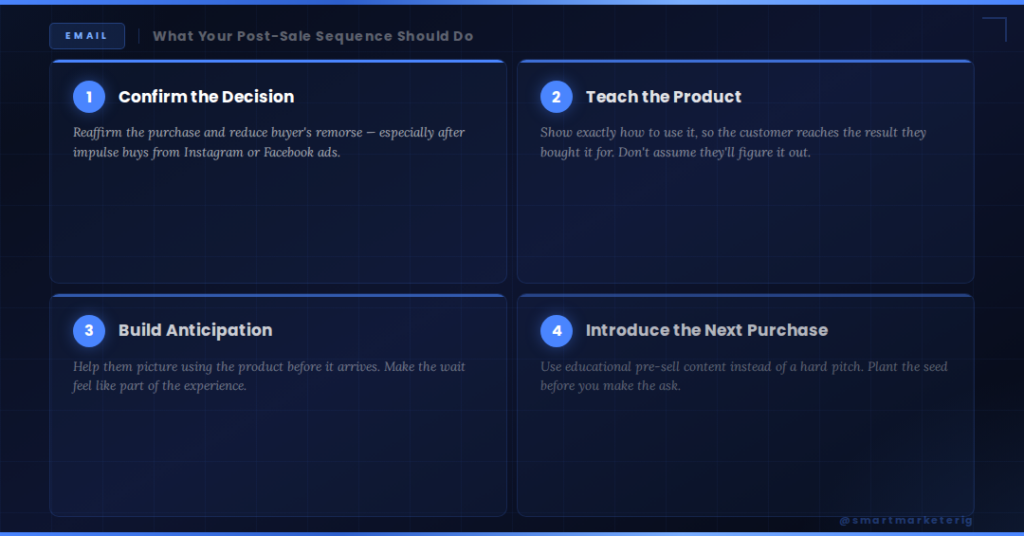
For BFCM, also add holiday shipping cutoffs and gift-giving tips to your post-purchase emails. Many Q4 buyers are shopping for someone else.
How do you audit your email flows before BFCM?
Run a quick health check on every flow, then go deep on one flow at a time. Check that emails are delivering, links work, content is current, and click rates haven’t dropped. Start now, while you still have a little time to test changes before Black Friday traffic hits.
“Set it and forget it” is the biggest trap in email automation. Flows break quietly. A pop-up stops showing, and your welcome flow dries up. A site update breaks a link. A flow is still promoting spring looks in November. None of it shows up until revenue dips.
Use this monthly audit process, and run it this week:
- Top-level check across all flows. Look at delivery, click rate, placed-order rate, and revenue per recipient in your email service provider.
- Diagnose any drops. If a flow’s numbers fall, check what feeds it before you rewrite the emails. Look at the pop-up, the signup form, the ad driving leads, and the product page.
- Pick one flow to optimize. Refresh stale or seasonal content, fix broken links, and update offers.
- Move winning campaigns into flows. If a broadcast email performed well, find a flow where that angle fits so it keeps working.
- A/B test content, not just subject lines. Test the angle or topic, and test changes flow by flow before rolling them out everywhere.
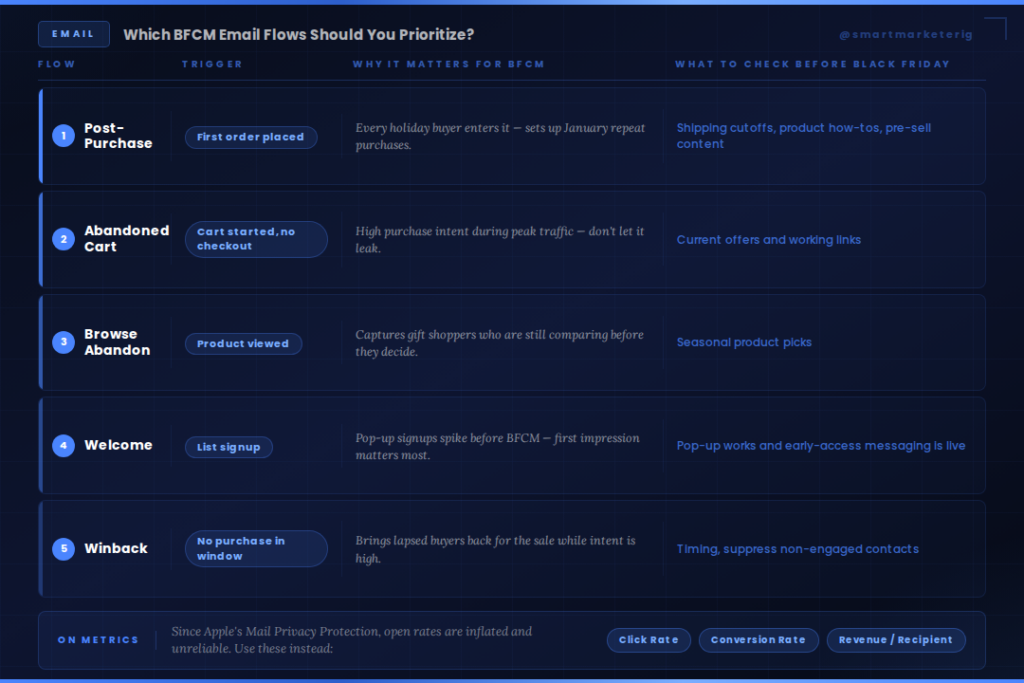
Which BFCM Email Flows Should You Prioritize?
Why should you clean your email list before Black Friday?
Cleaning your list protects deliverability right when you need it most. Gmail and Yahoo decide inbox placement based on engagement. If a large share of your list never opens or clicks, your BFCM emails and your flows risk landing in spam, even for your best customers.
List size is an ego metric. A list that’s 40% smaller but engaged will reach more real inboxes than a bloated list full of inactive subscribers. Automated emails are triggered by behavior, so they send whether your list is clean or not. Whether they land in the inbox depends largely on how engaged the rest of your list is.
Since February 2024, Google (Gmail) and Yahoo have enforced bulk-sender requirements you should already have in place:
- Authenticate your domain with SPF, DKIM, and DMARC.
- Include one-click unsubscribe in marketing emails, and honor unsubscribes within two days.
- Keep spam complaint rates low. Google’s threshold is 0.3%, and staying under 0.1% is safer.
Before holiday sending volume ramps up:
- Confirm SPF, DKIM, and DMARC are set up in your email service provider and DNS.
- Suppress subscribers who haven’t opened or clicked in 90–180 days, depending on how often you send.
- Run a short re-engagement flow first, so you give inactive subscribers one last chance.
- Increase send volume gradually through October and early November instead of jumping on Black Friday.
Do you need a separate post-purchase flow for every product?
No. Start with one general post-purchase flow for all orders. Then build product-specific flows for your best sellers, new launches, and products that need more instruction. If you have a large catalog, group products by category instead of building a flow for every SKU.
Personalized messaging almost never converts worse than generic messaging, so the only real limit is time and resources. Prioritize like this:
- Sort products by units sold per month and start with your top seller.
- Add flows for new or complex products that will raise questions after purchase.
- Group by category (for example, all cosmetics or all skincare) to cover more products with less work.
What should you send in a post-purchase flow besides “thanks for your order”?
Send pre-sell content for related products. A pre-sell is an educational, problem-focused piece, like an article or tip, that naturally leads to another product. It reads as helpful rather than pushy, so it drives extra sales while keeping the relationship strong.
For example, a customer who buys mascara might get tips for doing makeup while wearing glasses. Someone who buys a skincare set might get an article on why daily moisturizing matters. Customers want education and connection with the brands they just bought from, and pre-sell content gives them both.
What are the biggest BFCM email flow mistakes to avoid?
The biggest mistakes are growing list size at the expense of engagement, leaving flows untouched for months, and treating email as a standalone channel. In Q4, add one more: putting all your energy into sale broadcasts while the flows that drive much of your revenue go stale.
Other mistakes include:
- Chasing list size over list health. An inactive list hurts deliverability for everyone on it.
- Setting flows and forgetting them. Broken links, dead pop-ups and out-of-season content cost sales quietly.
- Only testing subject lines. Content and angle tests usually teach you more.
- Working in silos. If your email, SMS, and paid ads teams don’t talk, customers get bombarded with mixed messages.
Email is your most profitable channel, but it isn’t your only one. During BFCM, customers see you in the inbox, in SMS, on Meta, Google, and YouTube, and maybe on TV. Keep one consistent message across every touchpoint. Coordinate frequency so you stay the brand people are excited to hear from, not the one they unsubscribe from.
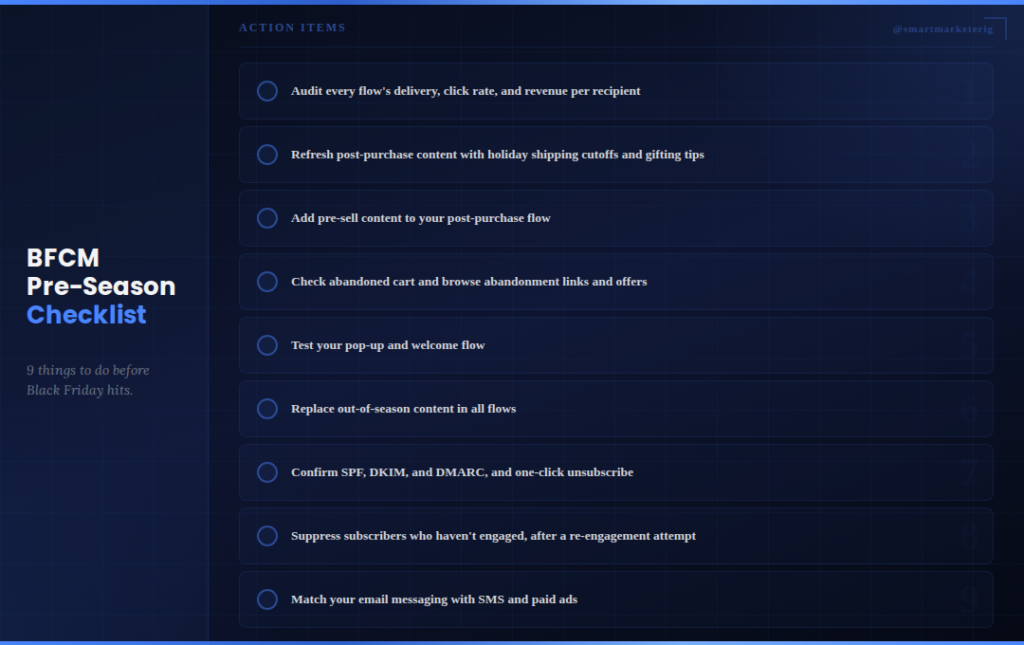
BFCM email flow checklist
Use this checklist in October to have your flows ready before Black Friday:
Get your flows ready now
Black Friday traffic is coming whether your flows are ready or not. Spend a few hours this month tightening them. Every new customer you win in November will get a better first experience, and more of them will come back in January.


