
Nearly 60% of Google searches now end without a click. People have not stopped looking for answers. They are simply getting those answers earlier, often before they reach a website.
That shift is already affecting the numbers. AI-referred buyers convert 42% better than average, and AI-driven retail traffic is up 400% year over year. One of the sharpest commerce operators we know, a person who has overseen more than $100 billion in transactions, believes all commerce will become agentic within the next 24 to 36 months.
Whether that timeline proves exact or not, the direction is clear: AI is becoming part of the buying process.
A customer asks a question. An AI tool builds a short list, explains the options, and may recommend one brand over another. By the time that customer reaches your site, a meaningful part of the decision may have already been made.
This is where Answer Engine Optimization, or AEO, comes in.
AEO is the work of helping tools like ChatGPT, Perplexity, Google AI Mode, and Gemini understand your brand well enough to recommend it in the right situations. It shares some fundamentals with SEO, but it requires a wider view of authority, reputation, context, and how your brand is represented across the web.
Most businesses have never checked what AI says about them. That creates an unusual window for brands willing to do the work now.
What AEO actually means
AEO stands for Answer Engine Optimization. The goal is to make your brand easy for AI systems to find, understand, trust, and recommend.
A citation is useful. A recommendation is much more valuable. AI can currently fail your brand in three ways:
1. Invisible: The tool does not recognize your brand as a relevant option.
2. Bypassed: The tool understands what you sell, then recommends a competitor because it has more confidence in that competitor’s fit.
3. Devalued: The tool finds enough weak reputation, review, or trust signals to warn the buyer away from you.
That third outcome deserves more attention than it gets. A brand can rank well in search and still lose the recommendation inside an AI answer. Software has traditionally been built to help businesses sell. AI assistants are being built to help customers buy. Those incentives overlap, but they are not identical. The AI wants to make a useful recommendation for a specific person in a specific situation. Your job is to give it enough clear, credible evidence to understand when your brand belongs in that answer.
We are already seeing the business impact across ecommerce:
– A wellness brand increased branded search by 50% in five months and moved its average Google position from 13.6 to 5.1.
– An outdoor gear brand tripled AI-attributed revenue and doubled average order value.
– A consumer wellness brand increased organic clicks by 64% and moved from page two to page one.
– A health and wellness brand attributed 16.5% of tracked revenue directly to AI.
These results will vary by brand, category, and measurement method. The pattern still matters. AI visibility is becoming commercially meaningful while the competitive field remains surprisingly quiet. In the data set behind this work, only about 2 out of every 1,000 competitors in a typical category are doing serious AEO work. That will not stay true for long.
Early search created a similar advantage. The businesses that established authority before every competitor understood the channel built a lead that became expensive to close. AEO appears to be in that stage now.
The BRAIN Framework
AEO can feel abstract until you turn it into a set of practical questions.
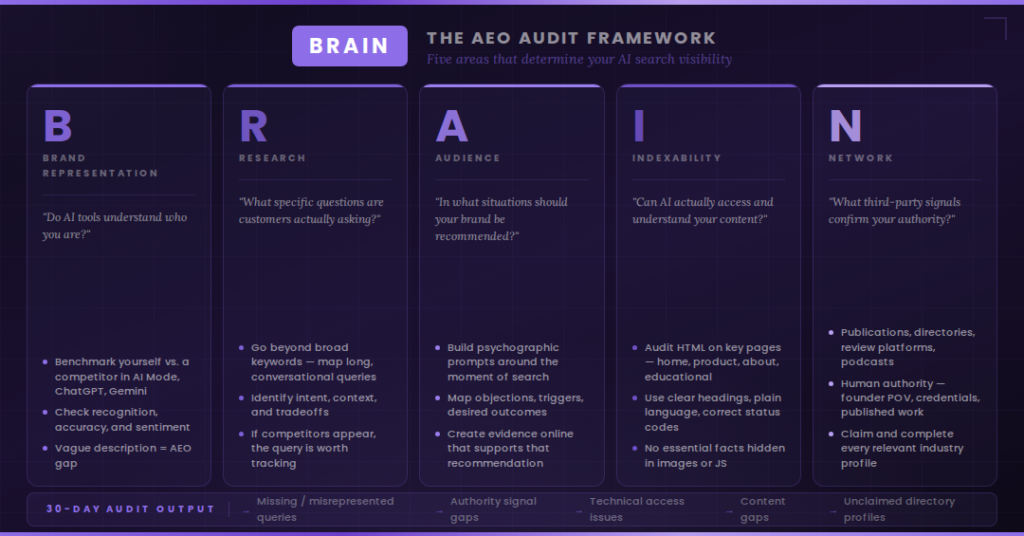
The BRAIN Framework does exactly that. It looks at five areas: Brand Representation, Research, Audience, Indexability, and Network.
Together, they show you where AI visibility is breaking down and what to fix first.
B: Brand Representation
Start with the most basic question: Do AI tools understand who you are?
Open a private or incognito browser window and run a simple benchmark in Google AI Mode, ChatGPT, Gemini, or Perplexity. Check your brand and a direct competitor using the same type of query.
You might ask:
– What is this company known for?
– Who is this product best for?
– What are the strongest alternatives in this category?
– Which brand would you recommend for a buyer with this specific need?
– What are the common concerns or complaints about this company?
Incognito mode reduces some personalization, although it does not create a perfectly neutral test. The purpose is to get closer to a clean baseline and compare how each brand is represented.
Look for gaps in recognition, accuracy, sentiment, specificity, and confidence. If the AI can explain your competitor clearly but describes your brand in vague terms, you have found an AEO problem.
R: Research
Traditional keyword research groups demand into broad themes. AEO research needs to go deeper into the actual questions customers ask.
AI is very good at handling long, conversational, highly specific prompts. Your research should reflect that behavior.
Instead of tracking a broad phrase like “best running shoes,” look at questions such as:
– What running shoe is best for a heavier runner with knee pain?
– Which shoe works well for wide feet on long trail runs?
– What is a good beginner running shoe under a specific budget?
– Which brands have the best return policy for someone unsure about sizing?
These questions reveal intent, context, concerns, and tradeoffs. They also reveal which competitors the AI already associates with each use case.
A simple validation rule helps: if a query consistently surfaces companies you recognize as real competitors, it is worth tracking. Your brand does not need to appear yet. Its absence is part of the finding.
A: Audience
Basic demographics are no longer enough.
AI answers change with context. The same product may be a strong recommendation for one customer and a poor fit for another. That makes psychographics, situational triggers, objections, and desired outcomes much more useful than a generic customer avatar.
Build prompts around the moment that created the search:
– What happened right before the customer asked for help?
– What have they already tried?
– What are they worried about getting wrong?
– Which tradeoffs are they willing to make?
– What would make them trust one option over another?
Deep research tools can run a large set of prompts against your brand, category, and customer profile in one session. The raw output gets dense quickly, so do not treat it like a report you need to read line by line. Export it, group repeated themes, and turn the findings into a clear question map.
The goal is to understand the situations in which your brand should be recommended, then make sure the web contains enough evidence to support that recommendation.
I: Indexability
AI cannot use information it cannot access or understand. Review the raw HTML for your homepage, collection pages, product pages, About page, and important educational content. Use a crawlability and content-access check to identify information that is hidden, unclear, duplicated, or dependent on scripts that some systems may not process well.
This work often belongs with a developer, technical SEO specialist, or webmaster. That is fine. Marketers do not need to fix every technical issue themselves, but they should know what to ask for.
At minimum, confirm that your important pages:
– Load reliably and return the correct status codes.
– Explain the company, products, audience, and use cases in plain language.
– Use clear headings and structured page content.
– Connect products to the problems they solve.
– Include accurate organization, product, author, and review information where appropriate.
– Do not hide essential facts inside images or inaccessible scripts.
Give the technical recommendations to the person who owns the site and ask for a clear implementation plan.
N: Network
The final pillar looks beyond your website.
AI systems build confidence from a network of signals: reputable publications, industry directories, review platforms, interviews, expert profiles, books, podcasts, videos, social content, and other sources that independently confirm who you are.
This is also where human authority becomes important.
Brands with a visible founder or subject matter expert often have an advantage. A real person can build a body of work, publish research, write a book, hold credentials, earn patents, appear on podcasts, and become known for a specific point of view. Those signals give answer engines more context than brand copy alone.
A BRAIN audit should leave you with a practical 30-day plan, including:
– The questions where your brand is missing or misrepresented.
– Your strongest and weakest authority signals.
– Technical access problems on important pages.
– Content gaps tied to real customer situations.
– Relevant industry directories and review platforms you have not claimed or completed.
– A short list of authority-building actions your team can realistically execute.
Every category has its own version of Yelp, TripAdvisor, G2, or Capterra. Many businesses have never checked whether their profile is accurate, complete, or even claimed.
How AI decides which sources to trust
Be careful with any tool that promises to show your fixed “ChatGPT ranking.”
There is no direct equivalent to Google Search Console for answer engines today. AI visibility is contextual. The answer can change based on the wording of the question, the customer’s situation, conversation history, location, available sources, and the model being used.
A single ranking number creates false precision.
You can still measure AEO. You simply need a better scorecard. Useful indicators include:
– Visibility across a consistent set of customer prompts.
– Share of recommendations compared with named competitors.
– Accuracy and sentiment in brand descriptions.
– Bot crawl activity.
– AI referral traffic with clear UTM tracking.
– Conversion rate, average order value, and assisted revenue from AI referrals.
– Post-purchase survey responses that mention an AI assistant.
– Changes in branded search and direct traffic.
Use a stable prompt set, run it on a schedule, and record the model, date, geography, and testing conditions. You are looking for patterns, not a universal rank. The citation data also shows why a broad strategy matters.
In the analysis shared with us:
– Perplexity citations overlap with Google search results roughly 70% to 80% of the time.
– ChatGPT citations overlap with Google roughly 50% to 60% of the time.
– Gemini’s overlap can be around 25% at the high end and much lower in some categories.
These percentages change over time and by category, so they should guide priorities rather than act as permanent platform rules.
The broader implication is useful. Strong SEO still matters, especially for tools that rely heavily on sources already visible in Google. It is only one part of the job. Brands also need credible third-party mentions, consistent entity information, useful expert content, strong reviews, and enough context for an AI system to understand fit. Paid media does not appear to offer a direct shortcut. There is currently no clear evidence that spending more on Google Ads causes AI tools to recommend a brand more often.
The durable lever is structural: Make your brand easy to understand and support it with sources the AI already trusts.
Why human authority matters so much
SEO has historically favored brand and domain authority. AEO places more weight on identifiable people with verifiable expertise. A person can write a book, earn a degree, hold a patent, publish original research, speak at an event, or build a public record of answering the same kinds of questions customers ask. AI systems can connect those signals to the person’s company and area of expertise.
This leads to a practical two-brand strategy:
1. Build the company brand.
2. Build the authority of a founder or expert and connect that person clearly to the company.
Before you invest in this strategy, answer three questions:
1. Who can credibly serve as the authority? This may be a founder, practitioner, product expert, researcher, or experienced operator.
2. Can AI independently verify who that person is? They need a clear profile, website, author page, body of work, or other consistent public presence.
3. Can they create useful content consistently? Consistency matters more than volume.
The content commitment can be smaller than most teams assume.
One focused hour each month may be enough to record answers to the questions customers are already asking. That session can become a full video, podcast episode, article, short clips, email content, social posts, and visual explainers.
This is content atomization: one useful conversation turned into multiple formats for different channels. The value comes from repeating a clear body of expertise across the places customers and AI systems already look. Podcasting is especially useful because it can create video, audio, transcripts, quotes, clips, and articles from one source. YouTube also plays a major role in podcast discovery, which gives the format reach beyond traditional podcast apps.
The format matters less than the consistency of the expertise. Pick questions that connect directly to what your company knows, answer them clearly, and publish them under a real person’s name.
Specific authority can beat broad authority
Large companies tend to produce broad content because they serve broad markets. That leaves room for smaller experts to win on specific questions.
A national health platform may have a powerful domain, but it is unlikely to publish a detailed guide to finding hospice care in one particular neighborhood. A local practitioner who answers that question with real experience, accurate details, and clear authorship may become the better source for that exact situation.
The same pattern appears across ecommerce.
A large outdoor brand may publish a general hiking boot guide. A smaller retailer can create the best answer for hikers with wide feet, recurring ankle pain, and a specific type of terrain. A national skincare company may own broad category terms. A qualified specialist can build stronger authority around one skin concern, one ingredient interaction, or one customer profile.
You do not need to become the internet’s leading authority on an entire category. You need to become a credible, useful source for the questions that matter most to your customers.
Write answers the way AI can use them
Good AEO content is also good customer communication.
Lead with the answer. If the question is yes or no, say yes or no in the first sentence. Then explain the conditions, reasoning, evidence, and exceptions.
For example:
Question: Is this product safe for sensitive skin?
Weak opening: Sensitive skin can be affected by many factors, and today’s skincare market contains a wide range of products designed for different needs.
Stronger opening: Yes, this product is formulated for sensitive skin. Anyone with a known allergy to one of the listed ingredients should avoid it.
The stronger version gives the reader an immediate answer and makes the qualification clear. It is easier for a customer to use and easier for an answer engine to extract accurately.
Use the same approach across product pages, FAQs, buying guides, founder content, help-center articles, and comparison pages:
– Answer the main question early.
– Name the person or situation the answer applies to.
– Explain important tradeoffs.
– Use specific evidence where it is available.
– Keep authorship and expertise visible.
– Update time-sensitive guidance when conditions change.
Clear writing will not replace authority, technical access, or reputation. It helps all three do their job.
Where to start this week
You do not need a six-month AEO roadmap before you take the first useful step.
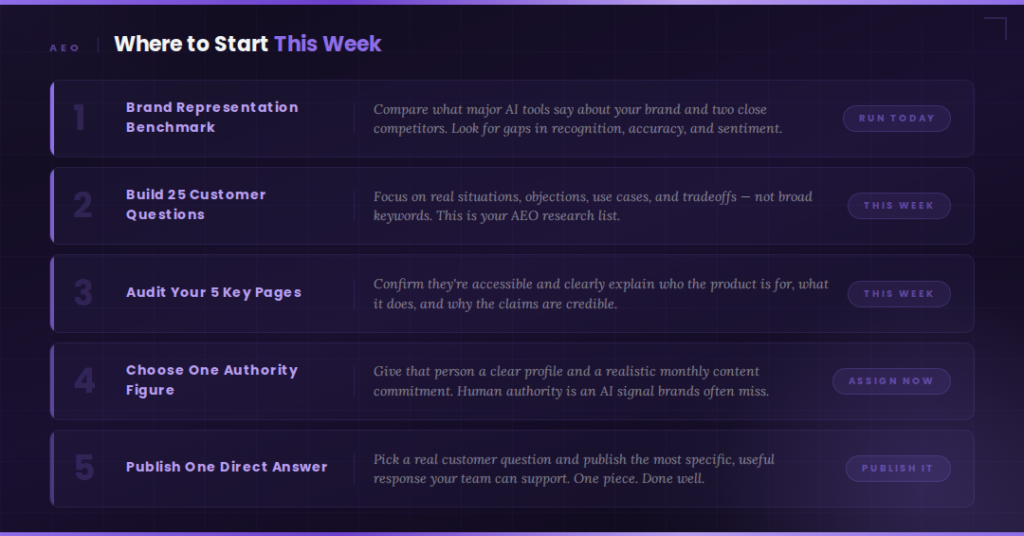
Start with five actions:
1. Run a Brand Representation benchmark. Compare what the major AI tools say about your brand and two close competitors.
2. Build a list of 25 customer questions. Focus on real situations, objections, use cases, and tradeoffs.
3. Check your five most important pages. Make sure they are accessible and explain who the product is for, what it does, and why the claims are credible.
4. Choose one authority figure. Give that person a clear profile and a realistic monthly content commitment.
5. Publish one direct answer. Pick a valuable customer question and create the most specific, useful response your team can support.
Then repeat the benchmark. Look for better accuracy, stronger recognition, more recommendations, and measurable business impact. Small, credible signals compound. The opportunity right now is simple: AI is already answering questions about your brand, while very few competitors are actively shaping those answers.
Our friend, Kasim, built a free community for marketers and founders working through this shift. Join the AEO community to go deeper on the BRAIN Framework, compare notes with other operators, and access the free AEO resources we have put together.
AI is already influencing what customers see, trust, and buy. Make sure your brand gives it something accurate and worth recommending.


