
Answer engine optimization (AEO) is the practice of making your brand the cited source when AI tools like ChatGPT, Google Gemini, and Perplexity generate an answer to a user’s question. Where SEO was about showing up on a page of results, AEO is about becoming the answer itself.
This is the channel that Molly Pittman and Kasim Aslam have been building toward together, and in a recent episode of the Smart Marketer Podcast, they broke down what AEO actually is, why it rewards businesses with real products and real expertise, and what their first client cohort has already produced in just 60 days. This is not just another AI theory conversation. There are case studies and numbers to back it up.
Key Takeaways
| AEO is to ChatGPT what SEO was to Google Search. The goal is to be the cited source when AI tools answer questions in your niche. |
| Schema.org validated schema markup appears on 90%+ of websites that AI tools cite. Only 12% of websites on the internet have it. This is the fastest fix most businesses can make today. |
| AI-referred traffic converts at 13x the rate of standard organic traffic. The intent behind these queries is unlike anything seen in traditional search. |
| Perfect attribution does not exist in AEO and likely never will. Measurement looks more like old-school radio and TV than a Google Analytics dashboard. |
| Answer engines trust people over brands. Someone at your company needs to be the expert voice, creating content consistently. |
What Is Answer Engine Optimization (AEO), and Why Should Marketers Care?
Answer engine optimization is the discipline of influencing which sources AI tools draw from when generating a response. Platforms like ChatGPT (OpenAI), Google AI Mode powered by Gemini, and Perplexity do not return a ranked list of pages. They synthesize an answer and, in many cases, attribute it to specific sources. Getting your brand into those citations is what AEO is about.
Kasim Aslam, who spent 15 years running one of the highest-performing Google Ads agencies in the world and oversaw more than $100 million in annual adspend, got his first exposure to the concept through a conversation with a business partner. That moment sent him down a two-year research track. His team built out a data operation with employees to study how Large Language Models (LLMs) source their citations, query by query, vertical by vertical. The team now has tens of millions of data points on the subject, making their research one of the most comprehensive sets of AEO intelligence outside of the platforms themselves.
The reason this caught Kasim’s attention so fast goes back to his background in paid search. Google and Meta are both reselling your customers’ intent back to you, and they operate on short attribution windows that make them look more responsible for conversions than they often are. Organic traffic, by contrast, has always driven the majority of actual internet activity. What AI tools do is concentrate the highest-intent slice of that organic traffic and deliver it through a single, synthesized answer. The commercial potential of that is significant.
How Is AEO Different from Traditional SEO?
Traditional SEO was gamifiable. Link building worked. If you built enough high-quality backlinks, you ranked. Content quality mattered, but it was largely secondary to the link game. Entire businesses like SEMrush, the Hoth, and PosiRank were built on that fact.
AEO does not work that way. The most important structural difference is that answer engines are deeply contextual in a way that search engines never were. In traditional search, 90% of the ranking equation was the question and the answer. With AI tools, who is asking matters as much as what they are asking. Demographic signals, psychographic signals, conversation history, location, and dozens of other factors all influence what any individual user sees. Two people in the same house, searching on the same network, can ask the identical question and receive meaningfully different responses.
This means scale is not the lever it used to be. You cannot buy your way into citations. You cannot manufacture your way into authority. What you can do is build a business that is genuinely good at something, make sure the internet knows about it through the right channels, and structure your digital presence so AI tools can actually parse and trust your content.
The other major difference is integrity. AEO rewards businesses that are demonstrably better in some way. If your product has unresolved complaints, negative reviews, or a reputation problem anywhere online, running an AEO strategy will surface all of it. The system shines a brighter light on whatever already exists. That makes it one of the most powerful quality filters in marketing history, and it is accelerating the end of business models built on slick advertising alone.
Why Do Answer Engines Trust People More Than Brands?
One of the more surprising findings from the data work Kasim’s team did is how dramatically answer engines weight individual human experts over brand entities. The discovery came through an unexpected observation: a citation that appeared to come from a well-known industry site turned out, on closer inspection, to be a citation of a specific person quoted on that site. The site did not get the credit. The person did.
This makes sense when you think about how expertise actually works. A practitioner with a small but highly relevant audience, where most of their followers are peers in the same field, carries more authority on a topic-specific query than a generalist with a million followers. AI tools are sophisticated enough to detect the difference. If most of the people engaging with your content are themselves recognized as credible in your space, that signal carries far more weight than raw follower counts or brand recognition.
The practical implication is that every business pursuing AEO needs a real person out front. A founder, an operator, a practitioner with genuine expertise and a willingness to create content that demonstrates it. Brands on their own are increasingly just shells in the eyes of these systems. The person behind the brand is what the AI is actually looking for.
How Do You Measure AEO Results When There Is No Click-Through Data?
Measurement is the hardest part of AEO, and anyone selling you a clean dashboard with traditional ranking positions is overselling what is currently possible. There is no Search Console equivalent for ChatGPT. There is no API that tells you where you rank inside an LLM because, structurally, there is no such thing as a fixed rank. Every user gets a response shaped by their own context, so your position is never the same twice.
Most of the tools on the market that claim to measure AI visibility operate by setting up sandboxed environments and querying AI platforms on behalf of clients. The problem is context contamination. When multiple clients share the same querying environment, the context window gets polluted, and the results become unreliable. After testing around 50 of these tools, the team at AEO.co has concluded that none of them can accurately represent where a business actually stands inside these platforms.
What you can measure are the signals around the edges. A few that are worth tracking consistently:
- Bot crawl frequency. With the exception of Gemini, AI platforms do not cache information. They fetch it fresh each time a query requires it. If you see a sustained increase in AI bot traffic to your site inside Google Analytics 4, that is a predictive signal that your content is being considered more frequently as a source.
- Post-click UTM tracking. Roughly one in a thousand users clicks through a citation in an AI response. At scale, that starts to produce measurable referral data you can attribute. It is a lagging indicator, but it is real.
- Verbal attribution. Asking customers how they heard about you is old-school, but it works. As AI referrals grow, you will start hearing answers that require a follow-up question, because many users will say Google when they actually mean Google AI Mode.
- Revenue, brand mentions, and share of voice trends. Track these over a 90-day window and look for correlation with your content and schema efforts.
The mindset shift required here is significant for anyone who came up in direct response. We are used to click-to-buy attribution. That does not exist in AEO, and it is not going to. The platforms have no incentive to reveal how they are sourcing their answers, because if they did, the whole system would be gameable overnight. AEO measurement is a sailboat, not a Formula 1 car. You read the wind, you track the direction, and over time, the compounding signals tell you whether it is working.
There are still brands today succeeding on SEO work they did 15 years ago. Those brands were willing to invest in secondary metrics when perfect attribution was not available. AEO is that same window, right now.
AI Platform Measurement: What You Can and Cannot Track
| Platform | Type | Measurement Signal | Notes |
| ChatGPT (OpenAI) | Conversational AI / LLM | Bot crawl frequency in GA4 | No native ranking API |
| Google AI Mode / Gemini | Search + LLM hybrid | Share of voice in AI overviews | Tied to Google Search Console signals |
| Perplexity | Answer engine | Citation tracking post-click (UTM) | Shows citations more consistently than others |
| Claude (Anthropic) | Conversational AI / LLM | Bot traffic signals | No public citation API |
What Is Schema Markup, and Why Is It the First Thing You Should Fix?
Schema.org validated schema markup is present on more than 90% of the websites that AI tools cite when generating answers. Only about 12% of websites on the internet have it. That gap is one of the most immediately actionable opportunities in AEO.
Schema functions as a structured table of contents for your website. It tells crawlers what your content covers without requiring them to read every page in full. This matters enormously for AI platforms because they are operating under significant compute and power constraints. They do not have the capacity to deep-crawl an entire website from scratch for every query. Schema gives them the minimum viable signal they need to see what you have and decide whether it is relevant.
Without schema, AI tools largely cannot see you. They will crawl a non-schema site only if it appears to have information that exists nowhere else on the internet. Breaking news on a unique event is one example. For everything else, schema is the baseline requirement. It does not guarantee citations, but without it, you are starting from invisibility.
Implementing schema.org validated schema should be the first technical step any business takes when starting an AEO strategy. It was the first move the AEO.co team made for every client in the first cohort.
What Does Content Atomization Have to Do with AEO?
One of the clearest patterns in the citation data is that AI tools reward cross-platform, multimodal content. A brand that publishes a blog post is less authoritative than a brand that publishes the same core insight as a blog post, a video, a podcast episode, an infographic, and a carousel, all distributed across the right channels. AI tools are effectively doing the same kind of cross-validation that we used to do with link building, except now they are looking for consistent signals of expertise across formats and platforms.
The problem most businesses run into is that they produce genuinely excellent content and then post it in one place. All that production effort, which is real, ends up generating a fraction of the citation authority it could if it were distributed properly.
Content atomization is the practice of systematically breaking one piece of source content into many distribution-ready assets. One founder video can produce 15 or more high-quality assets across different formats and platforms. Done well, that single piece of content becomes the foundation for a full month of cross-channel distribution. The team at AEO.co has been refining this process and believes that 15 assets per source piece could eventually scale to 50 as the methodology matures.
The important caveat is that the tools claiming to automate this at the push of a button do not yet work reliably. The atomization process currently requires human judgment to maintain quality. That is part of what makes it a competitive advantage for businesses willing to do it right.
What Results Is the AEO.co First Cohort Producing?
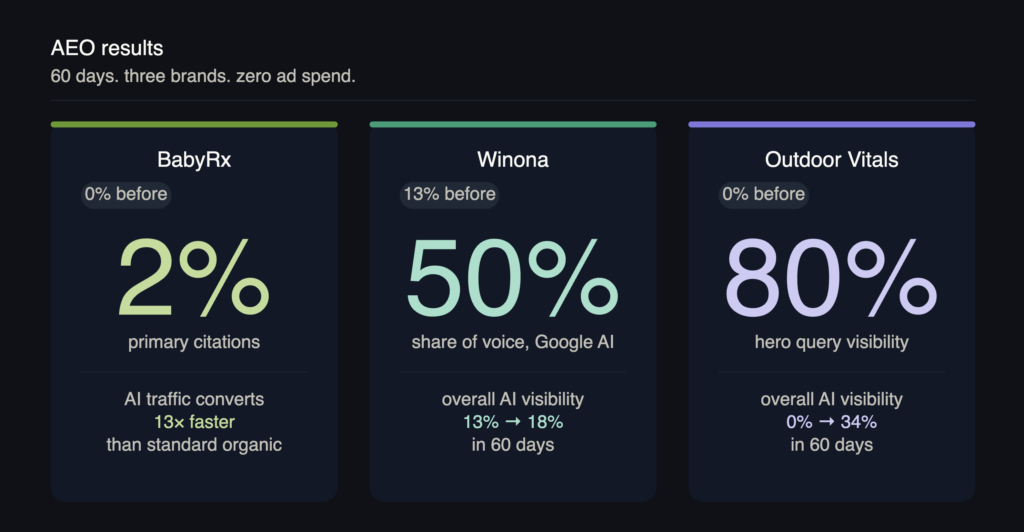
The first cohort launched 60 days before this episode was recorded. The first 30 of those days were mostly strategy, research, and groundwork. The results that have followed in the second 30 days are early but meaningful across three case studies.
BabyRx
BabyRx came in with zero AI visibility across all of their relevant queries. They were not showing up anywhere in any answer engine. The team started with schema implementation, then moved into a content atomization strategy that converted their existing content into a full suite of cross-platform assets. Within 60 days, BabyRx went from zero citations to appearing in 2% of primary citations for their most important queries. That includes queries around sperm count, which is directly tied to their core product.
Two percent sounds modest until you consider the nature of AI traffic. Research from Profound suggests that AI-referred traffic converts at 13 times the rate of standard organic traffic. These are not browsers. These are buyers who have already been nurtured through an AI conversation and are arriving with high commercial intent.
Winona
Winona operates in hormone replacement therapy, one of the more competitive and heavily regulated health categories online, with significant misinformation in the space. They moved from 13% AI visibility across their key queries to 18% in 60 days. More specifically, they achieved a 50% share of voice on Google AI Mode for their most important query set. Half the time a relevant question is asked in Google’s AI system, Winona is being cited.
Outdoor Vitals
Outdoor Vitals was completely invisible in AI search before working with AEO.co. In 60 days, they went from 0% to 34% overall AI visibility. For their hero query around lightweight backpacking gear, they are now surfacing 80% of the time.
The approach here leaned heavily on content atomization. Outdoor Vitals already had strong content, but like most brands, they were posting it in one place and moving on. The team took a single founder video and produced 15 high-quality assets distributed across every relevant channel. The backpack became the focal point because it functions as the gateway product. Someone who buys a backpack becomes an outdoor person, and an outdoor person needs everything that comes after it. Getting cited on that hero query means getting in front of buyers at the most valuable moment in their journey.
How Do You Get Started with AEO for Your Business?
The starting point is more accessible than most people expect. Before anything else, get schema.org validated schema implemented on your site. If you are in the 88% of websites that do not have it, you are invisible to AI crawlers by default. That is a technical fix and it should come first.
From there, the framework looks like this:
- Audit your reputation. Check your reviews, your BBB standing, your social sentiment, and any press coverage that exists. AEO amplifies what is already there. Make sure what is there is worth amplifying before you invest in visibility.
- Identify your expert voice. Who in your organization can create genuinely valuable, topic-specific content? This does not have to be the founder, but it does need to be a real person with real expertise and a willingness to show up consistently.
- Invest in content atomization. One high-quality source piece should live across video, audio, long-form written, short-form social, and structured data formats. Cross-platform, multimodal distribution is one of the key signals AI tools use to validate authority.
- Track the soft signals. Bot traffic trends, verbal attribution, revenue, and brand mentions over a 90-day window. Give your efforts enough runway before drawing conclusions.
- Let go of perfect attribution. It is not coming. The businesses that wait for a clean dashboard before investing in AEO are making the same mistake that brands made when they skipped early SEO. The compounding effect is already building for the businesses that are moving now.
Every single day that passes without an AEO strategy is a day the gap between you and the businesses that started earlier grows a little wider. There are still brands coasting on SEO work done 15 years ago. The window for AEO is open right now, and it will not stay this accessible forever.
Interested in Joining the AEO.co Second Cohort?
Kasim and Molly are opening a second test cohort starting around late July. They are looking for 10 ecommerce businesses, Shopify preferred but not required, who want to be part of the research process while it is still early enough to get the kind of hands-on attention that will not exist at scale later. Right now, the team has nearly twice as many employees as clients, specifically so they can crack the code before productizing.
To apply, go to AEO.co. You will need a product people genuinely love and someone willing to be the expert voice for your brand on camera and in content. If those two things are true, this cohort is worth a serious look.For the case study visuals referenced in this post, you can download the full PDF at smartmarketer.com/podcast.


