


A convincing ecommerce storefront used to require a designer, a developer, product copy, photography, and a fair amount of setup time.
That barrier is dropping fast.
Shopify’s AI Store Builder says it can generate personalized store designs in seconds from a short description of a business. Wix offers a similar prompt-to-site workflow, including online-store capability.
Those tools, and many more, are useful for legitimate founders. They also change the math for anyone who wants to imitate a real brand. A person can generate the shell of a store quickly, pull images and copy from an established business, attach a lookalike domain, and present shoppers with something that feels familiar enough to trust.
Website cloning existed before generative AI. AI simply reduces the time and skill needed to produce a convincing imitation.
That does not mean AI built every copycat store. It also does not mean you should panic. It means brand protection needs to become part of normal ecommerce operations, alongside inventory, fraud prevention, account security, and customer service.
What happened to Antler Rings
In Episode 239 of the Smart Marketer Podcast, Molly Pittman and John Grimshaw spoke with Brooke Wood of Antler Rings about a lookalike store her team discovered.
An employee found it during an ordinary product search. According to Brooke, the site reproduced Antler Rings product photography, product descriptions, About us content, and other website material. The faces connected to the real company had been removed, but much of the commercial presentation remained.
The site also displayed a working-looking checkout path with familiar payment options. Brooke’s team did not complete a purchase, which was the right call. They began documenting and reporting instead.
The team contacted parties connected to the domain and hosting, reported the site to payment and search providers, and sent cease-and-desist and trademark information. During the recorded conversation, participants observed that the site appeared to become inaccessible. The episode does not establish whether that was a permanent takedown.
Brooke said Antler Rings had not heard from affected customers at that point. She also described another business dealing with customers who had purchased through copycat sites and then looked to the real brand for help.
The group raised AI as a possible reason these scams are becoming easier to execute. That was a reasonable concern, but it was not proof that AI created the Antler Rings copycat. The useful lesson is broader: when the cost of building a storefront falls, your response time matters more.
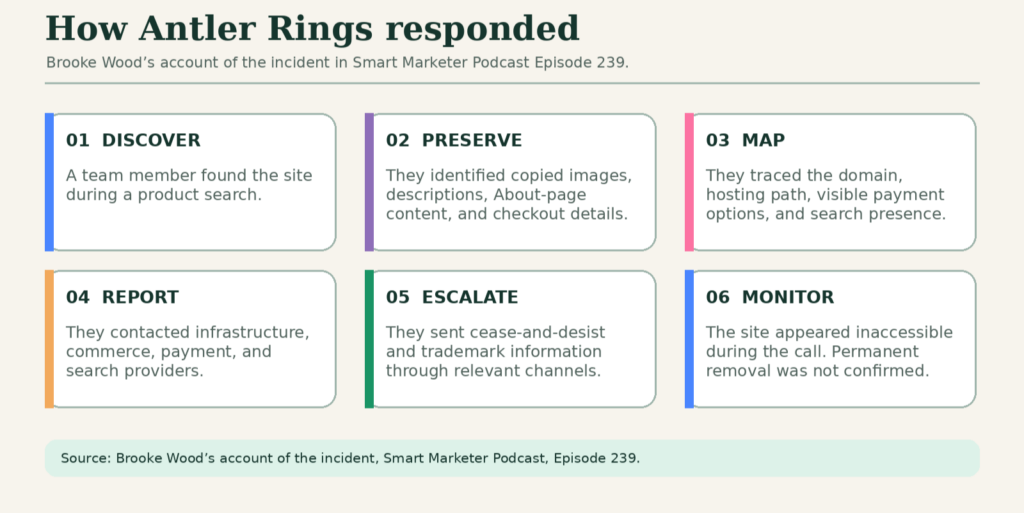
Antler Rings responded across evidence, infrastructure, commerce, and monitoring.
A copycat store creates more than an intellectual property problem
A copied image or paragraph is frustrating. A functioning lookalike storefront can create several business problems at once.
A shopper may send money or personal information to the wrong company. Search results and social posts can send prospects to an imitation. Your support team may receive complaints about orders you never accepted. Your real brand can absorb the reputational damage even when you had no connection to the transaction.
The strongest response plan needs to account for all of those risks. Legal rights matter, but so do domain infrastructure, payment processing, search visibility, customer communication, and internal recordkeeping.
Put the protection in place before you need it
Most teams move slowly during a copycat incident because the evidence and ownership records are scattered. You can fix that now.
1. Build an ownership file
Create one controlled folder containing the records that show what belongs to your business and when it was created.
Include:
- Trademark registrations and application records
- Copyright registrations, when applicable
- Original product-photo files and creation dates
- Design files, packaging files, and brand guidelines
- Final product descriptions and important site copy
- Contracts showing ownership of work created by employees, agencies, photographers, and freelancers
- Your official domains and social profiles
- The canonical URL for every important product page
The U.S. Patent and Trademark Office explains the benefits of federal trademark registration, including a public record of ownership and legal presumptions that may help in a dispute. Trademark registration does not automatically remove an imitation or protect every website element.
Website text, photography, graphics, and code can raise separate copyright questions. The U.S. Copyright Office’s guidance on registering websites and website content explains that different elements may need different treatment. Have qualified counsel help you decide what is worth registering and who owns each asset.
2. Make the real store easy to verify
Use one canonical domain consistently across email, social profiles, packaging, customer support, and marketplace listings. Publish a clear support address on that domain.
A shopper should not have to guess which website is yours.
If your brand has common misspellings or obvious high-risk domain variations, consider registering the most important ones and redirecting them to your official site. You do not need to buy every possible variation. Focus on the names a customer could realistically confuse with your store.
3. Monitor your brand like an acquisition channel
Brooke’s team found the imitation through a product search. That is a useful reminder: search your own brand and products regularly.
Set up Google Alerts for:
- Your brand name
- Your best-selling product names
- Distinctive taglines
- Founder and spokesperson names
- Common misspellings
- Brand name plus words such as “shop,” “store,” “sale,” or “official”
Alerts are not complete coverage. Add a recurring manual check of search engines, marketplaces, social platforms, and image search. Run the check more often when paid media spend or branded search volume increases.
Your support and social teams can help, too. Give them a simple internal form for suspicious domains, fake ads, copied images, and customer reports. The first signal may come from someone who is nowhere near the legal or ecommerce team.
4. Decide who owns the response
A copycat incident can touch legal, ecommerce, paid media, customer support, finance, and communications. Name one incident owner before anything happens.
That person should know who can:
- Preserve evidence
- Contact counsel
- Submit platform and provider reports
- Update customer-facing messages
- Review branded search and ad activity
- Maintain a single incident log
Brooke mentioned using a dedicated legal@ address on the company domain for this work. That does not create legal authority, but it can keep correspondence organized and make the response easier to track.
5. Prepare customer communication in advance
Create a short template that tells customers:
- Your only official store domain
- How to verify an email or promotion
- Where to report a suspicious site
- What your team can and cannot verify about an order placed elsewhere
Do not publish a warning before you confirm there is a real risk. When a copycat is active and creating confusion, a calm notice can help customers find the right place without turning the imitation into a bigger attraction.
What to do when you find a copycat storefront
Move quickly, but keep the response structured.
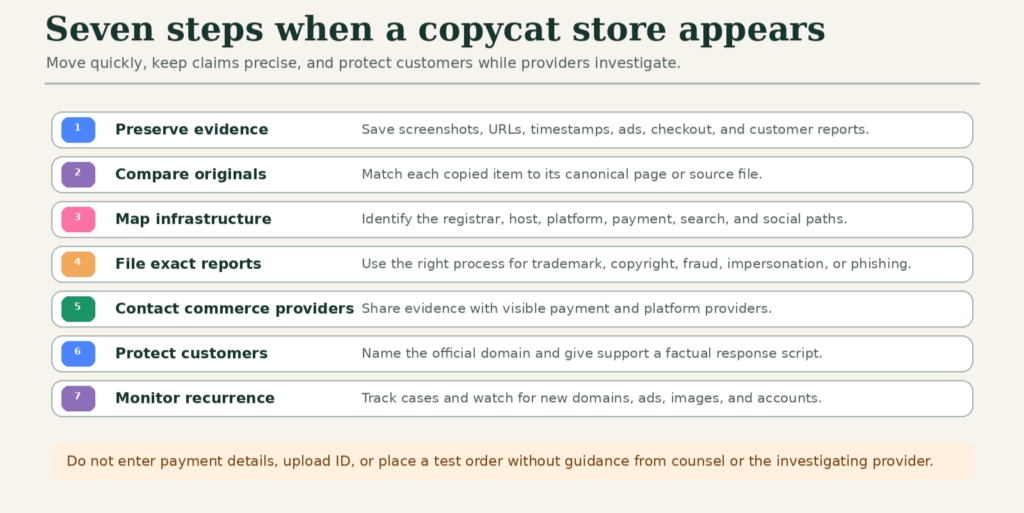
Step 1: Preserve evidence before reporting
A suspicious site may disappear or change as soon as reports begin.
Capture:
- Full-page screenshots and screen recordings
- The domain and every relevant page URL
- The date and time of capture
- Search results, ads, or social posts that led to it
- Copied product images, copy, logos, and policies
- The visible checkout and payment options
- Customer reports and support tickets
Do not enter payment information, upload identification, or complete a test purchase without advice from counsel or the appropriate investigator.
Step 2: Compare the imitation with your originals
Create a simple evidence table with four columns:
- Copied item
- Your original URL or source file
- Suspected copy URL
- Ownership or registration record
Specific reports are easier for providers to evaluate than a general statement that someone copied the whole brand.
Step 3: Map the site’s infrastructure
Use the ICANN Registration Data Lookup Tool to look for domain registration and registrar information. Some contact data may be hidden for privacy, but the lookup can still help identify the registrar and relevant reporting path.
Also identify the apparent:
- Hosting provider or ecommerce platform
- Content delivery network
- Payment providers
- Search listings
- Ad platforms
- Social accounts
- Marketplace profiles
One provider may remove content while another can restrict payments or visibility. A coordinated report usually has more leverage than a single email to an address buried on the fake site.
Step 4: Use the right report for the right issue
Different rights and risks have different reporting paths.
A trademark complaint may cover confusing use of a registered brand name or logo. A copyright notice may apply to copied photography, graphics, or original copy. A host, ecommerce platform, payment provider, search engine, or ad network may also have a fraud, impersonation, phishing, or abuse process.
For U.S. copyright notices, the Copyright Office maintains a directory of designated DMCA agents. Notices have specific requirements, and a defective or inaccurate notice can create problems of its own. Use the provider’s current instructions and involve qualified counsel when the facts or stakes are significant.
If the page appears designed to steal credentials, payment details, or other sensitive information, Google maintains a Safe Browsing reporting form. Use the category that fits the evidence. An imitation is not automatically phishing simply because it looks similar.
Step 5: Contact payment and commerce providers
If the site displays payment methods, report the suspected infringement or fraud through each provider’s official abuse channel. Include your evidence table, official domain, registration information, and any customer reports.
The logos displayed at checkout do not prove that every payment method is active. Report what you observed without claiming more than you know.
Step 6: Protect customers while reports are pending
Takedowns can take time. Prepare your customer-facing response while providers investigate.
Depending on the risk, that may include:
- A notice naming your official domain
- A support macro for suspicious-order questions
- A pinned social post or story
- An email to customers if confusion is widespread
- Branded search coverage that helps shoppers find the real store
- Direct outreach to customers who report an affected transaction
Avoid linking publicly to the suspected copy unless counsel or an investigator recommends it. A warning should reduce confusion without supplying free traffic.
Step 7: Keep watching after the site disappears
A removed domain does not mean the operator has stopped. Save the incident record and monitor for reused images, copied text, new domains, marketplace listings, and social accounts.
Track every report, response, case number, and outcome. That history makes the next escalation faster.
What will not solve the problem by itself
A few common tactics create friction without providing durable protection.
Disabling right-click can slow down a casual copier, but it does not stop screenshots or determined downloads. Watermarks can help identify ownership, but they may be cropped or removed. Buying several domain variations may reduce confusion, but it cannot cover every possible spelling. A trademark registration strengthens certain claims, but it does not monitor or enforce itself.
Use these tools as layers. The operating system around them matters more: ownership records, monitoring, clear responsibilities, fast evidence capture, provider reports, counsel, and customer communication.
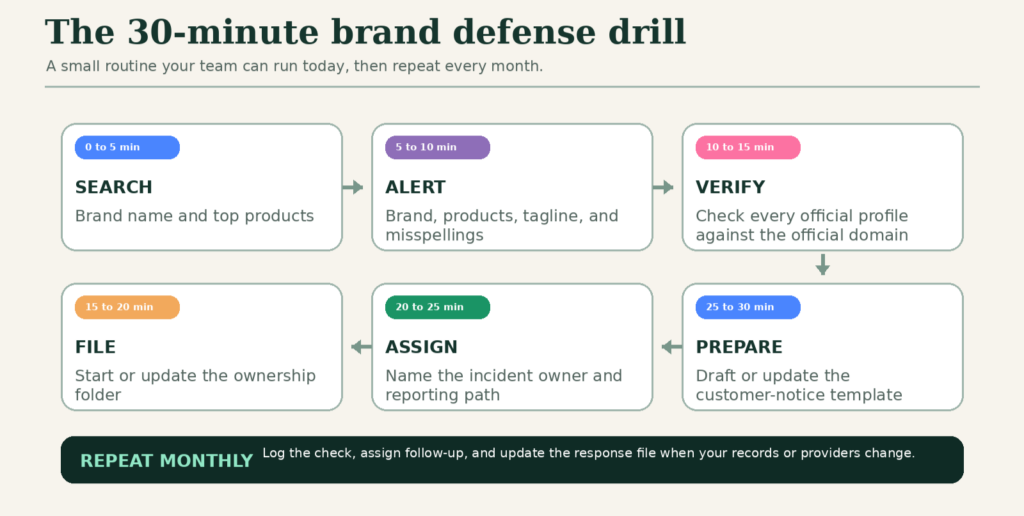
Run a 30-minute brand defense drill
You can make meaningful progress today without turning this into a giant legal project.
- Search your brand name and top three products in a private browser window.
- Set alerts for the brand, products, tagline, and common misspellings.
- Confirm that every public profile points to the same official domain.
- Create an ownership folder and add your current trademark, copyright, photography, copy, and contractor records.
- Name the person who owns a copycat-store response.
- Create a suspicious-site reporting form for support and social teams.
- Draft a customer notice that names your official store and support address.
Then schedule the search again. A simple monthly check is better than a detailed plan nobody runs.
Frequently asked questions
Can I prevent anyone from copying my store?
No control can guarantee that. You can make your official store easier to verify, strengthen the records behind your rights, detect imitations earlier, and respond through more channels.
Does a trademark registration protect my product photos and website copy?
Trademark and copyright address different rights. A trademark can protect source identifiers such as names and logos within its scope. Copyright may cover qualifying original expression such as photography, graphics, or written content. Ownership and registration depend on the facts. Ask qualified counsel about your specific assets.
Should I send a cease-and-desist letter myself?
That depends on the evidence, rights, jurisdiction, and business risk. The Antler Rings team used cease-and-desist and trademark materials as part of its response, but that story is not a universal legal template. Counsel can help you choose the right claims and avoid weakening your position.
Should I warn customers immediately?
Confirm the risk first. If customers are being confused or harmed, communicate through your official channels and keep the message factual. Name the official domain, explain how to contact support, and avoid claims you cannot substantiate.
Speed belongs on both sides of the equation
AI is helping legitimate founders create stores faster. The same speed can reduce the effort required to imitate a brand that already did the expensive work of earning attention and trust.
Your advantage is not that copying becomes impossible. Your advantage is preparation.
Keep the evidence organized. Monitor the places where customers discover you. Give your team a response owner and a clear reporting path. If a lookalike appears, preserve it, map the infrastructure, file precise reports, and help customers find the real brand.
For the complete Antler Rings story and the original conversation with Brooke Wood, listen to Episode 239 of the Smart Marketer Podcast.
This article provides general educational information and is not legal advice. Laws, platform rules, and provider procedures change. Consult qualified counsel about your rights, notices, and enforcement strategy.